


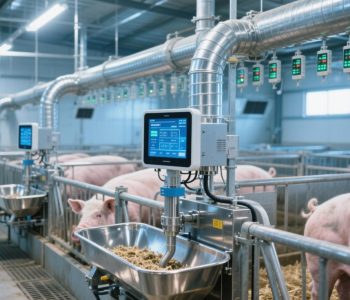
Over the past two decades, swine nutrition has undergone a remarkable transformation.
Advances in amino acid supplementation, alternative feed ingredients,
feed manufacturing, and precision feeding have reshaped how producers
formulate diets to improve efficiency, support animal performance,
and reduce environmental impacts.
The evolution of pig nutrition reflects a broader shift away from
relatively standardized feeding programs toward more precise strategies
that consider nutrient digestibility, production costs, animal
requirements, and sustainability.
In a recent article published by
National Hog Farmer
,
swine nutritionist Casey Neill reflected on the changes that have
influenced pig feeding practices over the past 20 years.
His observations provide a useful starting point for examining
how nutritional research and technological innovation have
transformed modern swine production.
KEY INSIGHT
Modern swine nutrition is increasingly focused on delivering
the right nutrients, in the right quantities, at the right
stage of production, while minimizing unnecessary
nutrient losses.
Amino acid nutrition: Moving beyond crude protein
One of the most influential developments in swine nutrition has been
the widespread adoption of feed-grade amino acids.
Historically, corn and soybean meal formed the foundation of many
commercial swine diets, with protein requirements addressed primarily
through conventional protein-rich ingredients.
The commercial availability of synthetic lysine, followed by
threonine, methionine, tryptophan, and valine, created opportunities
for more targeted nutritional strategies.
Rather than formulating diets primarily around crude protein
concentrations, nutritionists can now focus more closely on
meeting requirements for individual digestible amino acids.
This provides greater flexibility in ingredient selection and
can reduce reliance on conventional protein sources.
Why does this matter?
Pigs require an appropriate balance of essential amino acids,
rather than crude protein alone. Formulating diets according to
digestible amino acid requirements can improve nutrient efficiency
and help limit excess nitrogen intake.
Lower-protein diets and nitrogen efficiency
Reducing dietary crude protein while supplementing limiting amino
acids has attracted considerable attention as a strategy to
improve nitrogen utilization.
A
2025 review published in the
Journal of Animal Science
reported that nitrogen excretion in growing pigs can decrease
by approximately 8% for each percentage-point reduction
in dietary crude protein, provided that amino acid
requirements are adequately met.
These findings have important implications for manure management
and the environmental footprint of pig production.
However, reducing crude protein is not without limitations.
A
2024 review in Animals
emphasized that excessive protein reductions may compromise
productive performance, even when amino acids are supplemented.
NUTRITIONAL CONSIDERATION
Reducing crude protein should not be treated as an objective
in itself. The priority is to maintain adequate amino acid
supply, nutrient balance, and animal performance while
improving nitrogen efficiency.
Alternative feed ingredients: Expanding formulation possibilities
Another major development has been the diversification of
ingredients used in swine feeding programs.
The expansion of corn-based ethanol production increased the
availability of distillers dried grains with solubles
(DDGS), creating new opportunities to partially replace
conventional feed ingredients.
These coproducts can provide valuable nutrients and greater
flexibility in feed formulation, particularly when fluctuations
in grain and soybean meal prices place pressure on production costs.
Ingredient variability remains a challenge
The nutritional value of DDGS can vary depending on grain
composition, processing conditions, oil extraction, and
drying practices.
Consequently, evaluating alternative ingredients solely on
their average chemical composition may not accurately reflect
their contribution to the finished diet.
Modern formulation strategies increasingly consider
digestible amino acids, energy availability, phosphorus
utilization, fiber characteristics, and processing-related
changes in nutrient quality.
FORMULATION TAKEAWAY
The economic value of an alternative feed ingredient should
be assessed according to its usable nutrient contribution,
consistency, and impact on animal performance,
rather than purchase price alone.
Nursery nutrition: Rethinking traditional feeding strategies
Nutrition during the post-weaning period remains one of the
most challenging aspects of pig production.
Weaning exposes piglets to major dietary, physiological, and
environmental changes. During this transition, maintaining
adequate feed intake is essential for supporting growth
and adaptation to solid feed.
Traditional nursery diets frequently incorporate highly
digestible ingredients, including dairy-derived products
such as whey and lactose.
Although these ingredients remain valuable, nutritionists
have increasingly explored alternatives that may provide
comparable nutritional functionality at competitive costs.
In his
National Hog Farmer commentary,
Neill highlighted interest in food-grade ingredients,
including sucrose and processed oats,
as potential components of nursery feeding programs.
He also discussed research suggesting that piglets may
show preferences for certain sucrose-containing diets.
However, ingredient preference alone does not establish
superior growth performance under all production conditions.
Why early feed intake matters
A nursery diet may meet calculated nutritional requirements
but still deliver disappointing results if piglets do not
consume sufficient quantities.
Consequently, palatability, digestibility, physical
feed characteristics, and feeding management
should be considered together.
Practical implication:
Successful nursery feeding programs must encourage
consistent feed intake while maintaining nutritional
adequacy and controlling feed costs.
Feed additives and improved nutrient utilization
Alongside advances in ingredient selection, feed additives
have become important tools for improving nutrient availability.
Enzymes, particularly phytase, have contributed
to more efficient phosphorus utilization in swine diets.
A substantial proportion of phosphorus in plant-based
feed ingredients is associated with phytate, which limits
its availability to pigs.
Supplementation with exogenous phytase can improve phosphorus
digestibility and reduce the need for supplemental
inorganic phosphorus.
According to the
2025 review in the
Journal of Animal Science,
phytase supplementation can increase phosphorus digestibility
by approximately 30–50%, depending on dietary
composition and supplementation conditions.
Other enzymes, including carbohydrases and proteases,
are also being investigated and applied to improve
nutrient utilization.
Feed manufacturing: Technology as a nutritional tool
The evolution of swine nutrition has been closely linked
to developments in feed manufacturing.
Traditional on-farm grinding and mixing systems have
increasingly been complemented by automated commercial
feed mills capable of handling larger ingredient inventories
and producing more complex formulations.
Modern manufacturing systems provide greater control over
ingredient dosing, mixing uniformity, particle size,
and feed processing.
Particle size and pelleting
Physical feed characteristics can significantly influence
nutrient digestibility and feed efficiency.
Research summarized in the
Journal of Animal Science
indicates that reducing particle size and using pelleted
diets can improve feed efficiency under certain conditions.
However, excessively fine grinding may increase processing
costs and create gastrointestinal health concerns.
Similarly, pelleting conditions must balance feed quality,
energy consumption, and the stability of heat-sensitive ingredients.
IMPORTANT CONSIDERATION
More intensive feed processing does not automatically
translate into better performance. Manufacturing
conditions should be optimized to improve nutrient
utilization without compromising animal health
or economic efficiency.
Precision feeding: The next stage of swine nutrition
While advances in ingredients and manufacturing have
transformed feeding programs, precision nutrition
represents another important opportunity for the swine industry.
Conventional phase-feeding programs generally provide
diets formulated to meet the requirements of groups
of pigs over defined production periods.
However, nutrient requirements vary according to
body weight, genetics, sex, growth rate,
health status, and environmental conditions.
Consequently, supplying the same diet to animals with
different requirements may result in nutrient oversupply
for some pigs and insufficient provision for others.
Precision feeding strategies aim to reduce these
discrepancies by adjusting nutrient delivery more
closely to actual requirements.
Depending on the production system, this may involve
additional feeding phases, improved growth monitoring,
automated blending systems, or individualized feeding approaches.
PRECISION FEEDING AND SUSTAINABILITY
Research reviewed in the
Journal of Animal Science
indicates that precision feeding can reduce
nitrogen and phosphorus excretion by at least 11%
under evaluated conditions.
These findings highlight its potential to improve nutrient
efficiency and reduce environmental losses.
Nevertheless, successful adoption requires consideration
of equipment costs, data availability, management complexity,
and the economic benefits achievable under commercial conditions.
Sustainability: Looking beyond feed conversion
The environmental implications of swine nutrition have
become increasingly relevant.
Feed production and nutrient excretion contribute to
the environmental impacts associated with pork production.
Improving nutrient utilization can therefore influence
feed costs, manure composition, nitrogen and phosphorus
losses, and resource efficiency.
Strategies such as reduced-protein diets, balanced amino
acid supplementation, phytase inclusion, and precision
feeding may help address these challenges.
However, sustainability assessments should consider
the entire production system.
An ingredient that reduces one environmental impact
may increase another, depending on its sourcing,
processing requirements, transportation, and contribution
to animal performance.
THE BIGGER PICTURE
Nutritional sustainability should be evaluated through
an integrated approach that considers
productive performance, economic viability,
nutrient efficiency, and environmental outcomes.
What will shape swine nutrition in the coming years?
The next phase of swine nutrition will likely be influenced
by the interaction of several developments:
- Genetic progress: Nutritional programs will need to adapt to changing growth and productivity characteristics.
- Improved ingredient evaluation: Greater access to feed composition data and analytical technologies may enhance formulation accuracy.
- Digital monitoring: Automated feeding and data collection systems could improve responses to variation in animal requirements.
- Environmental efficiency: Nutrient utilization and resource management will remain important considerations.
- Economic resilience: Flexible ingredient selection and precision formulation may help producers respond to changing feed costs.
The challenge will be translating these technological
advances into practical solutions that remain economically
accessible and deliver consistent results under
commercial production conditions.
Looking ahead: From feeding more to feeding smarter
Over the past 20 years, swine nutrition has progressed
from relatively standardized feeding approaches toward
increasingly precise and flexible nutritional strategies.
The introduction of synthetic amino acids, broader use
of alternative ingredients, advances in feed processing,
and improvements in nutrient digestibility have all
contributed to this transformation.
Yet the fundamental objective remains unchanged:
providing pigs with the nutrients necessary to support
health and productive performance as efficiently as possible.
FINAL TAKEAWAY
The future of swine nutrition will depend not only
on discovering new ingredients or technologies,
but also on using existing nutritional
knowledge more precisely and effectively
to support animal performance, production
efficiency, and sustainability.
References and further reading
- Neill, C. (2026).
Two decades of swine nutrition: What have we learned?
National Hog Farmer. - Navales, R. A. S., et al. (2025).
Technologies and practices to improve feed and nutrient utilization by pigs.
Journal of Animal Science, 103, skaf043. - de Almeida, A. M., Latorre, M. A., & Alvarez-Rodriguez, J. (2024).
Productive, Physiological, and Environmental Implications
of Reducing Crude Protein Content in Swine Diets: A Review.
Animals, 14(21), 3081. - Cho, I., & Kong, C. (2025).
Growth performance of pigs fed low-protein diets
supplemented with crystalline amino acids at different growth stages.
Animal Bioscience, 38(2), 316–324.
Amino acid supplementation and substitution of soybean meal
in crude protein- and phosphorus-reduced diets for grower-finisher pigs:
Effects on performance and modelled environmental impact.
Livestock Science, 288 (2024), 105556.