


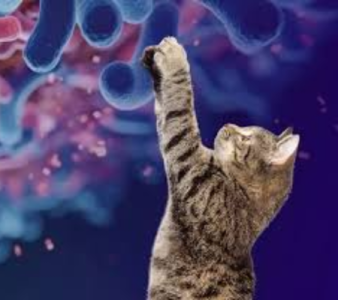
Bacillus probiotics help support intestinal health in cats
Lorenna Nicole Araújo Santos, Isabela Cubateli Bogo, Ricardo Souza Vasconcellos, and Magali Soares dos Santos Pozza
State University of Maringá (UEM)
Interest in probiotics for companion animals has grown substantially in recent years as research continues to demonstrate the importance of the intestinal microbiota in maintaining animal health, immunity, and digestive stability.
Among the microorganisms evaluated as probiotics, Bacillus spp. have attracted particular attention because of their remarkable stability, resistance to industrial processing, and potential effects on intestinal balance and immune modulation in cats.
Why probiotics matter
The intestinal microbiota plays a fundamental role in mucosal integrity, immune balance, and protection against pathogenic microorganisms.
Understanding the feline intestinal microbiota
The feline intestinal microbiota is mainly composed of bacterial groups such as Firmicutes, Bacteroidetes, Actinobacteria, and Proteobacteria. These microorganisms participate in the fermentation of fibers and proteins, generating compounds essential for maintaining intestinal health and immune function.
However, the composition of the microbiota can be influenced by several factors, including:
- Diet composition
- Age
- Environmental conditions
- Stress
- Health status
When this microbial balance is disrupted, dysbiosis may occur. This imbalance is characterized by reduced bacterial diversity and proliferation of potentially harmful microorganisms, often leading to digestive disturbances and inflammatory conditions.
Clinical impact
Dysbiosis in cats may be associated with diarrhea, allergic reactions, intestinal inflammation, and inflammatory bowel disease.
How probiotics work
Probiotics are defined as live microorganisms that, when administered in adequate amounts, confer health benefits on the host.
According to the article, probiotics may act through multiple mechanisms, including:
- Competitive exclusion of pathogens
- Production of antimicrobial substances and short-chain fatty acids (SCFA)
- Improvement of epithelial barrier integrity
- Immune modulation
- Systemic signaling through neurotransmitter pathways
Researchers have also reported increased production of immunoglobulin A (IgA), an important component of mucosal immunity.
Probiotics may support digestive health not only through microbial balance, but also by strengthening intestinal barrier function and modulating immunity.
Why Bacillus spp. are attracting attention
Bacteria belonging to the genus Bacillus spp. are Gram-positive microorganisms capable of forming highly resistant spores. This characteristic gives them important technological advantages in pet food production.
One of the major challenges in companion animal nutrition is maintaining probiotic viability during feed manufacturing, especially during extrusion, where high temperatures and humidity may destroy sensitive microorganisms.
The ability of Bacillus spp. to sporulate allows them to survive harsh processing conditions and remain viable in extruded pet food products.
Technological advantage
Spore-forming Bacillus species show high thermal stability, making them especially suitable for use in extruded pet foods.
Documented benefits in cats
Several studies highlighted in the article demonstrated promising effects of Bacillus supplementation in cats.
Research involving probiotic blends containing Bacillus amyloliquefaciens and Bacillus subtilis showed:
- Reduced incidence of soft stools and diarrhea
- Lower levels of pro-inflammatory cytokines
- Increased anti-inflammatory cytokines (IL-10)
- Improved microbial diversity
The supplemented cats also showed an increase in beneficial microorganisms such as Lactobacillus, as well as bacteria associated with higher production of short-chain fatty acids including acetate, propionate, and butyrate.
Short-chain fatty acids such as butyrate are strongly associated with intestinal integrity, anti-inflammatory effects, and microbial balance.
Potential benefits for chronic diarrhea
The article also discussed the use of Bacillus licheniformis in cats with chronic diarrhea. Researchers observed improvements in fecal consistency and beneficial changes in the intestinal microbiota.
Cats receiving the probiotic showed:
- Higher abundance of Blautia spp.
- Reduction of Clostridium perfringens
- Improved intestinal balance
These findings reinforce the idea that probiotics may support gastrointestinal health not only in healthy cats, but also in animals experiencing chronic digestive disturbances.
Modulating the intestinal microbiota may help reduce inflammation and support recovery in cats with chronic gastrointestinal disorders.
Safety and viability considerations
Although many Bacillus species show probiotic potential, the article emphasizes that not all Bacillus spp. are considered safe. Some species, such as Bacillus cereus, may produce toxins capable of causing serious health issues.
Another important factor is probiotic viability. The effectiveness of probiotic products depends directly on maintaining viable microorganisms until the time of consumption.
Factors such as:
- Temperature
- Humidity
- Storage time
- Feed processing conditions
can significantly reduce microbial viability, making technological protection strategies essential.
Probiotic effectiveness depends not only on strain selection, but also on maintaining viability throughout processing, storage, and feeding.
Final considerations
Species belonging to the genus Bacillus spp. show significant potential as probiotics in feline nutrition, particularly because of their ability to modulate the intestinal microbiota and support digestive health.
Their resistance to extrusion processing and promising effects on microbial diversity, inflammation, and intestinal balance make them attractive candidates for future companion animal nutrition strategies.
Bacillus probiotics may become increasingly important tools for supporting intestinal health, immune function, and digestive stability in cats.