


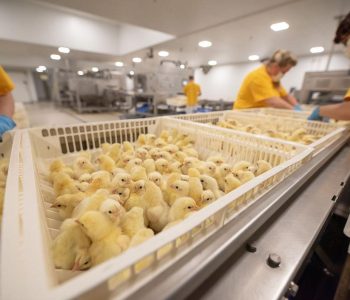
Canada’s broiler hatching egg industry is entering an important period of adjustment as poultry production continues to expand and the sector seeks to strengthen its domestic supply capacity.
Growing demand for chicken, changing import conditions and ongoing animal health challenges are placing renewed attention on the production of fertile eggs used to supply commercial broiler hatcheries.
Recent figures from Canadian Hatching Egg Producers (CHEP), Statistics Canada and Agriculture and Agri-Food Canada highlight the scale of the industry and the importance of maintaining a reliable supply of hatching eggs to support the country’s poultry production chain.
While additional production capacity creates opportunities for breeders, hatcheries and feed suppliers, it also brings challenges related to flock productivity, reproductive efficiency, biosecurity and production planning.
CANADIAN HATCHING EGG INDUSTRY AT A GLANCE
In 2025, Canada’s 235 broiler hatching egg producers produced more than 921.7 million broiler hatching eggs, generating approximately CAD 554.5 million in farm cash receipts, according to Agriculture and Agri-Food Canada.
Growing chicken production supports demand for hatching eggs
The broiler hatching egg sector occupies a critical position at the beginning of the poultry meat supply chain.
Unlike table eggs, which are produced for human consumption, broiler hatching eggs are fertile eggs produced by specialized breeder flocks and supplied to hatcheries for the production of commercial broiler chicks.
Consequently, the industry’s production requirements are closely connected to expected chicken demand, hatchery performance and the number of chicks needed by commercial poultry farms.
According to Statistics Canada, total Canadian chicken production, including stewing hens, increased by 2.1% in 2025, reaching approximately 1.4 billion kilograms.
The increase marked the fifth consecutive year of growth in chicken production.
Alberta, Ontario and Manitoba recorded some of the strongest provincial increases, while Ontario and Quebec continued to account for the majority of national chicken output.
This growth reinforces the importance of coordinating breeder flock production, egg availability, hatchery operations and broiler placements.
Hatchery egg production continued its upward trend in 2025
Statistics Canada reported that total hatchery egg production reached 82.9 million dozen in 2025, representing a 3.3% increase compared with the previous year.
This was the fifth consecutive annual increase in the national hatchery egg category.
However, this broader statistical category should not be confused with broiler hatching egg production alone, as it includes eggs intended for different poultry production systems.
KEY POULTRY INDICATORS – CANADA, 2025
| Indicator | Reported result |
|---|---|
| Broiler hatching eggs produced | More than 921.7 million |
| Broiler hatching egg producers | 235 |
| Broiler hatching egg farm cash receipts | CAD 554.5 million |
| Total hatchery egg production | 82.9 million dozen |
| Growth in total hatchery egg production | +3.3% year over year |
Sources: Agriculture and Agri-Food Canada and Statistics Canada. Broiler hatching eggs and total hatchery eggs are distinct statistical categories.
New production allocations establish a framework for 2027
Canada’s broiler hatching egg industry operates under a supply management system designed to coordinate domestic production with anticipated market requirements and regulated imports.
Production allocations are established through a federal-provincial framework, taking into account domestic demand and import arrangements.
In June 2026, amendments to the Canadian Hatching Egg Producers Quota Regulations established the initial provincial production limits for 2027.
For the six provinces listed in the federal regulation, the initial 2027 limits total approximately 906.1 million broiler hatching eggs for interprovincial and intraprovincial trade.
INITIAL 2027 BROILER HATCHING EGG LIMITS
| Province | Eggs allocated |
|---|---|
| Ontario | 316,747,951 |
| Quebec | 255,441,549 |
| British Columbia | 144,806,659 |
| Alberta | 112,597,072 |
| Manitoba | 41,081,528 |
| Saskatchewan | 35,387,536 |
Source: Canada Gazette, SOR/2026-104. These are initial regulatory limits, not actual production results or a complete national forecast.
The allocations provide a framework for planning breeder flock requirements and production capacity.
However, regulatory allocations should not be interpreted as a guarantee that the corresponding number of eggs will be produced or marketed.
Actual production depends on flock performance, health conditions, hatchery requirements and subsequent allocation adjustments.
Domestic supply remains a strategic priority
One of the industry’s continuing challenges is balancing domestic production with the availability of imported hatching eggs.
Canada’s supply management framework considers domestic production requirements alongside predictable import volumes, including imports governed by tariff-rate quotas and supplementary import policies.
According to CHEP’s 2025 annual report, the sector experienced difficulties related to shortages of hatching egg imports from the United States, alongside trade uncertainty and highly pathogenic avian influenza.
These challenges reinforced the importance of reliable domestic production capacity.
SUPPLY SECURITY MATTERS
Expanding domestic hatching egg production may help strengthen supply resilience, but it must be coordinated with hatchery demand, breeder flock capacity, imports and biosecurity requirements to avoid supply imbalances.
Avian influenza continues to influence production planning
Highly pathogenic avian influenza (HPAI) remains an important concern for the Canadian poultry industry.
Outbreaks can affect breeding flocks, disrupt production schedules and restrict the movement of birds or hatching eggs.
Even when breeder operations are not directly affected, disruptions elsewhere in the poultry supply chain can influence hatchery planning and the availability of replacement stock.
CHEP identified HPAI as one of the major factors contributing to uncertainty in the 2025 broiler hatching egg market, with potential repercussions extending into 2026.
For producers and hatcheries, maintaining robust biosecurity, surveillance and contingency planning remains essential.
What does expansion mean for poultry nutrition?
From an animal nutrition perspective, growth in the hatching egg sector places additional emphasis on the management of broiler breeder flocks.
Breeder nutrition differs from commercial broiler nutrition because the objective is not simply to maximize body weight gain.
Instead, feeding programs must support controlled growth, reproductive development, egg production, egg quality and hatchability.
Achieving these objectives requires careful coordination of energy supply, amino acids, minerals and vitamins throughout the breeder production cycle.
Maintaining appropriate body weight and uniformity
Body weight management is a fundamental component of broiler breeder production.
Excessive body weight or poor flock uniformity can complicate reproductive management, while inadequate nutrient supply may compromise body condition and productive performance.
Feeding strategies must therefore consider the birds’ age, genetic potential, body weight targets and stage of production.
Supporting egg quality and embryonic development
Mineral and vitamin nutrition is particularly important in breeding flocks because egg quality influences both handling performance and embryo development.
Calcium and phosphorus contribute to skeletal and eggshell mineralization, while trace minerals and vitamins support multiple metabolic and reproductive functions.
The objective is to provide adequate and balanced nutrient supply rather than simply increasing dietary concentrations.
Feed quality and ingredient consistency
Reliable breeder performance also depends on consistent feed manufacturing and raw-material quality.
Variability in ingredient composition, nutrient availability or feed contamination can make it more difficult to maintain uniform dietary supply.
Feed mills supplying breeder operations therefore play an important role in supporting predictable flock performance through formulation accuracy, ingredient evaluation and quality assurance.
Increasing hatching egg production is not simply a question of maintaining more breeder birds. It also requires consistent reproductive performance, reliable nutrition, effective health management and close coordination between farms and hatcheries.
Hatchery efficiency is another important consideration
Producing more fertile eggs does not automatically translate into an equivalent increase in viable chicks.
The efficiency of the production chain also depends on fertility, egg handling, storage conditions, incubation management and hatchability.
For this reason, improvements in hatchery efficiency may complement increases in breeder flock production.
Careful monitoring of egg quality, embryo development and chick quality can help identify opportunities to improve the conversion of hatching eggs into viable commercial chicks.
These considerations become increasingly relevant when supply conditions are tight or when imports are less predictable.
Economic implications for the poultry supply chain
Increased hatching egg production can create opportunities across several interconnected sectors.
Breeder farms may require additional housing capacity, equipment and production inputs, while hatcheries must align incubation capacity with anticipated chick demand.
Feed manufacturers and ingredient suppliers may also experience changes in demand as breeder flock inventories and production schedules evolve.
However, the scale of these effects will depend on actual flock placements and production rather than allocation figures alone.
Investments must also account for feed costs, labour, energy, biosecurity and the potential economic consequences of animal health disruptions.
Looking ahead: Balancing growth with production resilience
Canada’s broiler hatching egg industry is preparing for continued changes as the broader poultry sector evolves.
Growth in chicken production, new regulatory allocations and efforts to strengthen domestic supply provide opportunities for producers and hatcheries.
At the same time, import uncertainty, animal health challenges and the need for consistent breeder performance underline the importance of careful planning.
For nutritionists, veterinarians, feed manufacturers and poultry producers, the coming period will require an integrated approach combining reproductive management, nutrition, feed quality and biosecurity.
The long-term success of Canada’s hatching egg sector will depend not only on expanding production capacity, but also on improving efficiency, protecting breeder flock health and maintaining a dependable supply of high-quality chicks.
As the industry prepares for 2027, maintaining this balance will be central to supporting the competitiveness and resilience of Canada’s poultry production system.
Sources
Original news reference: Canadian Poultry Magazine. Hatching egg production set to rise 5.8 per cent. The full article was not independently accessible during preparation.
Industry data: Canadian Hatching Egg Producers. (2026). 2025 Annual Report.
Government statistics: Agriculture and Agri-Food Canada. Canada’s hatching eggs industry.
National production statistics: Statistics Canada. (May 27, 2026). Poultry and egg statistics, 2025.
Regulatory reference: Government of Canada. (June 17, 2026). Regulations Amending the Canadian Hatching Egg Producers Quota Regulations (SOR/2026-104).
This article is an independently written industry overview drawing on official Canadian poultry statistics, production allocations and sector reporting. The nutrition and hatchery management sections provide general technical context rather than findings from the original news report.