


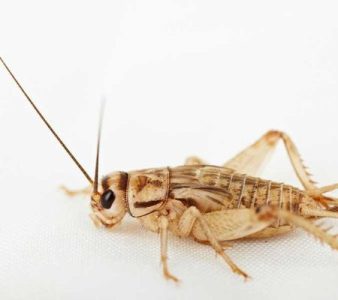
Could crickets become more than an alternative protein source for aquaculture?
As the aquaculture industry seeks sustainable alternatives to conventional
fishmeal, insect-derived ingredients are attracting increasing attention.
Among them, cricket meal offers not only a valuable
protein source but also several potentially functional components,
including lipids, chitin, chitosan, and bioactive peptides.
A recent scientific review published in
Aquaculture Journal
examines how the integrated utilization of cricket-derived components
could improve their nutritional and functional value in aquafeeds.
The review, titled
“Perspectives for Integral Utilization of Crickets in Aquaculture,”
highlights opportunities to move beyond conventional insect meal
production toward more sophisticated processing strategies
that recover and optimize multiple components from cricket biomass.
KEY INSIGHT
Cricket meal could evolve from a conventional protein ingredient
into a multifunctional aquafeed resource,
providing protein, recoverable lipids, chitin-derived compounds,
and potentially bioactive peptides.
Cricket Meal as an Alternative to Fishmeal
Fishmeal remains an important ingredient in aquaculture diets
because of its nutritional characteristics, particularly its
protein quality and amino acid composition.
However, increasing aquaculture production has intensified interest
in alternative ingredients capable of supporting growth
while reducing dependence on marine-derived feed resources.
According to the review, crickets can contain approximately
50–70% protein on a dry matter basis,
depending on the species and processing conditions.
Their relatively rapid reproductive cycles and potential
use of agricultural by-products as rearing substrates
also make them attractive candidates for circular
feed production systems.
Nevertheless, the nutritional value of cricket meal
cannot be evaluated solely on crude protein concentration.
Its amino acid profile, lipid composition, chitin content,
digestibility, and processing characteristics must
also be considered.
NUTRITIONAL POTENTIAL
Cricket meal may provide 50–70% crude protein
on a dry matter basis, but its effectiveness
in aquafeeds depends on species-specific requirements,
nutrient digestibility, and overall diet formulation.
Can Cricket Meal Replace Fishmeal Without Affecting Performance?
Research examining cricket meal inclusion in aquaculture
diets has produced promising but variable results.
The review summarizes feeding trials involving Nile tilapia,
blue tilapia, whiteleg shrimp, totoaba, and ornamental fish.
Across these studies, the effects of replacing fishmeal
depended on the aquatic species, developmental stage,
cricket species, and dietary inclusion level.
Promising results in shrimp
In one feeding trial involving juvenile whiteleg shrimp
(Litopenaeus vannamei), replacing
50% of fishmeal protein with two-spotted cricket
(Gryllus bimaculatus) meal
produced improvements in weight gain, feed conversion,
and survival compared with the control diet.
However, these findings should not be interpreted
as evidence that the same inclusion level will be
optimal for other species or production systems.
Different responses in tilapia
Studies involving tilapia have demonstrated that
partial fishmeal replacement can maintain productive
performance under certain conditions, whereas
higher replacement levels may reduce growth
or worsen feed conversion.
In one study involving blue tilapia
(Oreochromis aureus), replacing 20% of fishmeal
maintained growth, while higher replacement levels
were associated with reduced performance.
IMPORTANT CONSIDERATION
Successful fishmeal replacement is not determined
by cricket meal inclusion alone.
Species, life stage, dietary nutrient balance,
ingredient processing, and digestibility
all influence productive responses.
The Fatty Acid Challenge: Balancing Omega-3 and Omega-6
Although cricket meal provides valuable nutrients,
its lipid composition represents an important limitation
for some aquaculture applications.
Fishmeal and fish oil supply long-chain omega-3
polyunsaturated fatty acids, particularly
eicosapentaenoic acid (EPA)
and docosahexaenoic acid (DHA),
which play important roles in fish development,
health, and product quality.
Cricket-derived lipids generally contain relatively
high proportions of omega-6 fatty acids,
particularly linoleic acid, while their EPA
and DHA concentrations are typically low.
Consequently, replacing fishmeal with cricket meal
without adequately balancing the lipid fraction
may alter the fatty acid profile of the finished feed.
Can cricket fatty acid profiles be improved?
The review identifies several potential strategies
to improve the nutritional characteristics
of cricket-derived lipids.
- Defatting: Separating the lipid fraction
from cricket meal to obtain a more concentrated
protein ingredient. - Dietary enrichment: Modifying cricket-rearing
substrates with omega-3-rich ingredients to influence
fatty acid accumulation. - Microbial biotransformation: Exploring
microorganisms and enzymes capable of modifying
fatty acid composition. - Enzymatic interesterification: Investigating
ways to modify the positional distribution
of fatty acids in triglycerides.
Some enrichment strategies have already demonstrated
that cricket fatty acid composition can be modified
through dietary manipulation.
However, more advanced biotechnological approaches,
including microbial fatty acid conversion and
enzymatic interesterification, remain largely
prospective for cricket-derived aquafeed ingredients.
Chitin: From Antinutritional Factor to Functional Ingredient
One of the most interesting aspects of cricket meal
is its chitin content.
Chitin is a structural polysaccharide found in
the exoskeletons of insects and crustaceans.
In aquaculture nutrition, it presents both
opportunities and challenges.
At relatively high dietary concentrations,
chitin may reduce nutrient digestibility
and bioavailability, particularly in aquatic
species with limited capacity to degrade it.
However, at appropriate inclusion levels,
chitin has also been investigated for its
potential prebiotic and immunomodulatory
properties.
Its interaction with intestinal microbiota
and host immune responses suggests that chitin
should not necessarily be regarded solely
as an undesirable component.
A DUAL ROLE FOR CHITIN
At excessive levels: Chitin may impair
nutrient utilization and digestibility.
At appropriate levels: It may support
beneficial intestinal microbial activity
and selected immune responses.
The review emphasizes that the optimal dietary
inclusion level must be established for each
aquatic species and production stage.
Chitosan: A Potential Tool for Aquatic Animal Health
Chitin can be converted into chitosan
through a process known as deacetylation.
Chitosan has attracted scientific interest
because of its antimicrobial, antioxidant,
and immunomodulatory properties.
Research involving fish and crustaceans
has explored its potential to support
immune responses, intestinal health,
and resistance to certain bacterial infections.
In addition to its nutritional applications,
chitosan may also have potential uses
in aquaculture water treatment.
When applied directly to water under suitable
conditions, it can act as a
coagulant and flocculant,
helping aggregate suspended particles
and potentially improve water clarity.
What about cricket-derived chitosan?
Cricket exoskeletons could provide an additional
source of chitin for chitosan production.
The review reports chitin extraction yields
of approximately 4–8%
and chitosan yields of 2–6%
from house crickets.
Nevertheless, most studies evaluating
cricket-derived chitosan have focused
on its physicochemical characteristics
or laboratory-based antimicrobial activity.
Direct evidence demonstrating its effectiveness
in aquatic animals remains limited,
and further feeding trials are necessary.
RESEARCH OPPORTUNITY
Recovering chitin and chitosan from cricket biomass
could create additional value beyond protein production,
but their practical applications in aquaculture
still require species-specific validation.
Fermentation and Enzymatic Hydrolysis: Improving Cricket Meal Quality
Feed-processing technologies could play an important
role in expanding the use of cricket-derived
ingredients in aquaculture.
Two approaches discussed in the review are
fermentation and enzymatic hydrolysis.
These processes can modify the protein fraction
of cricket meal, potentially improving nutrient
availability, solubility, and functional properties.
Protein hydrolysis may also release smaller peptides
and free amino acids, some of which exhibit
antioxidant or other biological activities
in laboratory studies.
Do these improvements translate into better performance?
The available evidence remains mixed.
The review describes experiments evaluating
acid cricket silage in whiteleg shrimp diets.
Although processing improved apparent digestibility
in one experiment, increasing fishmeal replacement
with cricket silage reduced performance
in another experiment.
These findings demonstrate that improved ingredient
digestibility does not necessarily guarantee
better growth or feed conversion.
PRACTICAL IMPLICATION
Fermentation and enzymatic hydrolysis may improve
the nutritional properties of cricket meal,
but processing methods, inclusion levels,
nutrient balance, and economic feasibility
must be evaluated before commercial application.
Toward Integrated Cricket Biorefineries for Aquaculture
One of the central ideas presented in the review
is the possibility of utilizing cricket biomass
more comprehensively.
Rather than producing only a conventional insect meal,
integrated processing systems could separate
and recover multiple fractions with different
nutritional or functional applications.
- Protein fractions: For aquafeed
formulation and potential production of hydrolysates. - Lipid fractions: For further
characterization, processing, or nutritional applications. - Chitin: As a potential functional
ingredient or raw material for further processing. - Chitosan: For potential applications
in aquatic animal health and water treatment. - Bioactive peptides: As prospective
functional compounds requiring further evaluation.
Such approaches could help generate additional value
from a single raw material while supporting
more efficient biomass utilization.
However, the review cautions that environmental
and economic benefits should not be assumed.
Processing costs, energy consumption, water use,
chemical inputs, extraction yields, and waste
generation must all be considered.
What Are the Main Challenges for Commercial Adoption?
Despite the growing interest in cricket-derived
ingredients, several challenges remain
before their wider adoption in commercial aquaculture.
- Species-specific responses:
Different fish and crustaceans may respond
differently to cricket meal inclusion. - Fatty acid composition:
Low EPA and DHA concentrations may require
complementary lipid sources or enrichment strategies. - Chitin concentration:
Excessive inclusion may compromise digestibility. - Processing requirements:
Additional treatments can increase production complexity. - Limited feeding-trial evidence:
Many proposed functional applications
have not been sufficiently tested in aquatic organisms. - Economic and environmental feasibility:
Integrated processing must demonstrate practical
benefits under commercial conditions.
Looking Ahead: Beyond Protein Replacement
Cricket meal represents a promising alternative
ingredient for aquaculture, but its potential
extends beyond its protein content.
Advances in lipid modification, chitin and chitosan
recovery, fermentation, and enzymatic hydrolysis
could create opportunities to develop
multifunctional feed ingredients
with both nutritional and functional applications.
Nevertheless, translating these opportunities
into commercial feeding strategies will require
additional research to establish optimal
processing methods, inclusion levels,
biological effects, and production costs.
FINAL TAKEAWAY
The future of cricket-based aquafeeds may lie
not simply in replacing fishmeal, but in
maximizing the nutritional and functional
value of the entire cricket biomass,
while demonstrating measurable benefits
for aquaculture performance, sustainability,
and economic efficiency.
Scientific Source
Alvarez-Alvarez, O. R., Garcia-Clark, J. G.,
Fraijo-Valenzuela, A., Rodriguez-Anaya, L. Z.,
Díaz-Tenorio, L. M., Gortáres-Moroyoqui, P.,
& Gonzalez-Galaviz, J. R. (2026).
Perspectives for Integral Utilization of Crickets in Aquaculture.
Aquaculture Journal, 6(4), 53.