


FOOD & FEED SAFETY | EUROPEAN UNION
EFSA Looks to the Future of Food and Feed Safety with New Strategy for 2034
As the European Food Safety Authority prepares to celebrate 25 years of scientific risk assessment, its upcoming international conference will bring together experts and policymakers to examine how innovation, sustainability and emerging threats are reshaping food and feed safety.
The European Food Safety Authority (EFSA) is preparing to mark its 25th anniversary with a major international conference focused on the future of food safety, scientific risk assessment and regulatory innovation.
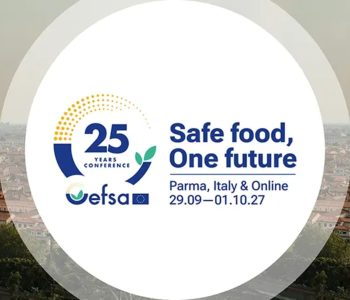
Scheduled for September 29 to October 1, 2027, the Safe Food, One Future Conference will take place in Parma, Italy, with online participation available. The three-day gathering will bring together scientists, regulatory authorities, policymakers and food system stakeholders to explore the challenges facing Europe’s food and feed supply chains.
Beyond celebrating EFSA’s contributions since its establishment in 2002, the event will serve as the official platform for introducing EFSA Strategy 2034, which will guide the agency’s strategic priorities and scientific activities throughout the 2028–2034 period.
A defining moment for European food safety: The conference will explore how scientific innovation, emerging technologies and stronger collaboration can improve the ability of regulatory systems to anticipate and respond to risks across the food chain.
A new chapter for science-based food safety
Since its creation in 2002, EFSA has played a central role in providing independent scientific advice to European Union institutions and Member States. Its work supports decisions affecting food safety, animal health, feed additives, contaminants, biological hazards and other areas relevant to the entire agri-food sector.
However, the scientific and regulatory landscape has changed substantially over the past two decades.
Climate change, antimicrobial resistance, zoonotic diseases, changing production systems and emerging food technologies are introducing new challenges that require more adaptable risk assessment methods and closer cooperation between scientific disciplines.
The 2027 conference will provide an opportunity to assess the progress made over the past quarter-century while considering how food safety systems must evolve to address increasingly interconnected risks.
Six priorities shaping the future of food safety
EFSA has identified several strategic themes that will guide discussions during the conference. These priorities reflect the growing need to combine scientific rigor with innovation, regulatory preparedness and public trust.
1. Supporting sustainable innovation
As new ingredients, production technologies and biological solutions enter the market, regulatory science must be able to evaluate their safety without unnecessarily delaying innovation. This includes the development of assessment approaches capable of responding to advances in food and feed production.
2. Modernizing scientific assessment methods
Advances in analytical technologies, computational modeling and emerging scientific methodologies offer opportunities to strengthen how potential hazards are identified and evaluated.
3. Integrating One Health and sustainability
The interconnected health of humans, animals and the environment is becoming increasingly important in risk assessment. EFSA aims to strengthen the integration of these relationships into scientific evaluations and regulatory decision-making.
4. Preparing for emerging risks
Improved surveillance, scientific cooperation and rapid-response capabilities will be essential to identifying and managing emerging hazards before they develop into wider food safety challenges.
5. Strengthening risk communication
Scientific evidence must be communicated clearly and effectively. Incorporating insights from social sciences can help regulatory institutions better understand public perceptions, address uncertainty and build trust.
6. Harnessing data and artificial intelligence
Digitalization, data integration and artificial intelligence could improve the efficiency and consistency of scientific assessments. Their adoption, however, must be supported by transparency, reliability and appropriate scientific oversight.
What does this mean for the animal feed industry?
Although EFSA’s mandate extends across the food chain, its future priorities have important implications for feed manufacturers, animal nutrition companies, ingredient suppliers and livestock producers.
The development of new feed ingredients, functional additives and innovative production technologies increasingly depends on scientific evidence demonstrating product safety and compliance with regulatory requirements.
As EFSA evaluates how to modernize risk assessment, the feed sector may benefit from clearer scientific approaches to emerging technologies, while also facing greater expectations regarding data quality, traceability, product characterization and risk management.
Why it matters for animal nutrition: Developments in regulatory science could influence how innovative feed additives, alternative ingredients and other nutritional technologies are evaluated in the coming years. For companies investing in research and development, understanding EFSA’s evolving scientific priorities will be increasingly valuable.
Another important consideration is the growing emphasis on One Health, particularly in areas such as antimicrobial resistance, biological hazards and the relationship between animal production practices and public health.
These priorities reinforce the need for integrated approaches that consider not only animal performance and productivity, but also the broader consequences of nutritional and management decisions for food safety and environmental sustainability.
Artificial intelligence and emerging technologies in regulatory science
One of the most forward-looking elements of EFSA’s agenda is the potential application of artificial intelligence and advanced digital technologies in food safety assessment.
These technologies could support the analysis of large scientific datasets, improve the identification of emerging hazards and help researchers evaluate complex relationships between biological, environmental and production-related factors.
For the animal feed industry, digital approaches may also support more sophisticated evaluations of feed contaminants, ingredient safety and exposure risks.
Nevertheless, the use of AI in regulatory science introduces questions surrounding data reliability, model transparency and scientific validation. EFSA’s discussions will therefore emphasize the need to adopt these technologies responsibly while maintaining confidence in scientific decision-making.
A collaborative approach to future challenges
The development of EFSA Strategy 2034 is also intended to strengthen cooperation between European institutions, national authorities, scientists and stakeholders throughout the food system.
At its October 2026 Stakeholder Forum, EFSA gathered input on its long-term direction, including how to make scientific advice more actionable, respond to technological developments and maintain transparency and independence.
The agency expects to open its draft strategy for public consultation in early 2027, ahead of its formal presentation at the anniversary conference.
Discussions and stakeholder contributions from the 2027 event are expected to inform how the strategy is implemented during the following years.
Looking ahead to a more resilient food system
EFSA’s 25th anniversary comes at a time when the European food system is facing growing pressure to balance food safety, innovation, environmental sustainability and economic competitiveness.
The Safe Food, One Future Conference represents an opportunity to establish a shared scientific direction for addressing these challenges.
For stakeholders across the food and feed industries, the event will offer valuable insight into the scientific and regulatory priorities likely to shape product development, risk assessment and food chain safety in the coming decade.
Ultimately, the future of food safety will depend not only on responding to known hazards, but also on developing the scientific tools, partnerships and regulatory capabilities needed to anticipate emerging risks.
Safe Food, One Future Conference 2027
Dates: September 29 – October 1, 2027
Location: Parma, Italy, and online
Organizer: European Food Safety Authority (EFSA)
Programme launch: December 2026
Registration opens: January 2027
Official event information:
EFSA Safe Food, One Future Conference
Sources and further reading
European Food Safety Authority (EFSA).
Safe Food, One Future Conference.
European Food Safety Authority (EFSA).
EFSA Stakeholder Forum 2026: Shaping EFSA’s Strategy 2034 Together.