



On 17 June 2026, after nearly a decade of argument, the European Parliament finally voted on a question it had circled for years: when does editing a plant’s own genes stop being the same thing as inserting a foreign one?
Jessica Polfjärd, the Swedish MEP who steered the file through Parliament, put the case plainly that day.
European farmers, she said, had been asking for years for access to modern breeding tools, tools that could give them crops that are more resilient and less dependent on pesticides.
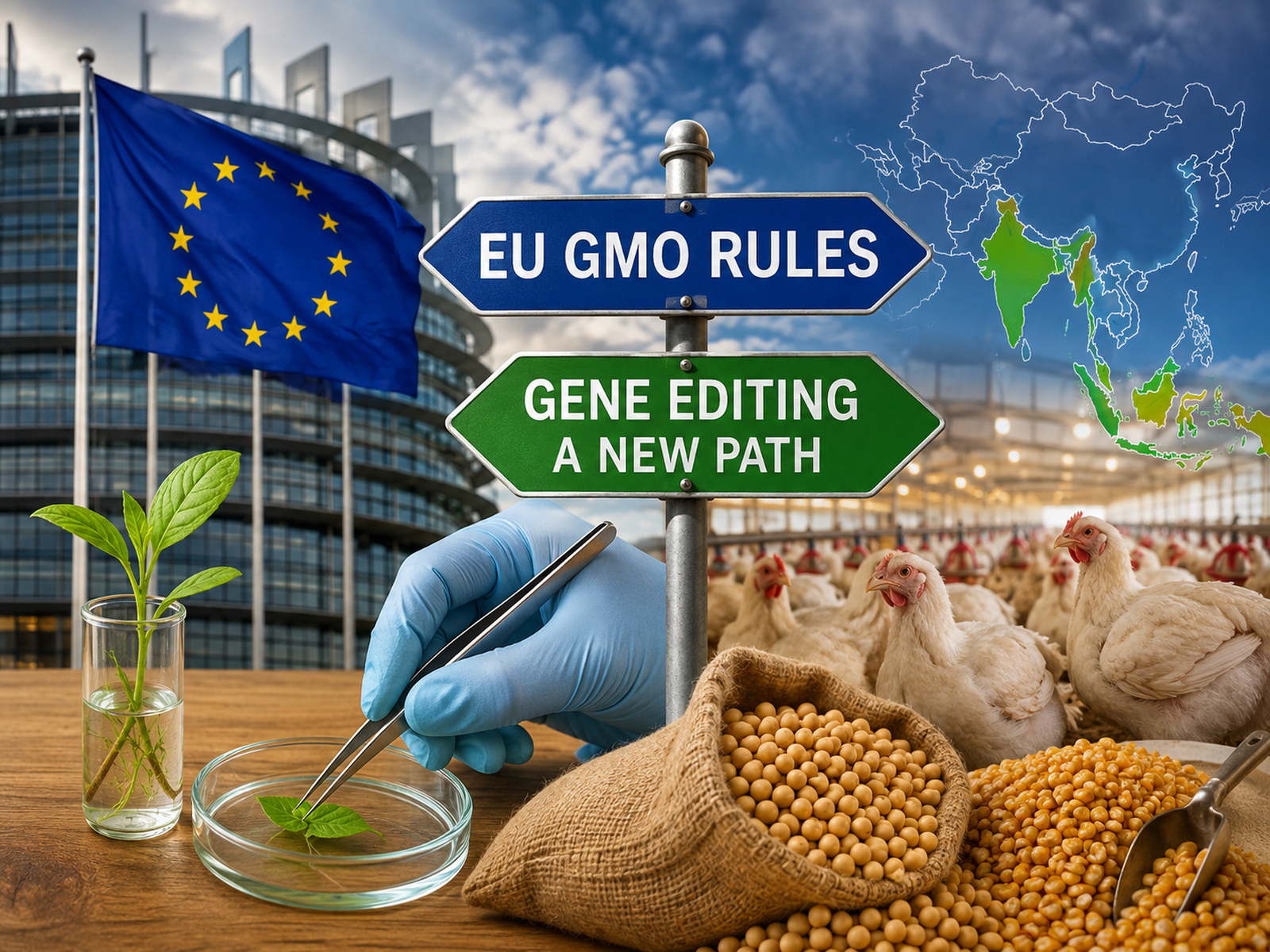
The vote passed, and with it, Europe drew a new line between what counts as a genetically modified organism (GMO) and what does not.
That line matters well beyond Europe’s borders. For 20 years, the European Union (EU) had built its entire relationship with GMOs around one word: caution.
Brussels approved GM (genetically modified) soybeans and corn for animal feed, but grudgingly, and its own Parliament kept voting against new approvals almost as a matter of habit.
Those votes never actually stopped an import. They were symbolic, a way for lawmakers to register discomfort while the machinery of trade rolled on regardless.
The new law does not undo that caution. What it does is split gene-edited crops away from traditional GMO rules altogether, and for poultry and livestock producers in India, Southeast Asia and beyond, many of whom are watching their own feed bills spiral, the European debate offers a preview of arguments that are likely coming their way too.
Three words that keep getting mixed up
Before going further, it helps to untangle three terms that are often used as if they mean the same thing.
A conventional, non-GMO crop is bred the old-fashioned way. Farmers and breeders cross plants with desirable traits over many generations, hoping the right combination shows up. It works, but it is slow and unpredictable.
A GMO works differently. Scientists insert DNA from another organism, sometimes a bacterium, sometimes an unrelated plant, directly into the crop’s genome. This is how most of the world’s herbicide-tolerant soybeans and insect-resistant corn were built.
The result works well in the field, but the ‘foreign gene’ origin is exactly what has made GMOs a lightning rod for public suspicion since the 1990s.
Gene editing, often done with a tool called CRISPR (Clustered Regularly Interspaced Short Palindromic Repeats, a set of molecular ‘scissors’ borrowed from bacteria), is neither of those things. Instead of adding outside DNA, scientists use precision enzymes to snip, delete or nudge a gene the plant already has. Nothing foreign goes in.
Researchers frequently describe it as a faster, more accurate version of the selective breeding humans have practiced for centuries. That distinction, between adding a new gene and editing an existing one, is the entire basis of Europe’s new law.

Why Brussels resisted for so long
The European Parliament’s objections to specific GM soybean approvals were rarely about a single scientific finding.
They tended to point to gaps: not enough long-term data on environmental effects, on animal health, on residues from herbicides such as glyphosate used alongside these crops. It was a precautionary stance rather than a definitive verdict, and it consistently ran into the same wall.
The European Commission held the actual legal authority to approve imports, and it kept approving them, regardless of how Parliament voted.
Why the mood is changing now
The regulation Polfjärd championed, officially called the New Genomic Techniques (NGT) law, does not reverse the EU’s caution toward classic GMOs.
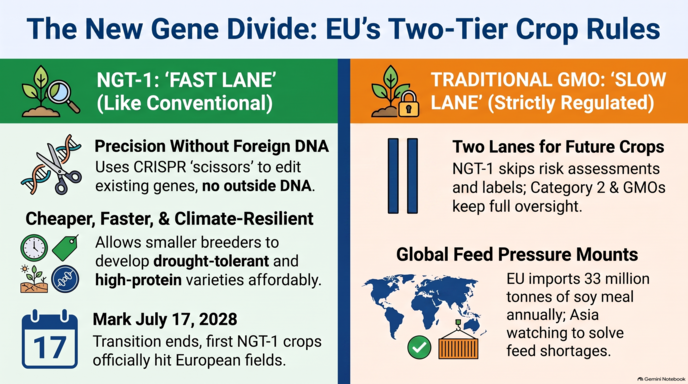
What it does is carve out a separate lane for gene-edited crops that make only small, targeted changes, changes that could plausibly have occurred through natural mutation or ordinary breeding.
These are called Category 1, or NGT-1, plants. They will be treated exactly like conventional crops: no lengthy GMO risk assessment, no mandatory label on the supermarket shelf.
More complex edits, and anything that inserts foreign DNA or builds in herbicide tolerance, stay in Category 2 and remain under the full weight of existing GMO law, including labelling and country-by-country opt-outs.
The logic behind the split is partly economic. Traditional GMO approval is so expensive and slow that only a handful of large companies have ever been able to afford it, which is why the technology concentrated on a small number of profitable commodity crops.
Gene editing is cheaper and faster, which opens the door to smaller breeders and a wider range of traits: drought tolerance, better nutrition, fewer allergens.
Which crops move first
Soybeans bred for a healthier fat profile or higher protein content are expected to qualify for the fast lane, along with drought-tolerant corn varieties bred to survive Europe’s increasingly punishing summer heatwaves.
Wheat edited to strip out most of its gluten is another early candidate. Herbicide-tolerant soybean, the trait behind most of the world’s commercial GM soy, is explicitly excluded from the light-touch category and stays under full GMO oversight.
A two-year transition period is now underway while the European Commission works out the technical detail, so none of this changes what lands in an EU feed mill tomorrow. It changes what gets planted a few seasons from now, and what gets approved with far less friction after that.

The global map has not moved nearly as much
It is worth remembering how lopsided the world’s GMO adoption already is. In the US, Brazil and Argentina, GM varieties account for 85-95% of total soybean and corn area.
Genetically modified soy alone covers close to three quarters of the world’s soybean acreage. Against that backdrop, Canada remains a notable non-GMO holdout, commanding premium prices for its beans in Japan and South Korea.
Europe sits awkwardly in the middle of this picture. It cannot grow anywhere near enough protein crop domestically to feed its own livestock, so it imports roughly 33 million tons of soybean meal a year, and more than 9 in every 10 tons of that is GM in origin.
Even a doubling of non-GM output from Brazil and Argentina combined would cover only a small fraction of EU demand.
A retail-facing non-GMO segment exists, mostly for poultry and pork sold under clean-label branding, but it survives on a thin premium, not a real alternative supply chain.
India tells a related but distinct story. For two decades, India built a reputation as a reliable non-GM soybean meal exporter.
That status came under real pressure in 2026, when a weaker domestic soybean harvest sent meal prices sharply higher and pushed poultry associations to lobby the government for emergency GM soymeal import quotas.
Ricky Thaper, Joint Secretary of the Poultry Federation of India, put a number on the ask: 1.5 million tons, enough to see the industry through until the next domestic crop arrives, and the same request the industry had made once before, back in 2021.
The parallel with Europe is not exact, but the underlying tension is identical: when domestic non-GM supply runs short, the industry that depends on it for daily protein starts asking why cheaper, GM-derived feed grain should stay off the table.
What this means at the feed trough
For European poultry and livestock producers, the immediate practical effect is limited. Most of the soy and corn going into EU feed rations will still arrive from the Americas as conventional GMO material, exactly as it does today.
What the new law changes is the pipeline of crops bred inside Europe itself, potentially giving feed millers access to home-grown, better-performing grain without the cost and delay of full GMO clearance.
It is also worth pushing back gently on the assumption that non-GMO feed is automatically the better choice for bird performance.
A Dankook University trial with 840 broilers found that chickens on a non-GMO corn-soy diet actually had slightly worse feed conversion than those on a GMO diet, with no measurable difference in meat quality, and that result lines up with a broader pattern researchers have reported across several independent broiler trials comparing GMO and non-GMO corn-soy rations.
The nutritional case for paying a non-GMO premium is thinner than the marketing around it often suggests.
For Asia’s poultry sector, the real lesson from Brussels may not be about soybeans or corn at all. It is about how a major regulator can reclassify a technology once it decides the risk profile has genuinely changed, and how quickly that can reopen conversations that looked politically settled.
India’s poultry industry is already having its own version of that conversation, driven not by European legislation but by its own feed shortage.
The EU’s new rules take full effect from 17 July 2028, once the transition period ends and the first NGT-1 crops start reaching European fields.
That date is worth marking on the calendar. It will be the first real test of whether ‘gene-edited’ and ‘genetically modified’ can actually be treated as different things, and Asian feed buyers and regulators will be watching the answer closely.