


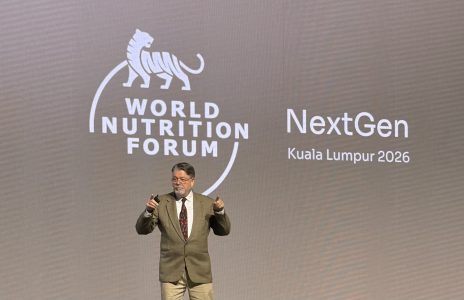
By Priscila Beck, Director General Brazil at agriNews Group, reporting from Kuala Lumpur, Malaysia
At the World Nutrition Forum 2026, the University of Arkansas Professor highlighted how nutrition, genetics, animal health and technical support can narrow the gap between on-farm performance and the potential already demonstrated by science.
Wider adoption of existing feeding, animal health and husbandry practices could reduce global greenhouse gas emissions from livestock supply chains by up to 30%. Marty Matlock presented this potential during the World Nutrition Forum 2026, organized by dsm-firmenich in Kuala Lumpur, Malaysia. It underpins one of the central messages of his presentation: existing knowledge offers scope to produce more food, provided it reaches farmers and translates into results.
A professor in the Department of Biological and Agricultural Engineering at the University of Arkansas in the US, Prof Matlock framed the challenge of feeding approximately 10 billion people around four gaps: crop yields, animal performance, human nutrition and health, and access to knowledge.
For the animal nutrition industry, his analysis raises the question of how effectively genetics, feeding and disease control translate into productivity. “We don’t need more animals. We need more productive animals,” he said.
What the 30% potential means
Discussing emissions, Prof Matlock referred to the work of the Food and Agriculture Organization of the United Nations (FAO) and its Global Livestock Environmental Assessment Model (GLEAM). The estimate of up to 30% is documented in the organization’s 2013 report, tackling climate change through livestock.
The study estimated the reduction under a scenario in which producers within the same system, region and climate adopted technologies and practices used by the 10% of producers with the lowest emissions intensity, meaning fewer greenhouse gas emissions per unit of product.
This is therefore a global potential associated with the wider adoption of good practices. The percentage does not represent a uniform reduction for every farm, species or country. The comparison considers differences in efficiency under similar production conditions, and opportunities depend on each system’s starting point.
Interventions include improvements in feeding, animal health and husbandry, as well as manure management and energy use. In his presentation, Matlock highlighted six interconnected factors that constrain performance: access to genetics, feed quality and availability, endemic diseases, heat stress, extension and advisory services, and access to markets and incentives.
Milk and eggs reveal the scale of the gaps
To illustrate the distance between performance already achieved and conditions in other systems, Prof Matlock compared milk yields. His slide showed a global benchmark average for 2018 of approximately 2,500 liters/cow/year, compared with around 10,200 liters in the US.
In low-productivity countries, including Mongolia and Nigeria as cited in the presentation, yields were 500 liters or less. The difference between the extremes exceeds twentyfold.
In his analysis, raising productivity in subsistence systems can increase food supplies and create opportunities to sell produce, with implications for farmers’ incomes and local economies.
In poultry, he contrasted commercial layers in higher-input systems, producing more than 300 eggs/hen/year, with unimproved hens in smallholder flocks, producing approximately 40 to 60 eggs annually. Prof Matlock also highlighted Newcastle disease as a major constraint on small-scale poultry production.
These figures illustrated differences between production systems. They are not targets that can be transferred directly from one farm to another: realizing genetic potential requires appropriate feeding, health and husbandry conditions. The constraints identified by the speaker reinforce the need to assess interventions together.
Knowledge must change on-farm decisions
Technology transfer was central to the presentation. Prof Matlock described four problems within the knowledge gap itself: missing or unreliable data, insufficient and uneven research investment, difficulties in getting innovations to users, and a shortage of trained professionals.
For those making investment decisions in animal nutrition and production, this perspective adds a question to technology assessments: what conditions allow demonstrated results to be reproduced on the farm? The answer involves diagnosis, technical guidance and performance monitoring, alongside the availability of the solution itself.
One slide illustrated disparities in agricultural research funding. According to the figures presented, referencing the ASTI assessment and GRAPE database, high-income countries allocated USD 3.07 to public research for every USD 100 of agricultural GDP. In low-income countries, the figure was USD 0.44, a roughly sevenfold difference.
Discussing extension services, Prof Matlock said that making information available is insufficient unless it changes farmers’ decisions. The ability to measure performance and identify constraints is part of directing investment effectively.
Food production must translate into access to nutritious diets
Prof Matlock also linked production efficiency to access to food. In his view, the challenge encompasses the nutritional quality of diets and people’s ability to afford them, alongside calorie availability.
During the question-and-answer session after his presentation, he argued that companies should connect profitability with the development of the communities in which they operate. He acknowledged profit as essential to remaining in business, while arguing that human prosperity must also form part of the business vision.
Closing his presentation, Prof Matlock summed up his view of the obstacles to food production: “They are gaps of investment, delivery, and knowledge.”