


Field challenges in broiler breeder performance – The biology and physiology behind eleven recurring field conditions
Breeder flocks today show a familiar set of problems: production that does not hit peak, livers that look pale or swollen at post-mortem, egg laying that quietly declines mid-cycle, birds heavier than their diet should allow, and shells that weaken with age. Farms usually treat each as its own problem.
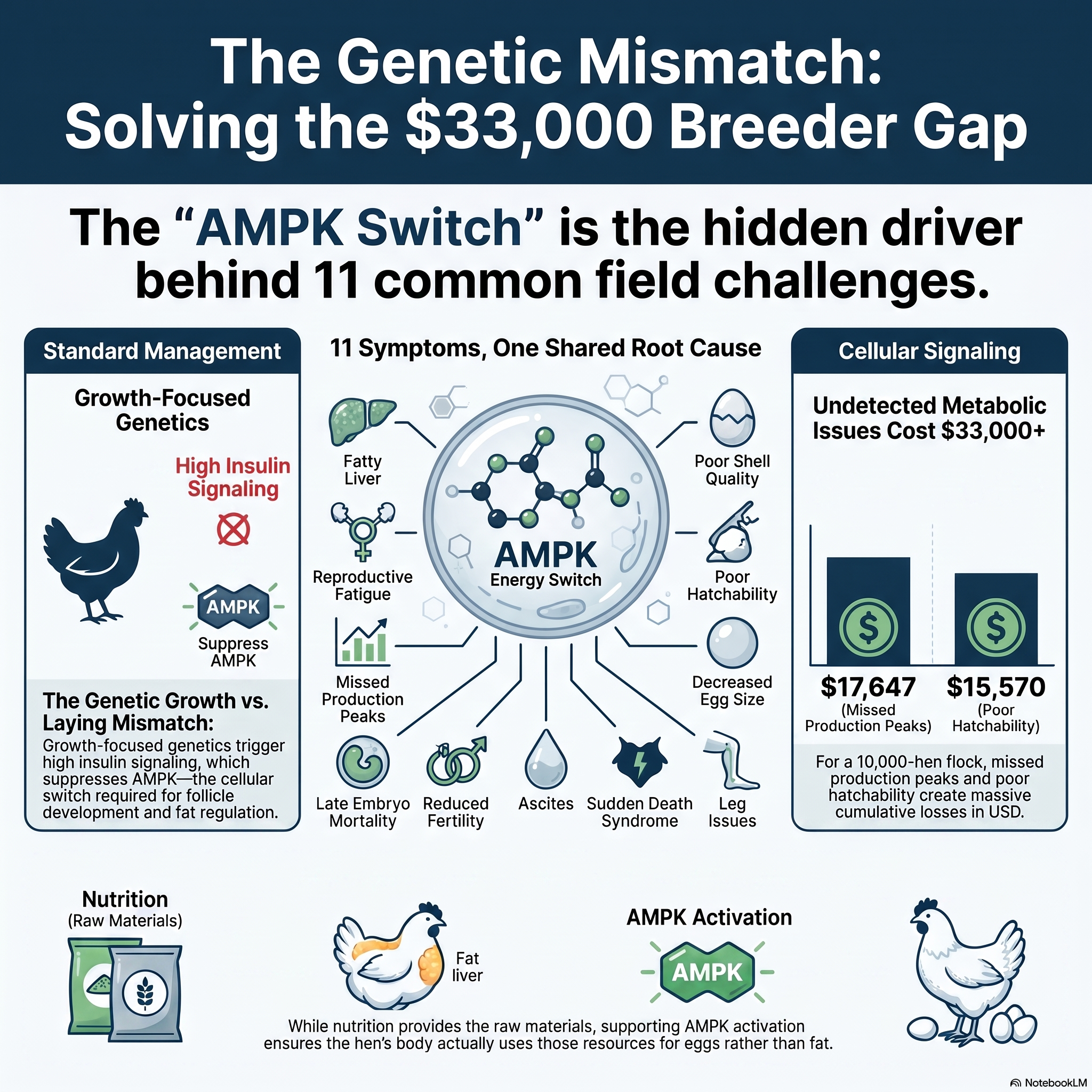
This article argues all 11 share one root cause: today’s broiler breeder is bred, through her offspring’s genetics, to grow fast and convert feed efficiently. Her job is the opposite laying steadily for over a year, not growing quickly. That mismatch sits behind every condition mentioned below.
This is not about abandoning what works. Restricted feeding, body weight targets, choline and methionine, calcium and vitamin D programs all still matter. What this article adds is a piece these tools do not reach: the hen’s internal energy signaling.
The economic cost
These conditions carry real cost even when each looks minor alone. For a 10,000-hen flock valuing each hatching egg at roughly INR 25 (USD 0.26): peaking five points below target through peak-lay can mean 60,000–70,000 fewer eggs, roughly INR 15-17 lakh (USD 15,570-17,647) lost. A 5% hatchability drop from fatty liver or embryo loss can mean a further 60,000+ eggs never becoming saleable chicks, INR 15 lakh (USD 15,570).
Elevated mortality from abdominal fat, hepatic lipidosis, or peritonitis removes birds before they complete their cycle, losing full rearing cost without full return. Figures are not precise per farm, but even conservative estimates show why the shared cause matters for economics, not just bird health.
Why this is not just a chicken problem
Genetic selection for growth and feed efficiency is a major success story for broilers which now reach market weight in about half the time on far less feed.
The breeder parent simply inherits traits that make her chicks grow fast, and those traits work against sustained reproduction; a modern issue, not common in flocks 30 or 40 years ago, before selection intensity reached today’s level.

The 11 conditions
(1) Peak production below 85%
Flocks plateau below the 85-87% hen-day target around weeks 27-32. Farms manage feed restriction, light timing, diet energy/protein, and uniformity tools controlling how much and when a hen eats.
If a flock does everything right and still underperforms, the cause is likely internal. Modern breeders carry higher insulin signaling than layer-type birds, dampening AMPK (AMP-activated protein kinase), a cellular energy switch that helps trigger the hormones driving follicle development.
Low AMPK slows follicle development, capping peak. Supporting AMPK directly addresses how well the body responds, not just how much she eats.
(2) Low eggs with pale or enlarged liver
Fatty liver syndrome an enlarged, pale, fragile liver. Hens move large amounts of fat through the liver to build yolks, and modern breeders are efficient fat-makers, so more raw material arrives than in older lines.
Farms control energy intake, add choline and methionine, and avoid oxidized fats, which helps clear fat but does not slow its production. AMPK normally breaks the liver’s fat-making enzymes; when weak, the liver outpaces clearance even on a well-managed diet.
(3) Reproductive fatigue after week 40
Past week 40, production drops faster than the standard curve, egg timing loses consistency, and double-yolked or soft-shelled eggs increase, even with feed and weight on target. Farms reduce feed gradually, watch shell quality, and raise calcium relative to phosphorus.
This fatigue often reflects cellular wear building over months. A mildly weak AMPK signal accumulates rather than causing sudden trouble, gradually disrupting follicle timing exhaustion that is really slow buildup. Supporting AMPK throughout the cycle, not just the start, matches how the problem develops.
(4) Excess body weight above standard
Flocks exceed the standard weight curve despite correct restriction, with more abdominal fat and lower uniformity. The efficient-conversion genetics behind broiler growth are present in parent stock too, so hens on identical rations diverge in weight.
Farms tighten feed for birds ahead of target, grade by weight, and use skip-a-day schedules. Beyond that, further tightening risks welfare remaining weight reflects how efficiently a bird handles her feed. Insulin signaling favors storage while weak AMPK fails to counter it; supporting AMPK addresses that tendency once feed tools hit their limit.
(5) Abdominal fat and hepatic lipidosis
Post-mortem shows heavy abdominal and liver fat, sometimes in birds with normal outward weight, so visual scoring misses it. Breeding for lean broiler meat has shifted where the parent hen stores fat, toward abdomen and liver rather than under the skin.
Farms control diet energy density and use choline, methionine, and herbal liver supplements, managing supply and clearance, not production speed. As in Condition 2, weak AMPK loosens the brake on fat-making enzymes and likely drives abdominal storage too one cause, two locations, addressed together by supporting AMPK.
(6) Peritonitis and erratic follicle growth
Follicles fail to grow in smooth sequence some shrink while others jump ahead often linked to yolk peritonitis, where a yolk enters the body cavity instead of the oviduct. Orderly growth depends on a hormone response calibrated to older, slower-laying lines; today’s metabolic changes strain that system under age or stress.
Farms rely on biosecurity, vaccination, and steady lighting, reducing outside triggers but not restoring the hormone response itself. AMPK helps follicles respond properly, in sequence; when weak, that response flattens, raising the chance of out-of-sequence maturation, which supporting AMPK targets at its source.
(7) Slow recovery after disease challenge
Some flocks recover far more slowly than others despite identical care, with feed and weight sometimes recovering before production and shell quality, or vice versa. Illness recovery and reproduction draw on the same energy systems, so insulin-signaling birds enter a challenge with less spare capacity.
Farms boost protein and vitamins and tighten biosecurity supplying raw materials but not improving how efficiently cells use them. AMPK helps cells respond to stress and clear damaged components; supporting it during and after a challenge aids recovery on top of standard care.
(8) Low hatchability and early embryo loss
Fewer fertile eggs hatch, with disproportionate embryo deaths in the first week, though eggs look normal externally. A healthy embryo depends on nutrients the hen packs into the yolk and the cell quality she passes on; insulin signaling may lower both.
Farms manage breeder nutrition, egg handling, and incubation conditions all outside the egg, unable to influence what the hen transferred into it. AMPK affects yolk fat quality and the embryo’s inherited cell machinery, so low AMPK means less support in that critical first week. Supporting AMPK at pre-lay and peak improves that contribution.
(9) Declining fertility beyond week 55
Past week 55, fertility drops faster than expected, often with no obvious male-side problem. Staying fertile this late depends on the hen’s sperm-storage system and ovulation timing; cumulative insulin-signaling effects over a year-plus of lay likely affect this independent of the male.
Farms focus mostly on males’ condition, ratios, semen quality so the female’s contribution often goes unchecked, even though both depend on reproductive-tract cells that accumulated weak AMPK signaling can compromise. Supporting AMPK through late lay addresses this female-side factor.
(10) Poor eggshell quality post-peak
After peak, shells thin and weaken faster than expected, with more breakage. Shell formation moves large amounts of calcium into the shell gland overnight; accumulating metabolic strain can affect the cells doing this even with correct dietary calcium and phosphorus.
Farms adjust calcium and phosphorus, manage calcium particle size, and use vitamin D3 managing supply, not the enzyme that builds the shell’s carbonate structure. That enzyme depends on the same AMPK-linked systems; low AMPK means shell gland cells may not support it well overnight. Supporting AMPK past peak sustains that enzyme alongside mineral management.
(11) Temporary non-laying episodes
Roughly 8-10% of hens stop laying for 4-5 weeks, commonly around weeks 31-33 and 40-45 the flock’s highest metabolic-demand points; 55-65% return to production, but the gap is a real loss.
Farms monitor flock-level dips, check body condition to distinguish temporary pauses from genuine non-layers, and avoid culling, since most recover on their own. The low-AMPK tendency may push a subset of hens past a threshold where laying pauses as a protective response, resuming once signaling recovers. Supporting AMPK around these risk windows may reduce how many hens cross that threshold, or shorten the pause.
One shared cause behind 11 problems
Looked at individually, these 11 problems touch very different areas production, liver health, fertility, body condition, disease recovery, shell quality making it easy to treat them as unrelated. But one pattern recurs: an inherited insulin-signaling tendency, most clearly demonstrated early in life, which weakens the AMPK energy switch and can still shape outcomes even once daily insulin levels are well controlled by restriction.
Because AMPK affects liver fat production, follicle hormone response, disease recovery, and shell formation, one weakened switch can surface as different problems in different parts of the bird. This does not mean every case has this cause infection, nutrition, and management issues should always be checked first. But when standard practice is correct and a problem persists, this signal is a reasonable next place to look. A flock showing two or more conditions together may be showing one problem twice.
A final note on applying this approach
Supporting AMPK activation can look like a simple, one-size-fits-all fix. It is not. Each flock arrives at these conditions through a different mix of genetics, age, management history, and health status.
Applying an AMPK-based approach without understanding a flock’s specific situation can disappoint even where the biology is sound. Correct application requires a proper flock assessment not a standard program applied uniformly.