


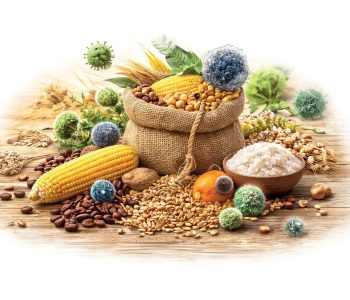
Mycotoxin binders explained: why one size never fits all
Mycotoxins are a diverse group of toxic, low-molecular weight compounds produced as secondary metabolites by various filamentous fungi. These substances are not immunogenic, meaning they do not trigger antibody production and therefore do not lead to immunity or resistance against them, yet they pose serious risks to both animal and human health.
Their formation can occur at multiple stages of crop handling, including growth, harvest, drying, and storage, affecting a wide range of plant-derived products such as grains, fruits, seeds, and agro-industrial by-products that commonly enter food and feed production chains.
Key point
Mycotoxin contamination is not only a feed safety issue. It directly affects animal health, welfare, productivity, and the quality of animal-derived foods.
The occurrence and concentration of mycotoxins are strongly influenced by environmental conditions, particularly temperature and humidity, which govern fungal proliferation. Additional factors such as water activity, pH, oxygen availability, substrate temperature, storage duration, microbial competition, and insect damage can further favor fungal colonization and toxin synthesis.
Feed represents a critical link in the food chain, influencing not only the health, welfare, and productivity of farmed animals, but also the safety and quality of animal-derived products including milk, meat, eggs, and aquaculture species.
Co-contamination is the rule rather than the exception
Complete feeds are typically formulated from a blend of plant-based raw materials, with composition depending on species, production goals, and regional availability. However, since many feed ingredients are of plant origin, and numerous fungal species are capable of producing multiple mycotoxins simultaneously, co-contamination is the rule rather than the exception.
Recent large-scale monitoring reinforces this scenario. The 2025 DSM-Firmenich Global Mycotoxin Survey, which included 25,326 samples and 14,752 analyses across 95 countries, reported that 83% of feed samples contained more than one mycotoxin.
Global survey insight
According to the 2025 DSM-Firmenich Global Mycotoxin Survey, 83% of feed samples contained more than one mycotoxin, highlighting the complexity of real-world contamination.
When examining finishing feeds, which include data from 3,049 samples collected across 71 countries, the extent of co-contamination becomes even clearer. According to the DSM-Firmenich global survey, 96% of poultry feeds, 90% of swine feeds, 81% of ruminant feeds, and 96% of aquaculture feeds contained more than one mycotoxin.
These findings underscore the widespread threat mycotoxins pose to the feed industry and illustrate the complexity of mitigating multi-mycotoxin contamination, where multiple toxins may interact additively or synergistically within the animal organism.
Subclinical exposure and hidden losses
Mycotoxin contamination imposes several challenges across both livestock and aquaculture production systems. Direct economic losses can arise from the rejection of raw materials or finished feeds that fail to comply with regional regulatory thresholds, or in extreme cases, from acute toxicity and mortality following ingestion of highly contaminated feed.
However, such acute scenarios are relatively rare. Far more common are subclinical or chronic exposures to low or moderate concentrations, often within “acceptable” recommended limits, that subtly impair animal performance.
Silent impact
Chronic mycotoxin exposure may reduce feed intake, slow growth, impair reproduction, suppress immunity, and increase susceptibility to infectious diseases.
Under chronic exposure conditions, mycotoxins may act as physiological stressors, leading to reduced feed intake, slower growth rates, impaired reproductive performance, and increased susceptibility to infectious diseases. This is largely due to their immunosuppressive and hepatotoxic effects, particularly when animals are simultaneously exposed to multiple toxins.
These effects often go undetected or misdiagnosed on farms, as the resulting symptoms, such as irregular performance, poor feed conversion, or opportunistic diseases, are multifactorial and non-specific. Even experienced veterinarians may find it difficult to attribute such conditions directly to mycotoxin exposure.
Why one solution cannot fit every situation
The co-occurrence of multiple mycotoxins raises major concerns for feed safety and animal health and must be a central consideration when designing a mycotoxin management programme.
Effective mitigation requires a strategic and balanced approach, combining targeted detoxification tools, such as enzymatic or microbial biotransformation agents, with broad-spectrum binders capable of adsorbing diverse toxin classes, and specific mineral adsorbents optimized for particular mycotoxins.
No single solution fits all scenarios. Binder selection must consider the mycotoxin profile, animal species, feed composition, gastrointestinal conditions, and economic return.
In parallel, the inclusion of hepatoprotective and immune-supporting additives can help alleviate the physiological burden associated with chronic, low-level exposure. Given the diversity of production systems, animal species, and contamination profiles, each case must be carefully evaluated to determine the most cost-effective and biologically efficient intervention.
Mineral-based mycotoxin binders
Mineral-based mycotoxin binders represent the oldest and most extensively studied category of in-feed mitigation strategies. Their efficacy depends primarily on the mineralogical composition and structural characteristics of the constituent clay minerals, which govern the accessibility, affinity, and stability of toxin-adsorbent interactions throughout the gastrointestinal tract.
The clay minerals relevant to mycotoxin sequestration are typically classified into three main structural groups:
- Layer silicates (phyllosilicates): including smectites such as bentonite, montmorillonite, and hectorite.
- Fibrous phyllosilicates: such as sepiolite and palygorskite, which possess elongated channels that can accommodate planar toxin molecules.
- Framework aluminosilicates (tectosilicates): notably zeolites and clinoptilolites, characterized by three-dimensional pore systems.
Mineral binders remain a cornerstone of mycotoxin management, but their performance is highly context-dependent.
Across these groups, differences in layer arrangement, charge distribution, interlayer chemistry, and surface functionality result in pronounced variation in binding specificity and capacity among mycotoxins. Beyond intrinsic mineralogy, several physicochemical parameters, including particle size, surface area, pore distribution, cation-exchange capacity, and pH-dependent charge behavior, critically influence adsorption performance under gastrointestinal conditions.
Clarifying the concept of “binders” in the feed industry
A persistent challenge in the feed additive market is the broad and often non-specific use of the term “binder.” In practice, binders may refer to a wide range of materials serving distinct purposes.
While this article focuses specifically on mycotoxin binders, it is important to distinguish them from technical binders, which are incorporated into feed formulations primarily to enhance pellet integrity, cohesion, and durability during processing and handling.
Important distinction
A technical binder improves pellet quality. A true mycotoxin binder must demonstrate adsorption efficiency across physiological gastrointestinal conditions.
Certain clay or mineral materials can apparently serve a dual function, being used both as technical binders and as adsorbents in mycotoxin control. However, conflating these two functional categories can lead to misinterpretation of product performance.
Binders intended for mycotoxin management should therefore be evaluated through comprehensive studies, characterizing their physicochemical properties and correlating these with their mycotoxin adsorption capacity.
Mineralogical and functional characteristics
Clays and silicates are among the most studied natural adsorbents used in feed-based mycotoxin mitigation. Clays are fine-grained natural materials composed primarily of hydrated aluminosilicates.
Phyllosilicates
Phyllosilicates consist of stacked tetrahedral and octahedral sheets. These minerals exhibit high surface area, cation exchange capacity, and interlayer expandability, making them highly efficient in adsorbing planar mycotoxin molecules such as aflatoxins.
Among phyllosilicates, bentonites, dominated by montmorillonite, are the most widely used in mycotoxin control. Their performance is primarily governed by montmorillonite content and the nature of exchangeable interlayer cations.
Modified aluminosilicates
Natural aluminosilicates are hydrophilic and therefore less efficient against non-polar mycotoxins such as zearalenone or ochratoxin A. Surface modification through organic cation exchange produces organoaluminosilicates with enhanced hydrophobicity, increasing affinity for low-polarity toxins.
Zeolites
Zeolites possess a three-dimensional framework forming channels and cages that can house exchangeable cations and water molecules. These microporous structures confer high internal surface area and molecular sieving properties, allowing selective adsorption of small polar molecules.
Fibrous clays
Sepiolite and palygorskite are fibrous magnesium silicates with an open-channel structure, offering high external surface area and numerous active silanol groups. Sepiolite is frequently used in combination with bentonite to enhance adsorptive and pelleting properties.
Activated carbon
Activated charcoal is a highly porous carbonaceous adsorbent with extensive pore systems and surface area. While highly effective in vitro, its in vivo performance is constrained by low specificity and saturation by dietary matrices.
The selection of a binder should consider not only adsorption capacity, but also specificity, pH stability, nutrient interactions, and the real contamination profile of the feed.
Additional consideration for aquaculture
In aquaculture, mycotoxin binder performance becomes even more complex than in terrestrial livestock due to the high physiological and environmental diversity among farmed aquatic species.
Fish and shrimp differ markedly in digestive anatomy and function. Some species, such as carps and other cyprinids, lack a true acid-secreting stomach and maintain a near-neutral intestinal environment. Shrimp digestive systems operate under mildly neutral to slightly basic pH conditions.
These differences, combined with variations in gastrointestinal transit time, influence the pH, retention time, and adsorption environment for mycotoxin binders. Beyond digestive physiology, the aquatic environment introduces additional challenges, including hydration, ion competition, and salinity.
Aquaculture perspective
Aquaculture-specific mycotoxin management requires tailored evaluation frameworks that account for species-dependent digestive and environmental conditions.
Summary and practical considerations
The physicochemical diversity among mineral adsorbents translates into variable specificity, affinity, and stability of mycotoxin binding. While aluminosilicates such as bentonite and HSCAS remain the gold standard for aflatoxin adsorption, modified and composite binders can extend the range of action to other mycotoxin classes.
Ultimately, the selection and evaluation of mineral binders must consider not only the mycotoxin profile and pH stability, but also potential side effects such as interference with nutrient absorption or veterinary treatments.
Efficient mycotoxin management requires species-specific, feed-specific, and toxin-specific strategies. One size never fits all.