


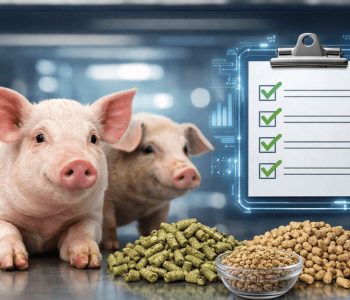
Net energy and growth: keys to better prediction in swine production
In swine nutrition, energy is one of the most critical and costly dietary components. However, not all dietary energy is used equally by the animal. Understanding how pigs utilize energy — and how net energy affects growth performance and feed efficiency — is essential for improving profitability and productivity in modern swine systems.
Net energy represents the fraction of dietary energy truly available for productive purposes such as growth, muscle deposition, and maintenance.
What is energy in animal production?
The energy content of feed ingredients can be estimated using different systems. Gross energy (GE) is measured by combusting a feed sample in a bomb calorimeter and determining the heat produced. Digestible energy (DE) and metabolizable energy (ME) are then estimated by measuring energy losses in feces and urine.
The final and most precise step is estimating net energy (NE), which accounts for heat losses generated during digestion and metabolism. This is particularly important because ingredients differ substantially in the amount of energy lost as heat.
Estimating the net energy of feed ingredients is essential because ingredients differ greatly in their heat increment and productive energy value.
For example, high-fiber ingredients lose a larger proportion of energy as heat during digestion, whereas fats and oils have a much lower heat increment. As a result, feeding fiber generates more heat than feeding fat.
This becomes especially relevant during warm seasons because excessive heat production can reduce feed intake and negatively affect pig growth performance.
Fats and oils historically have been used at higher levels during summer because they generate less metabolic heat compared with fiber-rich ingredients.
Net energy and growth prediction
Achieving optimal growth rates in an economically viable way remains one of the main priorities for swine producers. Prediction equations are valuable tools because they help estimate growth performance based on nutritional and production variables.
Research by Nitikanchana et al. (2015) evaluated 100 experiments from 41 trials to develop prediction equations for growing-finishing pigs.
The authors found that dietary net energy alone was a strong predictor of:
- Average daily gain (ADG)
- Feed conversion ratio (FCR)
However, prediction accuracy improved when additional variables such as:
- Average body weight
- Crude protein
- Standardized ileal digestible lysine (SID Lys)
- Nutrient interactions
were included in the models.
The interaction between dietary net energy and amino acid supply strongly influences pig growth performance.
The study reported that for every 25 kcal/lb change in dietary net energy, average daily gain changed by approximately 0.8%.
Predicting feed efficiency
Net energy was also a strong predictor of feed efficiency. The best prediction models included:
- Dietary net energy
- Body weight
- Dietary fat concentration
- Interactions with digestible lysine
Higher dietary net energy and increased fat inclusion improved feed efficiency, especially when amino acid supply was not limiting.
The model predicted that feed conversion improved by approximately 2% for every 25 kcal/lb increase in dietary net energy.
Heat stress and practical applications
One of the most practical applications of net energy systems relates to heat stress management during summer. High environmental temperatures reduce feed intake, slow growth, and negatively affect metabolism and immune function. :contentReference[oaicite:6]{index=6}
Under heat stress, pigs redirect available energy toward maintaining homeostasis and reducing inflammation rather than depositing muscle tissue.
During heat stress, dietary energy is diverted toward thermoregulation and immune responses instead of productive growth.
One nutritional strategy to mitigate heat stress is increasing dietary energy density using fats and oils. Because fats have a lower heat increment than fiber, pigs expend less energy dissipating heat during digestion.
This strategy can:
- Reduce metabolic heat production
- Improve calorie utilization
- Support growth during hot weather
- Improve feed efficiency
Providing highly digestible, energy-dense diets during summer may help pigs maintain growth performance under heat stress conditions.
Economic considerations
Although high-energy diets can improve performance, economic feasibility must always be evaluated carefully. Factors such as:
- Fat-to-corn price relationship
- Feed cost
- Pig density per pen
- Feeder and drinker availability
- Environmental temperature
should be considered before implementing higher-energy feeding strategies.
Ultimately, the value of increasing dietary net energy depends on whether the expected return on investment remains positive.
Proper management of net energy in swine nutrition can improve growth performance, feed efficiency, and resilience to heat stress while supporting more efficient production systems.
Conclusion
Net energy systems provide a more precise approach to evaluating the productive value of feed ingredients in swine diets. By accounting for metabolic heat losses and nutrient interactions, nutritionists can better predict growth performance and optimize feed formulation strategies.
As environmental and economic pressures continue to shape swine production, nutritional strategies focused on net energy optimization may become increasingly important for improving productivity, sustainability, and profitability.