


What are the biggest challenges facing poultry production today — disease, feed costs, raw-material availability or the search for more sustainable production?
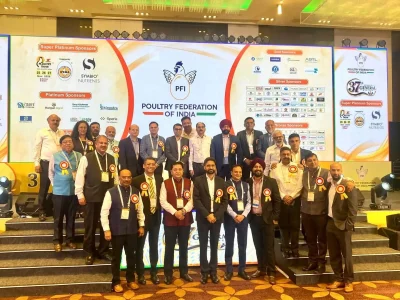
There was no shortage of subjects to discuss when the Poultry Federation of India (PFI) brought the industry together for its 37th Annual General Meeting (AGM), held on 23-24 September 2026 at the Grand Hyatt, Kochi.
The two-day program brought together poultry industry leaders, professionals, researchers, veterinarians, nutritionists, policymakers and representatives from allied businesses.
agriNews Group and its brands aviNews Asia and nutriNews Asia attended the AGM, providing an opportunity to meet industry professionals and gain a closer understanding of the issues being discussed across the poultry sector.
While the first day covered a wide range of technical subjects, the second day moved towards some of the industry’s more immediate concerns — particularly corn availability, feed costs and alternatives to conventional feed ingredients.


PFI office bearers open the proceedings
The formal AGM proceedings began with the welcome address by Ranpal Dhanda, PFI President. Ravinder Singh Sandhu, PFI Secretary, presented the Annual Report, while Rahul Khatri, PFI Treasurer, presented the accounts.
The formal proceedings also included a vote of thanks by Sanjeev Gupta, PFI Vice President (HQ). The second day’s program began with a welcome by the PFI leadership and included addresses from government and industry representatives. Ricky Thaper, PFI Joint Secretary, delivered the vote of thanks at the end of the morning session.
The presence of PFI’s office bearers throughout the program underlined the Federation’s role as a platform for interaction across the poultry industry.


Poultry health starts with the gut
The technical program on Day 1 began with subjects that are familiar to every poultry producer but continue to attract new research and approaches. ‘The gut revisited: A new perspective on health’ looked at the relationship between gut health and overall poultry performance.
Another presentation addressed microbial monitoring at farms and genetic resistance mapping against current bacterial resistance challenges. Better understanding of what is happening inside the flock and on the farm can help the industry move further towards prevention rather than simply responding when problems appear.
The program also covered the role and use of phospholipids in the livestock industry and the management of immunosuppression in broilers.


Nutrition remains a business issue
Nutrition was another strong theme during the first day’s sessions. Presentations on protein quality and the role of nutrition in poultry production brought the discussion back to a basic reality of poultry farming: what goes into the feed ultimately affects what comes out of the farm.
Feed efficiency, bird performance and production cost are closely connected. For producers operating in a competitive market, even relatively small changes in feed efficiency can have an impact on margins.
The program also looked at automation in modern poultry farming, including the use of climate-control technology. Technology is increasingly becoming part of everyday poultry production, particularly as farms look for better control over environmental conditions and more consistent performance.
Indigenous vaccine solutions under discussion
Disease control received particular attention through a panel discussion on indigenous viral strains for poultry vaccines. The discussion focused on strengthening disease-control solutions through India-specific approaches and brought together experts from the poultry health sector.
For an industry operating across widely different climatic and production conditions, disease prevention remains a continuing priority. Vaccination, surveillance, farm-level monitoring and biosecurity all form part of that equation.


Corn: A subject the industry cannot ignore
On Day 2, the discussion moved to one of the most important components of poultry economics — feed raw materials. Dr Sunil Neelam, ICAR–Indian Institute of Maize Research, presented strategies to meet the corn requirements of the poultry sector under changing circumstances.
For the poultry industry, corn is not simply another feed ingredient. It is a major component of poultry feed, making its availability and price important to farmers, feed manufacturers and the wider industry. When corn prices move, the effect can travel quickly through the poultry value chain.
That makes the question of future availability particularly important for an industry that needs a reliable supply of feed ingredients throughout the year.
Can the industry go beyond corn and soya?
The afternoon session took the discussion one step further. A panel titled ‘Beyond corn and soya: Alternative feed ingredients for efficient and cost-effective poultry production’ examined the possibilities of using other ingredients in poultry feed.
It is an issue that deserves attention because finding an alternative ingredient is not simply a matter of finding something that is available and cheaper. Its nutritional value, consistency, safety, availability, storage characteristics and effect on bird performance all matter.
For feed manufacturers and nutritionists, therefore, the challenge is to identify alternatives that work not only in theory but also under commercial poultry-production conditions.
Industry leaders share the floor
The AGM also gave industry leaders an opportunity to put forward their views. The Industry Leaders’ View session included Madan Mohan Maity, Vasanth Kumar, Divya Kumar Gulati, Dr Kolwankar and Bahadur Ali, among others.
Such interaction is particularly relevant in poultry because no single part of the value chain operates independently. Feed, genetics, animal health, farming, processing, technology and market demand are all connected, and a change in one area can have consequences elsewhere.
The Kochi AGM brought professionals from these different segments into the same forum.
Government and industry interaction
The morning session on Day 2 also included participation from government and industry representatives. The program featured presentations and addresses involving officials from the Department of Animal Husbandry & Dairying, Government of India, together with invited industry representatives.
The session included an address by SK Dutta, Joint Commissioner (NLM), Department of Animal Husbandry & Dairying, and an address by Ashok Thakur, Chairman, FMCAS – India & Director, NAFED. Dr Muthukumarasamy B, Joint Secretary (IT/NLM/SD), Department of Animal Husbandry & Dairying, also addressed the gathering.
The morning program concluded with an address by Hon’ble Minister of Education, Government of Haryana, Shri Mahipal Dhanda.


Poultry waste: From problem to resource
Another subject that received attention was poultry waste. Arvindra Singh of Perfect Bio-Waste and Power Management, presented solutions relating to poultry waste, bio-waste and power management.
Waste management is becoming an increasingly important part of the poultry industry’s sustainability discussion. The challenge is not only how to dispose of waste, but also whether parts of it can be put to productive use.
For a sector that continues to grow, this is an area where technology and practical farm-level solutions will have an increasingly important role.
Two days, many questions
The PFI AGM covered a wide territory in two days. There were discussions about gut health, bacterial challenges, vaccines, nutrition, protein, automation, corn, alternative feed ingredients and waste management. Alongside the technical sessions, the AGM provided the opportunity for people from different parts of the industry to meet and exchange views.
For agriNews Group and its brands aviNews Asia and nutriNews Asia, attending the meeting provided a valuable opportunity to connect with poultry industry leaders and professionals and to understand more closely the issues influencing India’s poultry sector.
One message came through clearly from the program: the future of poultry production will depend not on one solution, but on progress across several fronts — health, nutrition, feed security, technology, cost efficiency and sustainability. The conversations in Kochi reflected an industry that is continuing to look for practical answers to these challenges.
For poultry producers, feed manufacturers, animal-health companies and other stakeholders, those answers will matter not just at industry conferences, but on farms and in businesses across the country.