


Key Takeaways
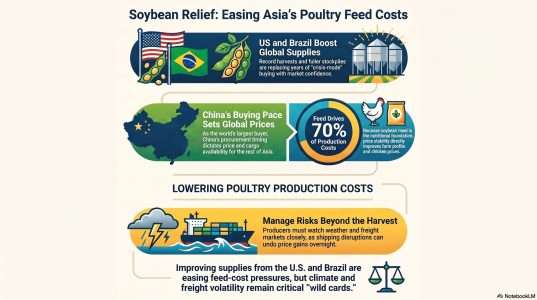
- ✅ Global soybean supplies are stabilising after years of volatility, easing feed-cost pressure across Asia.
- ✅ The U.S. and Brazil together decide most of the world’s soybean meal supply, and both look set for strong output.
- ✅ China’s buying pace still sets the tone for the region’s procurement timing and pricing.
- ✅ Freight and weather remain the two biggest wild cards that can undo a good soybean price overnight.
- ✅ India, where feed is 65–70% of production cost, has the most to gain from sustained stability.
Feed already eats up nearly two-thirds of what it costs to raise a bird in Asia. So when soybean meal prices move, poultry margins move with them, fast, and the effects land in feed costs, farm profits and eventually the price of chicken and eggs on the shelf. The latest USSEC report, the Soybean Market Summary for July 2026, offers a cautiously positive read: production is improving and supply chains are settling down. Even so, the report is clear that climate, geopolitics and shipping still carry real risk. For poultry businesses across Asia, doing well this year will mean pairing good market conditions with careful buying and solid risk planning.
A market returning to balance
The past few years were rough: the pandemic, geopolitical conflicts, shipping delays and bad harvests all hit at once. Now the soybean market is finally settling down. The USSEC report says larger harvests, fuller stockpiles and steady export activity are bringing back confidence. Prices can still swing, but a serious shortage looks less likely than it did a year or two ago. That’s good news for poultry producers, who can now plan diets, purchases and costs with more confidence. A calmer market isn’t a safe one, though. Weather, trade policy and shipping can all shift quickly, so this is a good moment to tighten procurement rather than relax.
Global production signals offer encouragement
The report’s best news is on the production side. U.S. farmers planted more soybean acres this year. Brazil, meanwhile, keeps delivering strong harvests that make it a dominant exporter. Between them, these two countries decide how much soybean meal is available to the rest of the world. Stockpiles look healthy too, which gives importers across Asia room to plan ahead instead of scrambling for last-minute supply. It’s a real shift from crisis-mode buying toward more deliberate purchasing. Plenty can still happen before harvest, though. Heat waves or heavy rain at the wrong time can quietly change the numbers, so it’s worth watching the growing season closely rather than trusting early forecasts.

Soybean meal – The foundation of poultry nutrition
There’s a reason soybean meal dominates poultry rations. It has strong protein content, a good amino acid balance and more consistency than most alternatives. Broilers, layers and breeders all depend on it. Because of that reliance, global soybean news becomes local news fast. Cheaper soybeans mean better margins. A shipping delay or a bad harvest elsewhere can eat into profits even when demand at home stays strong. For fast-growing poultry markets like Vietnam, Indonesia, Thailand, the Philippines, Bangladesh and India, a steady soybean supply is good for business and helps keep affordable protein on the table. As feed formulation gets more precise, predictable supply also helps nutritionists avoid last-minute ingredient swaps that can hurt bird performance.
China’s buying decisions continue to shape global trade
Ask any feed buyer in Asia which single country moves the market most, and the answer is almost always China. It’s the world’s biggest soybean buyer, and its purchasing decisions move prices and trade flows everywhere. Exporters in the U.S., Brazil and Argentina all watch Chinese demand closely. Right now, China’s buying is shaped less by simple demand and more by crushing margins, stockpile levels and government policy, and Chinese buyers keep splitting purchases between Brazil and the U.S. to manage cost and risk. That behaviour shapes buying elsewhere too. When China buys aggressively, cargo space gets tight and prices rise for everyone else, from Japan and South Korea to Thailand, Vietnam, Indonesia and the Philippines. When China slows down, other buyers sometimes find better deals. China is still the biggest player, but the rest of Asia’s own demand is growing fast enough to matter more each year.
Asia’s poultry industry stands to benefit
Asia’s poultry sector is growing faster than anywhere else, thanks to a bigger population, rising incomes and a steady shift toward chicken and eggs as affordable protein. All that growth depends on feed, and feed depends heavily on soybean meal. When soybean supply is stable, feed costs settle down too, which lets companies focus on running better operations instead of firefighting price spikes. But the benefits won’t land evenly. Countries that import almost all their soybean meal are more exposed to freight costs and currency swings, while those with local crushing capacity or diverse suppliers can absorb shocks more easily. India is a good example of where stability would help most: feed already accounts for close to 65-70% of production costs there, so steadier prices would ease life for broiler integrators, layer farms and independent feed producers alike.
Freight markets remain a critical variable
Even if soybean production looks solid, shipping still decides the final price tag. Freight rates, port delays, container shortages and insurance costs all add up before soybean meal even reaches an Asian port. The good news is that shipping has calmed down compared to the chaos of recent years. Routes are more reliable and delays have eased in several regions. But freight is still one bad headline away from trouble: a shipping disruption or a spike in fuel prices can undo a good soybean price overnight.
“Cheaper soybeans don’t help much if it costs more to ship them.”
Risk management is becoming a competitive advantage
Uncertainty isn’t the exception anymore. It’s just how the market works now, and weather, currencies, politics and trade rules can all shift with little warning. Buying feed at the lowest price isn’t enough on its own. What separates the best-run feed companies is planning: buying ahead when it makes sense, spreading purchases across suppliers, keeping healthy inventory levels and staying on top of market signals. In a market this interconnected, spotting trouble early is often more valuable than reacting well after the fact.
Climate remains the biggest wild card
Weather doesn’t care about market forecasts. No matter how good the numbers look on paper, farming still depends on it. The USSEC report points out that rainfall and temperature during the growing season can still swing yields, even when the broader outlook looks positive. A dry spell at the wrong moment, or too much rain during harvest, can quickly change how the market feels about supply. For Asia’s poultry industry, that means keeping an eye on crop conditions in major growing regions just as closely as domestic feed demand. Early warning gives procurement teams time to act before prices move.
Sustainability is becoming part of feed procurement
Sustainability isn’t just a talking point anymore. It’s starting to shape actual buying decisions. The USSEC report highlights programmes such as the Sustainable Grain Exports initiative and the Corn Sustainability Assurance Protocol, both aimed at tracking environmental performance across the supply chain. For poultry companies selling to premium retailers or export markets, showing proof of responsible sourcing is turning into a real requirement, not just good PR. Procurement teams now have to think about traceability and supplier credibility alongside price.
Preparing for the next market cycle
Markets move in cycles, and this calmer period won’t last forever. It’s a chance to prepare, not a guarantee that things will stay easy. Smart poultry businesses are using this window to strengthen supplier relationships, tighten procurement policies and improve inventory management. Staying on top of crop forecasts, freight trends and currency movements helps companies spot problems before costs rise. More are also turning to digital tools and closer teamwork between nutrition, procurement and finance teams to manage feed risk better.
Looking ahead
The rest of 2026 looks promising. Better production, healthy stockpiles and calmer shipping should give feed manufacturers across Asia more confidence. But nothing here is guaranteed. Bad weather, a political flashpoint, a shipping disruption or a sudden shift in demand from a major buyer could change the picture quickly, so today’s good conditions shouldn’t be treated as permanent.
The soybean market is finding its footing again after a rough few years, and that’s genuinely good news for Asia’s poultry industry. But real success will take more than cheap soybeans. Climate, freight, currencies and politics will keep shaping feed costs no matter how the harvest turns out. The companies that come out ahead will be the ones that turn today’s calmer market into a lasting advantage: smarter procurement, stronger supply chains and decisions backed by real data. As Asia’s poultry industry keeps growing, soybean meal will stay central to it, and the businesses that understand both sides of that equation will be the best positioned.
Source: This article is an independent editorial analysis based primarily on the U.S. Soybean Export Council (USSEC) Soybean Market Summary, Volume 40 (July 2026) and is written specifically for the readership of nutriNews Asia.