


The Future of Sustainable Aquaculture: Smarter Feeding, Technology and Innovation
As aquaculture continues to expand to meet global demand for nutritious food, improving its environmental performance is becoming just as important as increasing production. A new scientific review highlights how advances in nutrition, disease prevention, water management and digital technologies could help transform the sector.
Aquaculture has become an essential part of the global food system, supplying fish, shellfish and other aquatic products to a growing population. With wild fisheries facing biological and environmental constraints, the industry is expected to play an increasingly important role in meeting future demand for animal protein.
However, expanding production presents a fundamental challenge: how can aquaculture produce more food while reducing pressure on water resources, aquatic ecosystems and natural feed ingredients?
A scientific review published in 2026 examines this question through an assessment of 187 sources covering aquaculture sustainability research from 1990 to March 2026. The researchers evaluated established management practices alongside emerging technologies, including recirculating aquaculture systems, alternative feed ingredients, precision monitoring, artificial intelligence and genetic improvement.
The review identifies a central lesson: sustainable aquaculture cannot depend on technological innovation alone. Progress requires combining efficient production practices with appropriate investment, effective governance and solutions adapted to local conditions.
Key Finding: Sustainability Requires an Integrated Approach
The review proposes a “precision sustainability” framework that combines technological innovation, adaptive management and inclusive governance. Rather than applying a single solution across the industry, this approach emphasizes selecting technologies and management practices according to production systems, environmental conditions and economic realities.
Aquaculture’s Growing Role in Global Food Security
The expansion of aquaculture represents one of the most significant changes in global food production over recent decades. According to the Food and Agriculture Organization of the United Nations (FAO), aquaculture production of aquatic animals surpassed capture fisheries for the first time in 2022.
FAO’s State of World Fisheries and Aquaculture 2024 reported that global aquaculture production reached approximately 130.9 million tonnes in 2022, including aquatic animals and algae. Of this total, aquatic animal production accounted for approximately 94.4 million tonnes.
Beyond supplying protein, aquaculture contributes to rural employment, household incomes and access to essential nutrients. Fish and other aquatic foods can provide high-quality protein, omega-3 fatty acids, vitamins and minerals, although their nutritional composition varies substantially between species.
Yet the environmental footprint of aquaculture also varies widely. Production systems differ in their feed requirements, energy consumption, water use, waste management and potential effects on surrounding ecosystems.
This diversity makes it difficult to identify a single production model as universally sustainable.
Feed Efficiency: One of the Most Accessible Sustainability Solutions
Among the interventions examined in the review, improving feeding practices emerges as one of the most practical and economically accessible opportunities for reducing environmental impacts.
Feed represents a major input in many intensive aquaculture systems. Inefficient feeding not only increases production costs but also contributes to water pollution through uneaten feed and the excretion of nitrogen and phosphorus.
Excess nutrients can accumulate in surrounding waters, contributing to eutrophication, oxygen depletion and changes in aquatic ecosystems.
The researchers highlight several nutritional and management strategies that can help address these problems:
- Improving feed digestibility to increase nutrient utilization and reduce waste.
- Matching dietary nutrient concentrations to species-specific requirements and production stages.
- Optimizing feeding frequency and ration size to limit uneaten feed.
- Monitoring feed conversion ratio (FCR) to identify opportunities for greater efficiency.
- Introducing precision feeding technologies to adjust feed delivery according to fish behavior, biomass and environmental conditions.
Why Feed Management Matters
Better feeding practices can deliver benefits on two fronts: improved feed utilization and lower nutrient discharge. The review identifies feeding management as a particularly cost-effective starting point because many improvements can be implemented without the substantial capital investment required for new production infrastructure.
Alternative Feed Ingredients and the Transition Toward Circular Aquaculture
Alongside improved feeding management, the development of alternative feed ingredients is creating opportunities to reduce dependence on conventional marine resources and diversify aquafeed formulations.
Fishmeal and fish oil remain important ingredients in some aquaculture diets, particularly for carnivorous species. However, concerns surrounding resource availability, ingredient prices and environmental impacts have accelerated research into alternative protein and lipid sources.
The review identifies several promising options, including microalgae, insect meal, single-cell proteins and plant-derived ingredients.
Microalgae and Novel Protein Sources
Microalgae are attracting attention because they can provide valuable nutrients, including proteins and, depending on the species, long-chain omega-3 fatty acids.
Insect-derived ingredients, such as black soldier fly meal, offer another potential pathway toward circular production systems by converting suitable organic by-products into nutrient-rich biomass.
Single-cell proteins produced from microorganisms are also being investigated as alternative feed ingredients that may reduce dependence on conventional agricultural commodities.
Nevertheless, the sustainability benefits of these ingredients depend on how they are produced. Energy consumption, processing requirements, substrate origin, nutrient digestibility and economic competitiveness all influence their overall performance.
Beyond Ingredient Replacement
The objective is not simply to replace fishmeal or other traditional ingredients. Sustainable aquafeed formulation must consider nutritional adequacy, digestibility, feed conversion, ingredient sourcing, production costs and life-cycle environmental impacts.
Recirculating Aquaculture Systems: Reducing Water Use and Nutrient Discharge
Water management is another critical component of sustainable aquaculture.
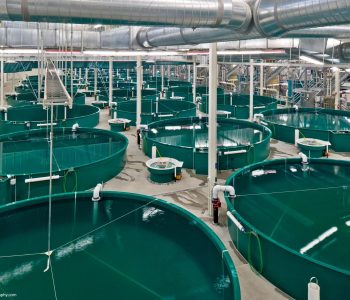
Recirculating aquaculture systems (RAS) use filtration and water-treatment technologies to allow substantial water reuse within controlled production environments.
According to the studies synthesized in the review, RAS can achieve substantial reductions in freshwater consumption and nutrient discharge compared with conventional flow-through systems.
Some of the research examined reported water consumption reductions of approximately 92% and nutrient discharge reductions of approximately 78%, although performance depends on system design, operating conditions and the comparison being made.
RAS can also offer greater control over water quality, temperature and biosecurity.
However, these benefits come with important limitations. High infrastructure costs, energy requirements, technical complexity and the need for specialized personnel can restrict adoption, particularly among smaller producers.
Technology Spotlight: Recirculating Aquaculture Systems
Potential advantages: Reduced freshwater demand, greater control of production conditions and improved effluent management.
Main limitations: High capital investment, energy consumption, technical requirements and operating costs.
Integrated Multi-Trophic Aquaculture: Turning Waste Into Resources
Another strategy gaining attention is integrated multi-trophic aquaculture (IMTA), which combines species occupying different positions within the aquatic food web.
For example, finfish can be cultivated alongside seaweeds, shellfish or other organisms capable of utilizing nutrients and organic matter generated during production.
By recovering nutrients that would otherwise be released into the environment, these systems can improve resource efficiency while potentially creating additional products and revenue streams.
The review reports that, under certain conditions, IMTA systems have achieved recovery of approximately 30–60% of dissolved nitrogen and 20–40% of particulate phosphorus.
However, nutrient recovery varies considerably depending on the species involved, stocking densities, water movement, farm layout and environmental conditions.
Successful implementation therefore requires careful system design and an understanding of local ecological processes.
Biofloc Technology: Combining Water Treatment and Nutrient Recycling
Biofloc technology represents another approach to improving nutrient utilization, particularly in intensive shrimp and tilapia farming.
These systems encourage the development of microbial communities that assimilate dissolved nitrogen compounds and convert them into microbial biomass.
The resulting bioflocs can help maintain water quality and may also provide supplemental nutrition for cultured animals.
Research summarized in the review indicates that biofloc systems can reduce nitrogenous waste and support favorable feed conversion under suitable management conditions.
Nevertheless, successful operation depends on maintaining appropriate aeration, microbial balance, water quality and carbon-to-nitrogen ratios. These technical requirements can create challenges for farms without access to specialized training.
Disease Prevention: A Critical Component of Sustainable Production
Animal health remains one of aquaculture’s most significant sustainability challenges.
Disease outbreaks can lead to substantial mortality, reduced growth, economic losses and increased use of veterinary medicines. They can also undermine resource efficiency when feed, energy and other inputs are invested in animals that do not reach harvest.
The review examines several approaches to improving disease prevention and management, including vaccination, probiotics, selective breeding and continuous environmental monitoring.
Vaccination, Probiotics and Genetic Improvement
Vaccination has demonstrated important benefits against specific diseases in several aquaculture species, although effectiveness depends on the pathogen, vaccine formulation and production conditions.
Probiotics have also been investigated for their potential to improve intestinal health, support immune responses and enhance growth performance. The review reports modest but generally favorable outcomes across several studies, while emphasizing that effects vary by microbial strain, species and farming environment.
Selective breeding offers a longer-term strategy for improving disease resistance. Research involving genetically improved tilapia and other species demonstrates the potential to increase resilience through targeted breeding programs.
However, the cost of genetic improvement programs and specialized disease testing can limit access for smaller producers.
Animal Health and Antimicrobial Stewardship
Preventing disease can help reduce the need for antimicrobial treatment. Effective biosecurity, vaccination where appropriate, water-quality management and responsible veterinary oversight are important components of a sustainable aquaculture health strategy.
Artificial Intelligence and Precision Aquaculture
Digital technologies are increasingly being explored as tools to improve decision-making in aquaculture production.
Real-time sensors can monitor environmental parameters such as dissolved oxygen, temperature, pH and other water-quality indicators. When combined with automated feeding systems and analytical software, these technologies can help producers respond more quickly to changing conditions.
Artificial intelligence and machine-learning applications are also being developed to support disease prediction, feeding optimization and early identification of abnormal behavior.
For example, predictive systems may use changes in water quality or feeding activity to identify potential health problems before they become clinically apparent.
The review highlights promising results from emerging digital technologies but cautions that their effectiveness depends on the quality of available data, system validation and the ability of producers to implement recommended actions.
For small-scale producers, affordability, internet connectivity, technical support and digital literacy remain important barriers.
The Promise of Precision Aquaculture
Integrating sensors, automated feeding and data analytics could allow farms to respond more precisely to animal needs and environmental changes. However, digital monitoring is most effective when supported by sound husbandry, reliable data and practical management decisions.
Environmental Sustainability Also Depends on Where and How Farms Operate
Beyond feeding and production efficiency, the review identifies habitat protection, biodiversity conservation and appropriate farm location as essential considerations.
Poorly planned aquaculture development can contribute to habitat degradation, nutrient accumulation and conflicts over coastal or freshwater resources.
In shrimp-producing regions, for example, mangrove conversion has historically raised significant environmental concerns. Integrated mangrove–shrimp systems and habitat restoration programs are among the approaches being explored to balance production with ecosystem protection.
Offshore aquaculture technologies may help reduce pressure on some sensitive coastal environments, but they also introduce engineering, financial and operational challenges.
These examples reinforce the importance of considering local ecological conditions rather than assuming that relocating or intensifying production automatically improves sustainability.
The Challenge of Making Innovation Accessible
Despite encouraging research findings, the review identifies a persistent gap between technological potential and widespread commercial adoption.
Large-scale operations may have greater access to capital, specialized personnel and digital infrastructure, while smaller producers can face significant financial and technical barriers.
As a result, the most sophisticated technology is not necessarily the most appropriate solution for every farm.
For some producers, improvements in feed quality, feeding schedules, biosecurity and basic water monitoring may deliver meaningful sustainability benefits at relatively low cost.
For others, investments in RAS, automated systems or advanced genetics may be justified by production scale, species value and market conditions.
The researchers therefore advocate an approach that integrates technological innovation with adaptive management and inclusive governance, ensuring that sustainability solutions remain practical across different production systems and economic contexts.
What Does This Mean for the Aquafeed Industry?
For aquafeed manufacturers, nutritionists and ingredient suppliers, the review highlights several opportunities to contribute directly to more sustainable production.
These include developing highly digestible diets, improving nutrient retention, evaluating alternative raw materials, supporting precision feeding and reducing nutrient losses associated with inefficient feed utilization.
At the same time, sustainability assessments should consider the full production chain. An ingredient that performs well nutritionally may not necessarily deliver the lowest environmental footprint if its production requires substantial energy, land or other resources.
Similarly, improvements in feed conversion must be evaluated alongside animal health, product quality and economic viability.
These considerations point toward a more integrated approach to aquafeed development, in which nutritional performance and environmental efficiency are evaluated together.
The Future of Aquaculture Is About More Than Producing More Fish
The next stage of aquaculture development will depend on producing aquatic foods more efficiently while protecting ecosystems, improving animal health and ensuring that innovations are economically accessible. From better feeds and smarter feeding strategies to water recycling and digital monitoring, the most promising pathway is one that combines technology with responsible management.
Toward a More Resilient Aquaculture Sector
Aquaculture will continue to play an important role in global food and nutrition security. Its long-term contribution, however, will depend on whether the sector can address the environmental and economic pressures associated with continued expansion.
The 2026 review suggests that many of the necessary tools are already available, while emerging innovations could further strengthen productivity and resilience.
The challenge now is to translate scientific progress into practical, measurable improvements across farms of different sizes, species and production environments.
For the aquaculture and aquafeed industries, sustainability is increasingly becoming a question of how effectively resources are used—not simply how much food is produced.
Sources and Further Reading
- Primary scientific review (2026). Review of aquaculture sustainability challenges, established interventions and emerging technologies, covering research published between 1990 and March 2026. Read the original publication on ScienceDirect.
- FAO (2024). The State of World Fisheries and Aquaculture 2024: Blue Transformation in Action. Food and Agriculture Organization of the United Nations. https://doi.org/10.4060/cd0683en.
- Naylor, R. L., et al. (2021). A 20-year retrospective review of global aquaculture. Nature, 591, 551–563. https://doi.org/10.1038/s41586-021-03308-6.
- FAO. Fisheries and Aquaculture resources, statistics and technical information. FAO Fisheries and Aquaculture.
Editorial note: The quantitative findings discussed above are drawn from studies summarized in the primary review and may vary by species, production system and experimental conditions. They should not be interpreted as guaranteed performance outcomes.