


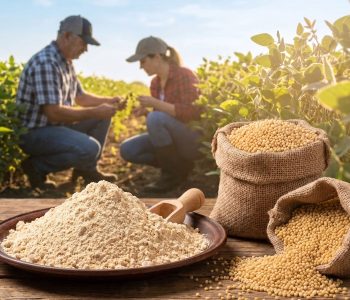
Sustainability has shifted from being a “nice to have” to something customers now expect as standard in animal nutrition. Today, feed manufacturers, integrators and livestock producers are no longer choosing feed ingredients based only on protein levels, digestibility and price. Increasingly, global food companies, retailers and even end consumers want proof that livestock was fed ingredients that were responsibly sourced and backed by credible environmental standards.
This change is reshaping how soybean meal is bought and positioned in the market. Through programs led by the U.S. Soybean Export Council (USSEC), U.S. Soy has developed tools and labeling systems that help companies meet these expectations while also strengthening their competitiveness in global markets.
SUSTAINABILITY AS A MARKET REQUIREMENT, NOT A TREND
Animal nutrition supply chains are facing growing pressure to show environmental responsibility. Population growth, climate concerns and rising consumer awareness are key drivers behind this shift. As customer expectations continue to rise, sustainability has become an increasingly important factor in purchasing decisions. USSEC helps companies meet those expectations by providing the resources needed to support informed sourcing decisions.
Soybean meal sits right at the center of this change. It’s the most widely used plant protein in animal feed globally, and roughly 98% of it goes into livestock feed. For feed buyers, sustainability is no longer just a CSR checkbox. It’s increasingly tied to market access and the ability to meet downstream customer requirements for verified environmental performance.
THE FED WITH SUSTAINABLE U.S. SOY LABEL: A COMMUNICATION TOOL FOR VALUE CREATION
One of the most recognizable tools from USSEC is the Fed with Sustainable U.S. Soy label. It gives companies a simple way to communicate sustainability to customers and consumers.
This label—along with the broader Sustainable U.S. Soy label—shows that soy has been verified through the U.S. Soy Sustainability Assurance Protocol (SSAP). The SSAP provides third-party verification that soybeans are produced under recognized environmental and regulatory standards.
The system is designed to ensure U.S. Soy production:
✓ Protects land, water and biodiversity
✓ Complies with U.S. environmental and labor laws
✓ Maintains verified shipment documentation
✓ Encourages continuous improvement in farming practices1
In practice, the Sustainable U.S. Soy label signals that the soy meets established sustainability standards and provides transparency across the supply chain.2 It allows meat, dairy and seafood brands to show that the animals were raised on verified sustainable feed.
In other words, it connects the sustainability story all the way from the soybean field to the final retail product.
Today, these labels appear on more than 1,200 products across 22 countries, showing how widely they are being adopted across the food and feed sectors.2
SUSTAINABILITY ASSURANCE AND VERIFIED SOURCING COMMITMENTS
Beyond branding, U.S. Soy sustainability efforts are built on a verification system designed to support sourcing decisions and manage risk.
In 2025, 71% of U.S. soybean exports were SSAP-verified, showing strong adoption across the industry.1
For feed companies, this kind of verification makes it easier to meet growing sustainability requirements from global customers without adding unnecessary complexity to procurement processes.
WHERE SUSTAINABILITY CREATES MARKET OPPORTUNITY
Sustainability is also opening doors for companies that actively communicate and leverage it.
Companies using the Sustainable U.S. Soy label are often better positioned to build stronger customer relationships and stand out in competitive markets.
The same logic applies to animal nutrition. Today, livestock producers and feed companies compete on more than just cost; they’re also judged on environmental impact, responsible sourcing and ESG alignment.
For feed mills and integrators, sustainability tied to soybean meal can help:
✦ Strengthen positioning in export markets
✦ Improve relationships with global food brands
✦ Support access to sustainability-linked financing
✦ Build trust with environmentally conscious customers
Sustainability is also opening doors for companies that actively communicate and leverage it.
CONNECTING THE ENTIRE VALUE CHAIN
A major shift in animal nutrition is the recognition that value is created across the whole supply chain, not just at the feed formulation stage.
U.S. Soy production is part of a system that delivers measurable sustainability outcomes, including improved land efficiency, reduced emissions per bushel and stronger soil conservation practices.1
These improvements matter because livestock production emissions are heavily influenced by feed. So, choosing lower-impact soybean meal can play a meaningful role in reducing Scope 3 emissions for food companies.
What’s also changing is how this story is communicated. The Fed with Sustainable U.S. Soy label helps connect farm-level practices directly to retail products, closing the gap between agriculture and consumer-facing sustainability claims.
WHAT THIS MEANS FOR ANIMAL NUTRITION COMPANIES
For feed manufacturers, integrators and traders, a few clear trends are emerging:
Procurement is becoming part of brand strategy.
Soybean meal selection now affects downstream positioning, not just feed cost.
Source verification is a competitive advantage.
Verified systems like SSAP help meet buyer expectations for transparency.
Sustainability supports market access.
Many export markets are tightening requirements around environmental sourcing.
Collaboration matters more than ever.
Farmers, crushers, feed mills and processors all need to align to deliver consistent sustainability claims.
SOYBEAN MEAL’S EVOLVING ROLE
Soybean meal is still the backbone of global animal nutrition, but its role is expanding. It’s no longer just about nutrition and cost; it’s also about connecting agriculture with environmental performance and consumer expectations.
With tools like the SSAP and the Fed with Sustainable U.S. Soy label, USSEC is helping the industry turn sustainability from a concept into something measurable and usable in real supply chains.
For animal nutrition companies, the takeaway is straightforward: sustainability in soy sourcing is now closely tied to competitiveness, market access and long-term growth, not just compliance.
As global food systems continue to evolve, soybean meal will remain at the center of a value chain where environmental performance and business performance are increasingly linked.
To learn more about U.S. Soy sustainability initiatives and how they are meeting today’s customer expectations, visit USSEC.org.
SOURCES
1. U.S. Soybean Export Council (USSEC), Sustainable U.S. Soy SSAP Annual Report, MY25.
https://www.flipsnack.com/C7965866AED/sustainable-us-soy-ssap-annual-report_my25
2. U.S. Soybean Export Council (USSEC), Sustainable U.S. Soy Label.
https://ussec.org/buyer-tools/sustainable-us-soy-label