


In modern livestock production, precise nutrition is key to achieve optimal performance. Mineral nutrition, even if animals’ requirements are low, is no exception.
Minerals are indeed essential for proper growth and are involved in many metabolic functions. In the past, due to their unreliable bioavailability, inorganic minerals such as oxide, sulfate and carbonate were often fed in excess to be sure to cover animals’ needs.
This option is no longer applicable as today’s farming must be sustainable. The challenge is thus to meet animals’ requirements without excess to avoid mineral leakage in the environment.
Organic minerals can be a solution however how to find our way through the variety of products available on the market?
ORGANIC MINERALS
Organic minerals are linked to one or several molecules that contain carbon, those molecules are called ligands.
The function of those ligands is to protect the mineral from interactions in the digestive tract and to improve its absorption by allowing the mineral to use more efficient absorption pathways.
Efficacy of the organic minerals will therefore rely on the type of ligands.
QUALITY CRITERIA TO SELECT ORGANIC MINERALS
One of the first thing to consider is the chelation index, it is a way to quantify the share of mineral under organic form in a commercial product. This must be evaluated together with mineral concentration. For example, in a 18% zinc product, if chelation index is 85%, it means that 15.3% of zinc are under organic form. The target is to have high chelation index, this arises from the chosen ligands but also the production process, and know-how of the supplier.
The links between the mineral and its ligands must be strong enough to avoid dissociation prior to absorption; otherwise, the mineral would not benefit from its ligands’ absorption pathways.
Thus, using the same ligand for all minerals does not allow to take advantage of these preferential bonds. The most used ‘specific’ ligands, meaning the same ligand is used to bind all minerals, are glycine, methionine or MHA.
On the contrary, when the ligands are ‘non-specific’, suppliers use protein hydrolysates (variable composition in amino-acids and peptides) which allows each mineral to choose its preferred amino-acids to bind with, and thus ensure a stronger chelation. Then, bioavailability defines the quantity of ingested mineral that will be effectively valorized by animals. It is partly influenced by chelation index and stability but also by the ligands’ nature as it determines the absorption pathways that can be used.
Choosing ligands known for having an effective absorption or able to take different pathways is a good strategy to optimize bioavailability.
BIOAVAILABILITY STUDIES
Bioavailability can be evaluated by conducting in vivo studies in which an inorganic mineral source is compared to an organic one at different doses. For a proper evaluation, a rigorous protocol is needed. For example, initial mineral status of animals must be precisely known, a depletion can even be necessary.
Then, performance must be monitored but also the mineral balance (retention, excretion) in different tissue. It is key to obtain a clear understanding of the mineral’s valorization by the animals.
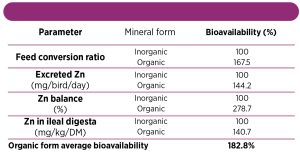
In the table below are presented, the results of a study conducted in Brazil, with Cobb 500 broilers, in which was compared an organic zinc (chelate of amino-acids and small peptides) to zinc sulfate (inorganic).
Based on the different evaluated parameters (from day 1 till day 21), the average bioavailability of the organic source was 182.8%. In practical terms, it means that 100 mg of zinc sulfate could be substituted by 54.7 mg of the tested organic zinc to obtain the same performance.

ECONOMIC EFFICIENCY
Lastly, selecting the best organic minerals cannot be done without considering economic efficiency. After having compared organic minerals based on above criteria, the cost per point of mineral is an indicator allowing to compare the different commercial products and move towards a cost-effective choice.