


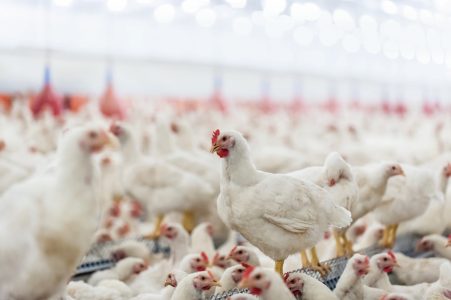
Modern broiler breeders are capable of producing exceptional numbers of high-quality chicks, but genetics alone cannot deliver that potential.
Nutrition remains one of the most powerful management tools available. Feeding to a fixed program will not meet the varying needs of a flock.
Constant monitoring is required to ensure that the birds’ nutritional needs are being effectively met.
Let bird condition guide feed allocation
The recommended feed volumes provided by Aviagen are based on a 2800 kcal/kg diet. However, the energy density of any formulated diet will be determined by the available raw ingredients, local environmental conditions, and feeding strategies.
The remaining nutrients in the diet, especially digestible lysine, should be adjusted proportionally to reflect the diet’s energy content.
Similarly, the daily intake for birds should be based on calories, so feed volumes should be adjusted to provide the target energy intake.
Throughout the flock cycle, feed allocation should be guided by body weight, weight gain, fleshing, fat reserves, feather cover, and egg mass, which account for environmental conditions, altitude, activity levels, and disease challenges.
The objective is to ensure nutrients are directed toward maintenance, continued growth, and egg production in the correct proportions throughout the production cycle.


Uniformity starts in the rear
Today’s breeders are extremely efficient at converting feed into growth, meaning their daily feed allocation may be lower than in previous generations.
To effectively start development and uniformity, birds must reach their 4-week target weight.
In the growing phase, due to relatively low feed volumes, equal feed distribution and, therefore, weight uniformity, are challenging to maintain.
To support flock evenness, after week 4, feed energy levels can be reduced to increase the feed volume, distribute the feed more effectively, and extend clean-up time.
These low-density diets require the inclusion of fibrous materials or clays as filler in the diet, which require strict quality control.
Feed clean-up times must be continuously monitored to ensure that all birds receive an equal share.
Smooth nutritional transitions
Current recommendations suggest either a four-stage or a five-stage rearing program with gradual transitions between feeding phases.
Pre-breeder diets have typically been used to increase dietary calcium to promote calcium deposition in bones; today, they can also be used as a transition diet from lower- to higher-energy.
The five-stage program introduces a developer diet before the pre-breeder diet, creating an even smoother transition into production.
These gradual changes help birds continue to build body reserves, especially fat, while preparing their reproductive system for egg production.
The critical weeks before peak
From photostimulation to peak production, the nutrition provided must allow the hen to maintain herself, continue growing, and produce eggs.
Even small inaccuracies in feed allocation can disrupt the follicular hierarchy, leading to variable egg sizes and metabolic issues.
Feed increases should occur at every 5% increase in production up to 55%, and then at every 10% increase.
Peak feed should be achieved no later than 75% of production. If the hens’ fat reserves become depleted, either because they were too low to start with or because the peak feed was delayed, post-peak feed adjustments will need to be lower, with body and egg weight harder to control and a higher risk of reduced persistency.


Post peak
Once the flock has peaked, its nutritional demand will start to decline. Post-peak feed adjustment should start once the egg mass has remained stable for 5-7 days.
The modification will then depend on the flock’s status and environment. Feed clean-up time varies with feed form, but changes in the time taken to consume feed are often indicative of changes in weight or egg production.
Egg weight can be measured daily, and the trend in egg weight can be used to predict changes in body weight more quickly.
The amino acid requirements of the hens decline at a more rapid rate than the energy requirements. Multiple breeder feeds with the same energy but lower amino acid levels are recommended to control body and egg weight without reducing feed volume so quickly that it impacts production, uniformity, feathering, or hatchability.
It is generally recommended that feed at the end of production should be no more than 8% lower than peak feed.
Think daily nutrient intake
Nutritional requirements are impacted by both the environment and the bird. Temperature, feather cover, and activity all influence maintenance energy requirements.
Cold birds need additional energy to maintain body temperature, which can lead to an oversupply of amino acids. Heat stress alters nutrient utilization and may require adjustments to feed composition.
Larger birds with higher egg mass will require more energy to maintain themselves and sustain their production rate. For birds with lower production, nutrient intake should be changed to target optimal body weight.
Nutrition is a management tool
Modern breeder nutrition is no longer about feeding to a guide. It is about continuously matching nutrient supply to the bird’s changing needs.
When body weight, flock uniformity, feed allocation, energy intake, and digestible amino acids are managed together, breeders are better able to maintain persistency, produce more saleable hatching eggs, and deliver stronger chicks throughout the laying cycle.

