The concept of “Ideal Protein”, in which the needs of each amino acid is expressed as a ratio to the amount of Lysine in the diet, has been a foundation for nutritionists to formulate broiler diets for over 30 years.
The broiler industry has primarily focused on Methionine plus Cystine (Met+Cys), Lysine (Lys), and Threonine (Thr), mainly because these were the first 3 non-bound feed-grade amino acids that were commercially available. Other non-bound amino acids are now widely available, opening up new strategies for feed formulation.
Given genetic improvements and the advances in amino acid technology, an update to the amino acid needs for broilers is appropriate. Aviagen has conducted several studies to evaluate the less-limiting amino acids, such as Arginine (Arg), branched-chain amino acids (BCAAs), Histidine (His), and Phenylalanine (Phe), for modern broilers.
Arginine
High dietary Lys without the correct supply of Arg can reduce growth performance in broilers. Arginine plays important roles in many processes, including the urea cycle, protein synthesis, and blood flow.
Aviagen’s recent work to establish an Arg : Lys ratio indicated that a 108% ratio is sufficient to optimize FCR from 1 to 25 days of age (Figure 1). There is evidence that as birds age, or are exposed to higher temperatures and/or disease challenge a higher ratio can help maintain performance.
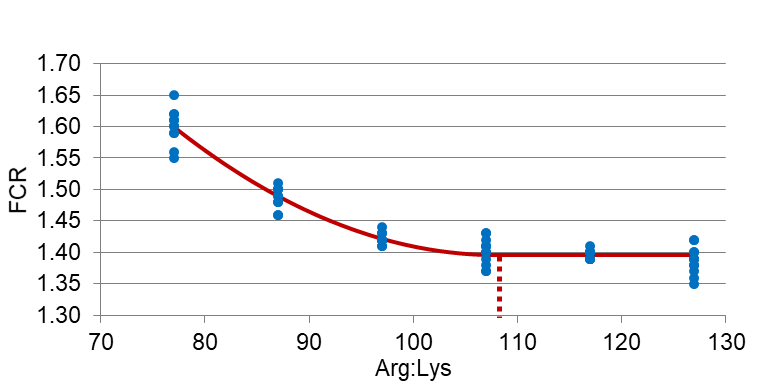

Figure 1. Response of broiler FCR to various digestible Arg: Lys ratios from 1 to 25 d of age.
Branched chain amino acids
Valine (Val), Isoleucine (Ile), and Leucine (Leu) are characterized as BCAAs. They have a similar structure, which allows them to be broken down by the same enzyme. This requires that they all be balanced with each other.
In broiler diets, when feed formulas rely heavily on corn products (corn, corn DDGS, corn gluten meal, etc.), which are high in Leu, this can increase the breakdown of Val and Ile.
To address a high Leu level, it is beneficial to increase dietary Val and Ile intake. In Figure 2, the ratio of Val : Lys and Ile : Lys must be increased to optimize body weight gain when the Leu : Lys ratio is high. Although a high dietary Leu can be addressed by increasing Val and Ile, maximum body weight gain is only achieved at a Leu : Lys ratio of 110. Hence, nutritionists must pay attention not only to Val and Ile but also to Leu.
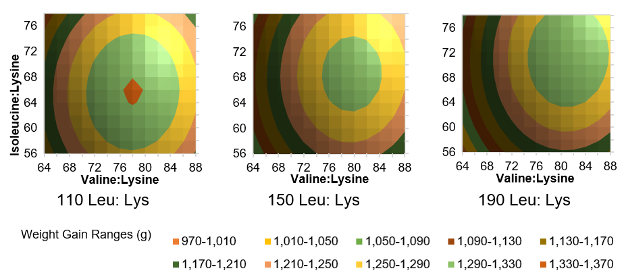

Figure 2. Body weight gain of broilers from 20 to 34 d of age, fed diets containing varying ratios of Val : Lys, Ile : Lys, and Leu : Lys. The highest body weight gain (1332 g) was obtained at Val: Lys, Ile: Lys, and Leu: Lys of 78, 66, and 110, respectively.
Histidine and Phenylalanine
Histidine (His) and Phenylalanine (Phe) are some of the lower-limiting amino acids in broiler diets. His plays a role in antioxidant capacity, the immune system, and maintaining the pH balance of cells. At the same time, Phe serves as a structural component of organ tissues and can be converted to Tryptophan (Tyr), which is essential for the function of the nervous system, intestines, muscles, and glands.
A recent Aviagen study showed that reducing dietary crude protein by 3% increased FCR by 6 points in broilers from 1 to 41 d of age when His : Lys and Phe+Tyr : Lys ratios were not maintained at 34% and 105%, respectively. However, when these ratios were increased to 38% and 114% in the low-protein diet, FCR was similar to that of the standard protein diet, underscoring the importance of these amino acids.
Practical adjustment for balanced protein
Overall, a balanced protein diet should consider not only Met+Cys, Lys, and Thr but also other amino acids. Once balanced, the next step is to determine the appropriate Lys level based on the objective of the broiler operation.
If a lower FCR is the target, nutritionists can increase dietary balanced protein. However, optimizing FCR does not always maximize economic return. In an Aviagen study, the lowest feed cost per kg of broiler produced was achieved at 106% of the Aviagen nutritional specification for a 1.8 kg broiler (Figure 3).
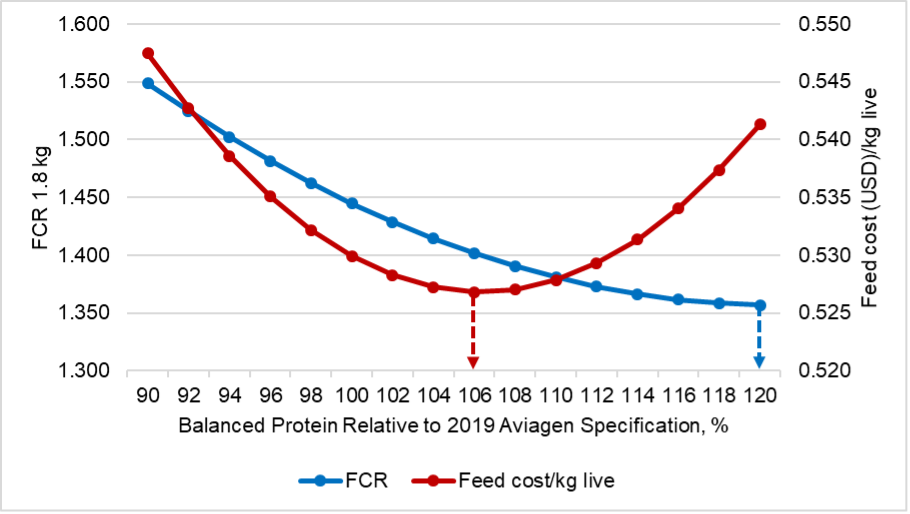

Figure 3. FCR and feed cost to produce 1 kg of broilers when adjusted to 1.8 kg market weight.
In summary, the key to optimizing broiler performance lies in balancing amino acids and the overall Lys level. Nevertheless, each company may have its own objective in producing broilers, and not all of them aim for maximum performance. Hence, nutritionists must be aware of their company’s objectives, whether to optimize performance or maximize economic return.
Published references are available on request from asia.marketing@aviagen.com. For further information, visit www.aviagen.com or scan the QR code.