


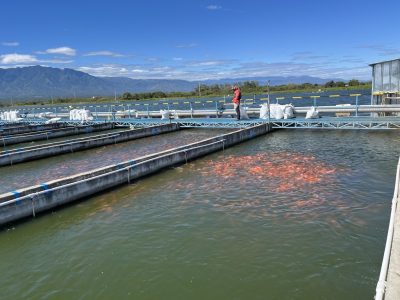
As global demand for protein from fish sources grows, so does the need for aquaculture systems that can deliver more with less – less land, less water, less waste. That is where the In-Pond Raceway System (IPRS) comes in.
IPRS is one potential solution for fish farmers aiming to improve efficiency without expanding their physical footprint. IPRS confines fish into raceways within existing ponds and constantly moves aerated water through the raceway, using the remaining pond volume to maintain water quality.
This system allows for tighter control of water quality parameters, improved feed management, greater harvesting efficiency, and ultimately results in increased pond carrying capacity and higher levels of fish production.
But here is the catch: IPRS is not a ‘build it and forget it’ solution. It is a high-efficiency tool that requires a high level of day-to-day management. And when that management is well executed, the results are noticeable.
What is IPRS?
IPRS is an innovation in pond-based fish farming that creates a more controlled and productive environment for more intensive aquaculture.
Unlike traditional pond systems, which allow fish to roam freely and feed in the open pond, IPRS confines fish into raceway units within the pond. These raceways are equipped with continuous water flow, aeration, sludge removal and sometimes feeding systems.
The result is a system that enables:
- 🐟 Better water quality control
- 🐟 Higher stocking densities
- 🐟 Faster, more uniform fish growth
- 🐟 Improved feed efficiency
- 🐟 Easier, more efficient harvesting
But these benefits only exist when the system is proactively managed. And that is where things can often go wrong.
Good tech cannot fix poor oversight
In 2024, Wittaya Aqua analyzed 346 IPRS production lots across several countries. Their findings revealed something surprising: some IPRS operations achieved excellent results – better feed efficiency, faster growth and higher survival rates. Others did not perform any better than traditional ponds. A few even underperformed.
So, what made the difference? It was not the region, species or even infrastructure. It was the quality of management.
The most successful farms treated IPRS not as an automated solution, but as a precision tool. Managers closely monitored performance, made proactive adjustments and implemented strong daily protocols. Those who treated IPRS like a traditional pond system did not achieve the results they were hoping for.
When it comes to IPRS and intensive pond systems, effective and profitable production can only be achieved with equally intensive management protocols.
Why IPRS requires a different approach
IPRS creates a high-density environment with little room for error; even small mistakes can be catastrophic. Negligence in water quality monitoring, feeding accuracy or waste removal can lead to increased stress, increased disease risk and poor performance of the entire system (and increased production costs!).
That is why successfully adopting IPRS requires more than infrastructure and capital. It demands a mindset shift.
IPRS is a precision farming system. Successful implementation of IPRS requires operators to make data-driven decisions, rather than relying on assumptions, and to act proactively rather than reactively to address issues. Most importantly, it means investing time and money in training, production planning and being accountable for the operation every day, not just during setup.
What good IPRS management looks like
There is no single approach to IPRS management, but there are clearly defined principles that successful IPRS managers follow. These are not simply suggestions. They are the foundation of good performance, profitability and fish welfare.
Here is what top-performing farms prioritize:
- 🐟 Daily water quality monitoring – With more fish per cubic meter, water conditions can change quickly. Dissolved oxygen (DO), pH and ammonia concentration must be measured daily to keep the system stable. Even brief drops in DO can cause stress, trigger disease or result in mortality events.
- 🐟 Real-time feed adjustment – Feeding should be based on actual biomass and growth data, not estimates. Overfeeding leads to waste and oxygen depletion. Underfeeding slows growth and delays harvest. Matching feed to performance is the key to efficiency.
- 🐟 Routine sampling and biomass estimation – Knowing how much fish are in the system and how fast they are growing is very important. It allows for informed decisions on feeding rates, system loading and harvest timing. Without it, operators are guessing, and IPRS does not run well on guesswork.
- 🐟 Sludge removal from the quiescent zone – The Quiescent Zone (QZ) is designed to trap waste. But if that waste is not removed regularly, it breaks down, depletes oxygen and spikes ammonia levels. Cleaning the QZ is not optional – it is core system maintenance.
- 🐟 Preventative equipment maintenance – Blowers, diffusers, sludge removal systems and feeders are critical to system function. If one fails, fish health can deteriorate fast. Regular checks reduce risk and downtime.
- 🐟 Detailed record-keeping – Management decisions should be based on trends, not memory. By logging growth rates, mortalities, feeding schedules and water quality metrics, farms can identify problems early and improve performance over time.
- 🐟 Ongoing staff training and accountability – Even the best-designed system is only as good as the people running it. Operators must understand the why behind their work. They need to be trained to detect subtle issues before they become big ones, and how to fix them.
Farms that invest in discipline, precision and training turn IPRS from an expense into an efficiency-boosting, long-term asset.
What happens when these practices are skipped?
Unfortunately, many early adopters of IPRS bring conventional pond habits with them, and those habits do not work well in IPRS.
Here are some of the most common mistakes and why they can be costly:
- 🐟 Treating IPRS like a traditional pond – Infrequent monitoring or visual feeding estimates may work in basic ponds, but they don’t work well in IPRS.
- 🐟 Overestimating capacity – Stocking more fish without increasing aeration or refining feed strategy puts the system at risk of failure.
- 🐟 Feeding low-quality or poorly matched diets – In IPRS, feed quality directly affects waste output and oxygen demand. Poor digestibility can undermine the whole system.
- 🐟 Ignoring water flow and DO monitoring – Water flow and DO levels are crucial to good IPRS function. Disruption in circulation or oxygenation can lead to enormous issues.
- 🐟 Undertraining staff – Operators need to understand the logic behind SOPs, not just follow instructions. When staff don’t understand the system, they typically can’t manage it well.
- 🐟 Skipping performance tracking – Without data, farms miss warning signs, repeat mistakes and fail to optimize.
These are not minor oversights. They are structural issues that can compromise fish health, increase costs and negate the system’s benefits.
Getting the most from IPRS starts with good management
At its best, IPRS can offer greater production in less space, with less environmental impact. But it only works that way when it is managed with precision.
Farmers and aquaculture leaders considering this system should start by preparing their teams, not just their ponds. Monitoring protocols, SOPs, record-keeping tools and staff education are the true foundation of a successful IPRS implementation.
Because when it comes to this technology, the system is only as strong as the people behind it.