By Dr. Arnau Vidal, Global Product Manager Biomonitoring & Mycotoxins & Dr. Francisco Pinto, Global Product Manager Biomonitoring & Mycotoxins
On most farms, the mycotoxin conversation begins and ends at the feed bin. A field investigation in South-East Asia suggests it should begin a generation earlier — in the sow’s bloodstream, and in piglets that have never eaten.
In August 2024, a South-East Asian breeding operation faced unexplained reproductive failures: sows aborting and prolapsing, piglets with swollen vulvae and prolapses — classic signs of an oestrogenic insult. A mitigation strategy was already running: 3 kg of deactivators per tonne (2 kg premium detoxifier plus 1 kg clay-based binder). On paper the farm was protected; in the farrowing house it was not.
The obvious step was to test the feed, and the result reassured: only aflatoxin B1 at 2.1 ppb and fumonisins below 250 ppb (fumonisin B1 174 ppb, fumonisin B2 67 ppb) (Table 1) — low-risk by any conventional reading.
To find the cause, the investigation looked not at what the animals were fed, but at what they had actually absorbed.
| Sample | Sows | Sucklings (no feed consumption yet) |
|---|---|---|
| Feed | Aflatoxin B1 (2.1 ppb) Fumonisin B1 (174 ppb) Fumonisin B2 (67 ppb) |
— |
| Blood | Deoxynivalenol (3.6 ppb) DON-glucuronide (12.3 ppb) Zearalenone (Traces) ZEN-Glucuronide (7.2 ppb) |
Fumonisin B1 (Traces) Deoxynivalenol (1.4 ppb) DON-glucuronide (6.7 ppb) Zearalenone (Traces) ZEN-Glucuronide (2.1 ppb) Alternariol (1.2 ppb) |
Vertical transfer is the movement of mycotoxins from dam to offspring before that offspring ever meets contaminated feed. It happens by two routes, both of which matter in a breeding herd (Figure 2).
The first is placental transfer. When a gestating sow ingests mycotoxins, certain compounds cross the placenta and reach the fetus — an exposure linked to impaired fetal growth, anomalies, endocrine disruption and immunosuppression (Sayyari et al., 2018). The damage is done in utero, while organ systems, immune competence and the reproductive tract are still forming.
The second route is lactational. Mycotoxins the sow consumes pass into her milk, dosing the suckling piglet directly — linked to reduced weight gain, poorer gut integrity, greater susceptibility to infection and hormonal imbalances (Trevisi et al., 2020). The piglet need not eat to be exposed: the sow’s diet becomes its own through her milk, a transfer more pronounced in sows than in ruminants.
Both routes matter because of the recipient’s biology: young piglets clear mycotoxins less efficiently than adults, so the same load hits them harder, with lower body weight and weaker immune responses. The herd’s most vulnerable animals are the least able to clear what reaches them, exposed exactly when future performance is set.
Placenta transfer:
Milk transfer:
This reframes where reproductive risk lives: much of an animal’s final performance is fixed in its earliest, most sensitive stages. Endocrine disruption in development, immunosuppression before the immune system matures, poor early gut integrity — these do not resolve once feed improves; they become part of the animal the producer must raise.
So in the breeding herd, mycotoxin exposure is not just feed quality: it is a reproductive and developmental issue, tied to fertility, farrowing performance and piglet viability.
Feed analysis answers what is present in this sample, this moment, this batch. It is necessary but only a snapshot — it cannot show what the animal has absorbed, metabolized and distributed through its tissues. Blood analysis is complementary, measuring internal exposure: the mycotoxins and metabolites in circulation, and therefore biologically active.
Blood from the lactating sows revealed a greater threat than the feed had: deoxynivalenol (DON) at 3.6 ppb, with its metabolite DON-glucuronide at 12.3 ppb — clear evidence of active DON exposure the feed had missed (Table 1). Zearalenone (ZEN) was in trace amounts, its metabolite ZEN-glucuronide at 7.2 ppb. Neither had stood out in the feed.
The investigation sampled both generations: feed and blood from five lactating sows and their piglets at 15 days of age, before any feed intake — 10 blood samples and one feed sample. Blood was collected on FTA cards (Figure 1), a dried-blood-spot format needing just 60 µL per animal yet quantifying up to 36 mycotoxin biomarkers by LC-MS/MS; the feed was screened for 16 key mycotoxins.
Figure 1. Blood samples were collected using FTA cards. Only 60 µL of blood per animal were necessary to quantify 36 mycotoxin biomarkers.
The piglet results should give any manager pause. These piglets had never eaten feed — their only intake was their dam’s milk — yet four mycotoxins appeared in their blood: fumonisin B1 (trace), deoxynivalenol at 1.4 ppb, zearalenone (trace) and alternariol at 1.2 ppb. DON-glucuronide reached 6.7 ppb and ZEN-glucuronide 2.1 ppb, confirming the toxins were being processed by the piglets themselves (Table 1).
The piglet pattern correlated with the exposure in the sows: a transfer from dam to offspring across the placenta and through the milk — the two routes the literature describes, captured here on one working farm.
Where fertility is the concern, the clearest thread links biomarkers to the clinical picture: two of the mycotoxins found in blood, zearalenone and alternariol, are oestrogenic, and they fit the oestrogenic presentation seen here, which they could well have caused.
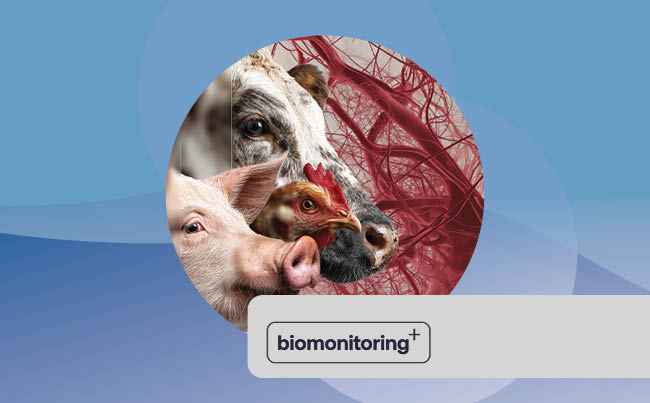
The practical contribution of blood biomonitoring, the basis of Innovad Group’s Biomonitoring+ program, is to shift the question from “what is in the feed?” to “what has reached the animal, and which animals?” Sow and offspring can be assessed together, making prenatal and lactational exposure visible. The FTA-card format keeps field sampling to a few drops of blood per animal, dried and shipped, for a 36-biomarker profile.
None of this replaces feed control. The lesson here is that a mitigation strategy was already in place, yet problems persisted: the point is to verify whether it actually reduces systemic exposure.
Biomonitoring and mitigation are not alternatives: one reduces risk, the other confirms whether it has fallen.
The conventional model places mycotoxin risk at feed intake. The vertical-transfer evidence moves that starting point earlier — to gestation and lactation, before the animal has any dietary agency. The implication for fertility is clear: exposure should be monitored in the breeding herd, not just grow-finish, because that is where its consequences are seeded.
Vertical exposure is a significant risk: what happens in the earliest, most sensitive stages sets an animal’s final performance. The confirmed transfer of mycotoxins through placenta and milk reinforces the need for integrated risk-mitigation and biomonitoring in breeding herds. Controlling exposure in sows and piglets protects health and maximizes performance from the start — when prevention is most effective and recovery often impossible.
Stop assuming. Start biomonitoring.