


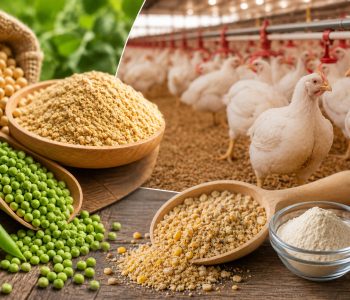
Sustainable poultry diets: replacing soybean meal with field peas and amino acids
Soybean meal (SBM) has long been considered the standard protein source in poultry nutrition due to its high protein content, balanced amino acid profile and good digestibility. However, growing concerns about carbon footprint, transport costs, supply-chain volatility and dependence on imported protein sources are encouraging the poultry industry to explore more sustainable alternatives.
At the same time, the use of low-protein diets supplemented with non-bound amino acids (NBAA) has gained increasing attention. This strategy allows nutritionists to more precisely meet the amino acid requirements of broilers while reducing dietary crude protein levels.
This approach can help decrease nitrogen excretion, improve litter quality and support better environmental performance. However, completely replacing soybean meal with only synthetic amino acids or other plant protein sources can compromise broiler growth if the diet is not carefully balanced.
Key message: Replacing soybean meal in broiler diets requires more than simply adding synthetic amino acids. Combining field peas with non-bound amino acids may offer a more balanced and practical solution.
The challenge of reducing soybean meal
The shift toward lower-protein poultry diets is being driven by both environmental and production-related goals. By reducing total crude protein and supplementing key amino acids, producers can formulate diets that more closely match the bird’s nutritional requirements.
In practical terms, this can reduce excess nitrogen intake and limit nitrogen losses into the environment. Lower nitrogen excretion may also contribute to better litter conditions, which is important for bird welfare, footpad health and air quality inside poultry houses.
However, soybean meal is difficult to replace completely because it provides not only crude protein, but also a broad supply of amino acids and other nutritional characteristics that support broiler performance.
Previous work has shown that in wheat-based diets, replacing more than 50% of soybean meal with non-bound amino acids alone can lead to poorer growth performance and reduced feed efficiency. This suggests that birds may still benefit from an intact protein source when soybean meal is reduced.
Why this matters: Low-protein diets can support sustainability, but they must be carefully formulated to avoid performance losses.
Why field peas?
To address this challenge, researchers evaluated whether field peas could help replace soybean meal when used together with non-bound amino acids.
Field peas are an interesting alternative protein source because they are a sustainable rotation crop and can contribute to more diversified feed ingredient strategies. They contain approximately 23% crude protein and provide slow-digesting starches that may support nutrient utilization in broilers.
From a sustainability perspective, field peas can also help reduce dependence on imported soybean meal, particularly in regions where local protein crops are available. This is especially relevant as feed manufacturers look for ways to reduce exposure to global commodity volatility and long-distance transport costs.
The study: testing field peas and amino acids
A 42-day trial was conducted using 300 Ross 308 broiler chickens. The researchers used a full factorial design to test three levels of soybean meal inclusion: conventional, medium and low/nil.
These diets were evaluated with or without field pea inclusion. Field peas were included progressively across the production cycle at:
- 5% in the starter phase
- 8% in the grower phase
- 10% in the finisher phase
- 12% in the withdrawal phase
By adjusting soybean meal, field peas and non-bound amino acids, the researchers were able to reduce total dietary crude protein by up to 20 g/kg, equivalent to a 2% reduction in crude protein in the low-SBM diets.
Practical formulation concept: Field peas provided an intact plant protein source, while non-bound amino acids helped fine-tune the amino acid profile of the diet.
Growth performance was maintained
One of the most important findings was that replacing soybean meal with a combination of field peas and non-bound amino acids did not compromise broiler performance.
In fact, field pea inclusion improved growth outcomes regardless of soybean meal inclusion level. Over the full 42-day period, birds fed diets containing field peas showed a 2.87% improvement in body weight gain, reaching 3,519 g/bird compared with 3,421 g/bird in birds fed diets without peas.
Feed efficiency also improved. The inclusion of field peas reduced the feed conversion ratio (FCR) from 1.518 to 1.487, indicating more efficient use of feed.
These results suggest that field peas may do more than simply replace part of the protein contribution from soybean meal. When properly balanced with amino acids, they may support efficient growth and nutrient utilization in wheat-based broiler diets.
Improved protein digestibility
The reduction of soybean meal and total crude protein also appeared to benefit digestive efficiency. Birds fed diets with the lowest soybean meal inclusion showed higher apparent protein digestibility in the distal jejunum and distal ileum compared with birds on conventional diets.
In addition, the lowest soybean meal diets increased the apparent ileal digestibility of specific amino acids, including valine, glycine and proline, by more than 7%.
This is relevant because amino acid digestibility is central to broiler performance. If birds digest and absorb amino acids more efficiently, diets can be formulated with greater precision while reducing unnecessary crude protein excess.
Important point: The goal is not simply to reduce soybean meal, but to maintain a balanced supply of digestible amino acids that supports growth and feed efficiency.
Better nitrogen retention
Another major advantage of lower-protein diets is their potential to reduce nitrogen waste. In this study, broilers fed reduced or no soybean meal diets showed higher total tract nitrogen retention, regardless of whether field peas were included.
This finding supports the environmental value of reducing dietary crude protein when diets are properly supplemented with non-bound amino acids.
Improved nitrogen retention means that birds are using more of the nitrogen they consume and excreting less. In commercial production, this can contribute to improved litter quality and potentially lower ammonia emissions.
Can soybean meal be completely removed?
One of the most practical conclusions from the study is that soybean meal can be substantially reduced, and even completely removed during later growth phases, when diets are carefully formulated.
The combination of 5% to 12% field peas with non-bound amino acids allowed researchers to reduce crude protein by 20 g/kg without compromising broiler growth performance.
Importantly, this strategy was particularly promising in the finisher and withdrawal phases, where soybean meal could be removed entirely under the experimental conditions.
Commercial takeaway: A phased approach using increasing field pea inclusion and precise amino acid supplementation may help poultry producers reduce soybean meal dependence without sacrificing performance.
Implications for sustainable poultry nutrition
For feed manufacturers and poultry producers, the findings highlight a practical route toward more sustainable diets. Reducing soybean meal can help decrease reliance on imported ingredients, lower crude protein levels and improve nitrogen efficiency.
However, the study also shows that successful soybean meal replacement depends on balanced formulation. Field peas should not be viewed as a simple one-to-one replacement, but as part of a broader nutritional strategy that includes digestible amino acid supply, phase feeding and careful diet optimization.
As the poultry sector continues to balance performance, cost and sustainability, ingredients such as field peas may become increasingly important in future feed formulation strategies.
Conclusion
The combination of field peas and non-bound amino acids offers a promising strategy for reducing soybean meal in wheat-based broiler diets.
The study showed that including field peas at 5% to 12%, alongside precise amino acid supplementation, allowed a 20 g/kg reduction in dietary crude protein while maintaining excellent broiler performance.
This approach also improved feed efficiency, enhanced protein digestibility and increased nitrogen retention, supporting both production and environmental objectives.
For commercial poultry nutrition, field peas may represent a valuable tool in the transition toward more sustainable, cost-effective and lower-protein broiler diets.
Reference
Kandel, M., Toghyani, M., Macelline, S. P., Selle, P. H., Zadoks, R. N., & Liu, S. Y. (2025). The impact of soybean meal and field peas inclusion on growth performance, carcass traits and nutrient digestibilities in broiler chickens offered wheat-based diets. Animal Nutrition, 22, 113–126. https://doi.org/10.1016/j.aninu.2025.03.011