


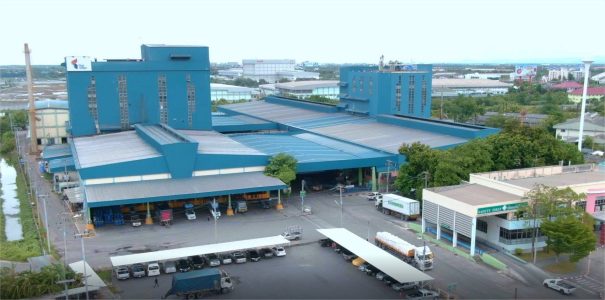
Thai Union Feedmill (TFM) has secured halal certification, further strengthening its production standards in quality, safety, and traceability while enhancing its competitiveness in the aquafeed market.
The halal certification also supports TFM’s expansion into the halal aquafeed market, enabling the company to broaden its customer base and capture growing opportunities in the Middle East and ASEAN, while creating new opportunities in international markets and reinforcing its position as a leading aquafeed producer in the region.
CEO Peerasak Boonmeechote said TFM received halal certification from the Central Islamic Council of Thailand, covering 48 SKUs of shrimp and fish feed products.
The certification marks an important step in enhancing TFM’s product standards and readiness to serve markets where halal standards are highly valued, particularly in the Middle East and ASEAN, as well as among customers who place importance on quality, safety and internationally recognized standards.
TFM places strong emphasis on comprehensive quality control across its operations, from the selection and management of raw materials and collaboration with suppliers and business partners to production processes and personnel management.
These practices help ensure compliance with the requirements of the halal assurance system. This is particularly important to the aquaculture supply chain, especially for farms and processing operators that export to Muslim markets, where the concept of ‘Halal from Farm to Table’ is increasingly important.
The concept covers the entire supply chain, from the feed used in aquaculture production through to finished products. Halal certification therefore helps strengthen confidence among farmers, operators, business partners, and customers across the value chain.
In addition, the certification enhances TFM’s competitiveness and creates opportunities to reach a broader customer base, including industrial-scale aquaculture farms and integrated aquaculture operators that place importance on quality, safety, and traceability.
It also supports further market expansion into high-potential markets, particularly in the Middle East, Malaysia, and Bangladesh.
At the same time, the aquafeed market continues to benefit from seasonal demand, particularly around major religious occasions such as Ramadan and Hari Raya (Eid al-Fitr and Eid al-Adha) when aquaculture operators typically plan their farming cycles and place feed orders in advance to meet anticipated market demand.
Meanwhile, many countries are accelerating the development of their aquaculture industries to strengthen food security and reduce reliance on imports.
These trends create opportunities for TFM to leverage its halal certification to expand its customer base, respond to demand in high-potential markets, and increase its presence and revenue opportunities in international markets over the long term.
As part of its next phase of development, TFM plans to extend halal certification to its Ranot plant in Songkhla province to enhance its capacity to serve customers in southern Thailand and overseas markets.
This expansion will be carried out alongside the company’s operations under Thai Union Group’s SeaChange 2030 strategy, which aims to drive sustainable growth through quality, innovation, and international standards.
“With our commitment to elevating product quality and production standards to international requirements, TFM became the first aquafeed manufacturing facility in Asia to achieve ASC Feed certification, a global standard for responsible aquafeed production. Together with halal certification, these certifications further strengthen our competitiveness and creates opportunities to reach new customers and international markets. This is an important step toward our goal of becoming a leading aquafeed producer in the region while delivering sustainable long-term growth,” said Mr Boonmeechote.


Peerasak Boonmeechote
Sustainability-driven growth strategy
In another development, TFM continues to drive its sustainability-driven growth strategy to address the growing challenges posed by climate change, which is creating increasingly significant structural impacts on the aquaculture industry, affecting production efficiency, farming costs, and the stability of farmers’ income. These challenges have become key issues for the long-term development of Thailand’s shrimp industry.
The government has accelerated efforts to strengthen the competitiveness of Thailand’s shrimp industry. These efforts include expanding market access, restructuring production costs through the promotion of solar energy (solar cell) adoption in shrimp farms, developing the ‘Thai Shrimp’ brand to enhance product value and strengthen its image, as well as expanding both domestic and international markets to improve the industry’s long-term competitiveness.
These efforts are closely aligned with TFM’s commitment to leveraging innovation, technology, and technical expertise to help reduce farming costs, improve production efficiency, and continuously enhance the capabilities of Thai shrimp farmers.
“Climate change is creating significant challenges for the aquaculture industry. Today, strengthening the industry’s competitiveness requires more than effective cost management. It requires the integration of scientific knowledge, technology, and innovation to improve production efficiency, reduce costs, and strengthen the resilience of both farmers and the industry, while supporting sustainable long-term growth,” said Mr Boonmeechote.
Global warming has led to greater fluctuations in water temperatures, directly affecting pond ecosystems, including dissolved oxygen levels, the feeding behavior of aquatic species, and the risk of disease outbreaks. These factors directly impact production efficiency, farming costs, and farmers’ profitability.
To address these challenges, TFM has strengthened the role of its technical service team by working closely with farmers in the field. The team applies scientific knowledge and technological solutions to help increase productivity, reduce losses, lower farming costs, and improve farm management efficiency, ultimately enhancing farmers’ income and long-term competitiveness.
In line with the government’s efforts to strengthen the capabilities of Thai farmers, TFM also promotes Lower Carbon Aquaculture by supporting the adoption of solar energy (solar cell) systems in shrimp farms, together with automated feeding systems and advanced farm management technologies. These initiatives help reduce energy costs, improve production efficiency, and lower greenhouse gas emissions throughout the aquaculture value chain.
In addition, TFM continues to invest in technology and innovation, including digitalization, automation, and Artificial Intelligence (AI) across its manufacturing processes and factory management systems. These investments enhance operational efficiency, strengthen the company’s cost competitiveness, and improve its ability to respond to market volatility and future industry changes.
TFM remains committed to its strategy of being a cost-efficient, high-quality aquaculture feed producer, while continuing to advance the future shrimp farming model through technology, innovation, and sustainability. Through these efforts, the company aims to strengthen the long-term competitiveness of Thailand’s shrimp industry and support its sustainable growth on the global stage.
Strong Q2 performance
On its financial performance, TFM reported strong operating results for Q2 2026, with revenue increasing by 9.8% and net profit rising by 9.0% from the previous quarter.
This performance brought the company’s first-half sales revenue to USD 85.62 million and net profit to USD 9.49 million, driven primarily by its shrimp feed business.
Mr Boonmechote said TFM continued to deliver steady growth in Q2 2026. The company reported sales revenue of USD 44.97 million, an increase of 9.8%, and net profit of USD 4.96 million, up 9.0% from the previous quarter.
The strong performance was supported by the onset of the aquaculture high season, which drove higher sales revenue and sales volume across all product categories.
Compared with the same period last year, sales of shrimp feed and livestock feed continued to grow. Shrimp feed, TFM’s largest business segment, continued to perform strongly in both domestic and export markets, with domestic sales increasing 2.3% and export sales surging 62%. Although fishmeal prices remained elevated, the company maintained healthy profitability through effective cost management.
For H1 2026, TFM recorded sales revenue of USD 85.62 million, an increase of 2.7% from the same period last year, while net profit reached USD 9.49 million. Gross profit margin stood at 18.8%, while net profit margin was 11.1%, reflecting the strength of the company’s business.
The shrimp feed business remained a key growth driver, supported by the company’s market leadership, continued customer base expansion, and ongoing penetration of international markets.
Despite higher raw material costs, particularly elevated fishmeal prices, TFM continued to manage costs and control expenses effectively. As a result, the selling and administrative expenses to sales ratio declined to 8.6%.
In addition, the company received tax incentives from Thailand’s Board of Investment (BOI) for shrimp feed production at its Songkhla plant and fish feed production at its Samut Sakhon plant. These incentives reduced the company’s effective tax rate to 7.3%, from 14.1%.
“Looking ahead to the second half of the year, TFM remains committed to enhancing operational efficiency while maintaining disciplined cost management to strengthen its competitiveness and support long-term growth. Although the industry continues to face challenges from higher raw material costs, the company is closely monitoring fishmeal prices and proactively managing procurement and inventory to mitigate the impact of cost volatility,” Mr Boonmechote explained.
“At the same time, TFM will continue expanding its customer base, developing new products, and driving growth in both domestic and international markets. By leveraging its strengths in product quality, technical services, and a solid financial position, the company aims to deliver sustainable long-term growth.”