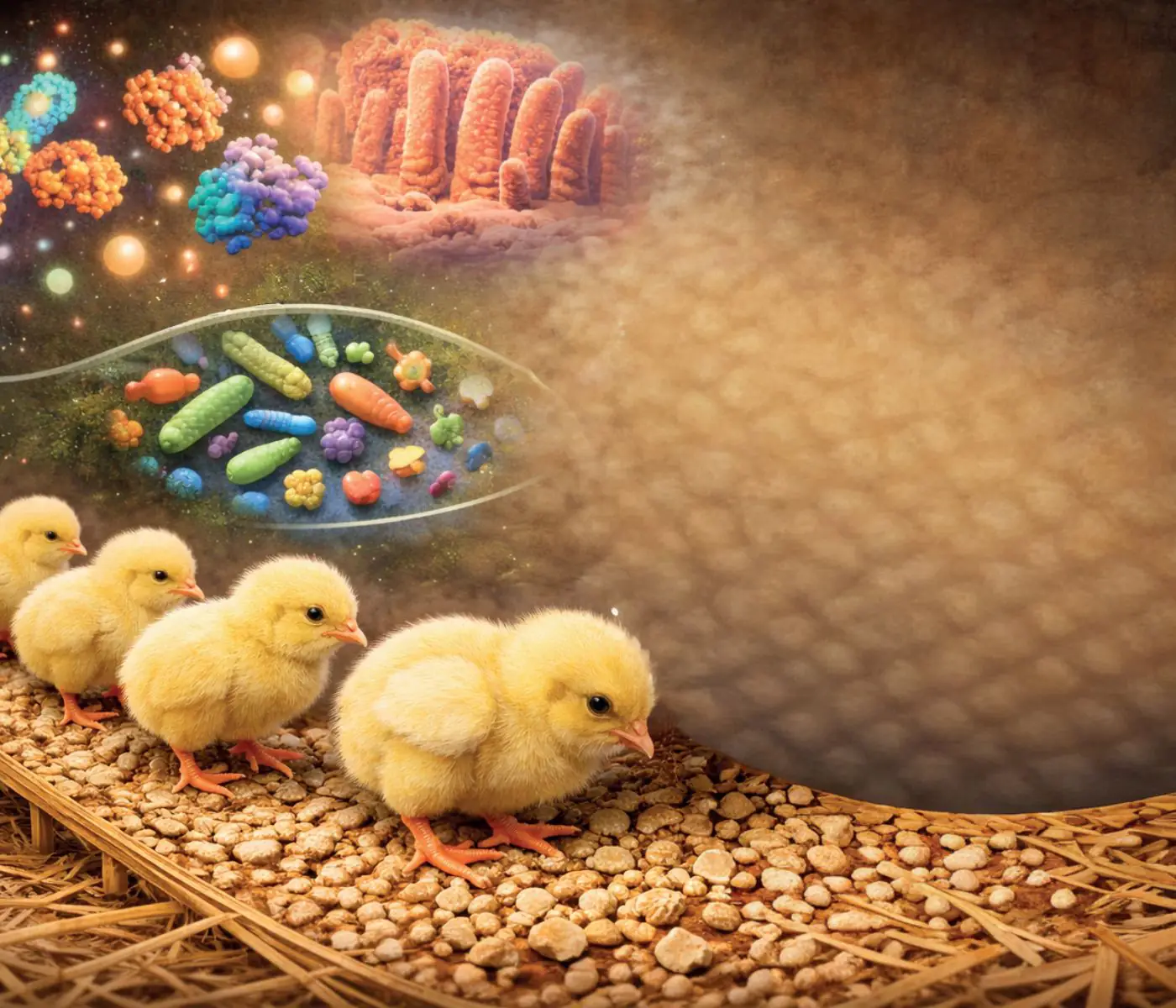
The first feeding phase is a short window with long-term consequences for broiler performance, gut development, and meat yield.



Read more content on nutriNews International March 2026
The nutrient composition and quality of the first feed offered to broiler chickens strongly influence muscle cell proliferation, digestive tract development, microbiota establishment, immunity, and intestinal enzyme activity.
In recent years, starter and pre-starter diets have been widely adopted by broiler producers around the world. These diets may last only a few days, but their impact can extend through the entire production cycle, influencing final flock productivity, health, welfare, and carcass yield.
The first feeding phase is a short window with long-term consequences for broiler performance, gut development, and meat yield.
The first days after hatch are characterized by rapid physiological changes. During this period, the chick transitions from relying on yolk-derived nutrients to obtaining energy and amino acids from feed. This transition directly affects intestinal maturation, nutrient absorption, immune function, and early growth.
Because of this, nutritional decisions during the first 3 to 10 days of life should not be viewed as minor adjustments. Even small improvements in early nutrient supply can influence uniformity, body weight, feed efficiency, organ development, and later carcass traits.
Starter and pre-starter diets represent a small portion of total feed cost, but they can have a disproportionate impact on final production results.
Energy is not a nutrient itself, but rather a property of energy-yielding nutrients such as carbohydrates, lipids, and proteins. According to the article, the apparent metabolizable energy (AME) of practical diets decreases rapidly from day 3 or 4 post-hatch, reaches its lowest point between 6 and 9 days of age, and then increases again by 14 days.
Higher dietary energy is not always beneficial in the first week, especially because fat digestibility remains limited in young broilers.
One of the practical limitations of increasing energy in starter diets is that many fat sources show low digestibility during the first week of life. In corn-soybean meal diets, additional fat may be needed to increase dietary energy, but young chicks may not yet be able to use these fats efficiently.
This highlights the importance of selecting highly digestible ingredients and avoiding unnecessary over-concentration of dietary energy during the earliest feeding stages.
Early energy formulation should focus on digestibility and nutrient availability rather than simply increasing calorie density.
Amino acid nutrition during the first feeding phase is critical because early muscle development depends on adequate supply of digestible amino acids. The article highlights evidence suggesting that some broiler nutrient requirements, especially digestible amino acids, may be higher than current recommendations during the first 10 days of life.
The maximum recommended level for digestible lysine in commercial starter or pre-starter diets is often around 1.32%. However, recent studies suggest improved responses when diets contain approximately 1.36% to 1.37% digestible lysine, depending on the genetic line.
Higher digestible amino acid density during the starter phase may improve body weight, feed efficiency, carcass development, and breast yield.
Research summarized in the article shows that Ross 308 AP broilers responded to increasing amino acid concentrations based on digestible lysine levels ranging from 1.12% to 1.43%. Linear effects on body weight were observed at both 7 and 28 days of age, with stronger effects at 28 days. Feed efficiency showed a quadratic response, with the best results around 1.36% digestible lysine.
Similarly, work with Cobb 500 broilers showed that starter diets containing 1.37% digestible lysine from 0 to 10 days improved body weight, feed conversion, carcass weight, and breast yield by day 39.
Early amino acid nutrition can influence not only chick growth, but also digestive organ development and later carcass traits.
Amino acid levels affect more than growth. The article notes that increasing dietary amino acids may influence digestive physiology, including pancreatic protease activity, villus width, villus surface area, and crypt depth.
This is particularly important because the first feeding phase coincides with rapid development of the small intestine, pancreas, immune tissues, and gut microbiota.
Optimizing amino acid density during the first feeding phase supports both growth performance and intestinal maturation.
Although higher amino acid density may improve performance, excessive dietary crude protein can create risks. During the first days of life, amino acid digestibility is still limited, averaging approximately 0.77–0.78 in corn-soybean meal diets during the first four days, increasing to 0.84 at 7 days and 0.87 by 21 days.
Undigested nitrogen and amino acids may increase proteolytic fermentation, providing substrate for less desirable microbial communities in the intestine, particularly in the ceca.
The risk of gut health issues during the third and fourth weeks of life may increase when crude protein levels are too high during the first week.
One effective strategy is to use pre-starter diets from 0 to 4 days of age, followed by starter diets from 4 to 10 or 11 days. Research cited in the article reported that broilers fed a pre-starter diet had 2.54% higher body weight at market age, 2.2% heavier carcasses, improved uniformity, and lower lameness incidence compared with birds fed a standard starter diet from 0 to 11 days.
Although pre-starter diets are used for only a short time, they may help support early development and improve final production outcomes.
Pre-starter diets represent a small feed investment with potential benefits for market weight, carcass yield, uniformity, and locomotion.
Starter and pre-starter diets account for a small proportion of total feed consumed, but they can strongly influence broiler productivity. For this reason, producers and nutritionists should pay close attention to:
According to the article, these factors will become increasingly important as producers seek to improve efficiency, health, welfare, and final flock performance.
The first feeding phase should be treated as a strategic nutritional window capable of shaping broiler growth, gut health, carcass development, and flock uniformity.