


Malaysia’s poultry industry is still seen as overly dependent on imported feed sources, thus exposing it to the risk of global market volatility including price increases and supply disruptions.
The high dependence on grain corn and soybeans not only puts pressure on production costs, but also makes the country’s food supply chain more fragile when faced with international crises.
Animal nutrition expert Hasliza Abu Hassim said Malaysia currently does not have significant local corn and soybean production, causing the industry to continue to depend on imports.
“Malaysia also basically does not have significant local corn and soybean production, so the dependence on imported feed materials remains high. The implication is that the country’s chicken production costs are very sensitive to global market prices,” she told Bernama.
“This includes currency exchange rate fluctuations and disruptions to international supply chains. Therefore, whenever there is geopolitical uncertainty or an increase in world commodity prices, the local chicken industry will be directly affected.”
The Deputy Director of the Institute of Tropical Agriculture and Food Security at Universiti Putra Malaysia said for the period 2025/2026, Malaysia’s corn imports are projected to reach around 3.8 million tons, while soy consumption is estimated at 1.69 million tons, with the poultry sector as the main consumer.
In this regard, she stressed the urgent need to explore more sustainable alternative sources to reduce dependence on imported livestock feed.
BSF larvae as alternative protein source
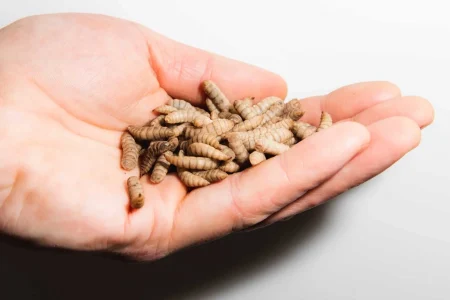
Among those seen as having potential is the use of black soldier fly (BSF) larvae as an alternative protein source.
Previous studies have shown that BSFL can be used in the diet of broiler chickens and free-range chickens without affecting performance, and even supporting growth, metabolic status and livestock health.
“BSFL contains high protein between 30% to 45% and has the potential to reduce dependence on imported soy,” Prof Hasliza said.
However, she explained that BSF larvae is not a complete replacement for corn because corn functions as an energy source, while BSF larvae is more of a source of protein and fat.
“In most cases, alternative materials such as BSF larvae are only suitable as partial replacements and require precise diet formulation and additional processing to ensure the quality of livestock feed,” she said.
Apart from BSF larvae, several other alternative feed ingredients such as palm kernel cake/palm kernel meal (PKC/PKM), rice bran and broken rice have also been used, but have not been widely used due to constraints in terms of quality, nutrient variation and digestibility.
Elaborating, Prof Hasliza said BSF larvae also has the advantage of a fast production cycle, which is between 10 to 21 days depending on the farming environment.