 13 Feb 2023

FAO modifies its cereal production forecast for 2022/2023
The Food and Agriculture Organization of the United Nations (FAO) has adjusted its forecast of global cereal production for 2022/2023. The figure published on February 3 differs from that of December 2022 by 8.3 million tons (0.3%), now standing at 2,764.7 million tons.
There are multiple factors that explain this update. However, wheat harvests for Australia and Russia have been highly influential in FAO’s predictions.

“The increase is mainly wheat-related and reflects upward revisions for Australia and the Russian Federation, which raised the forecast for world wheat production to 794 million tonnes and reinforced the expectations for a record production in 2022. As for coarse grains, world production was estimated at 1 459 million tonnes in 2022,moderately down compared to the preceding forecast in December and now 3.3 percent below the level in 2021.” details the recent FAO report.
Despite this new adjustment, and the excellent numbers promised by the wheat harvest, the total values for the 2022/2023 harvest are still lower than those of the previous year. In which world cereal production reached a total of 2,810 million tons (1.7% higher).
Figure 1. Production, use and stocks of cereals.



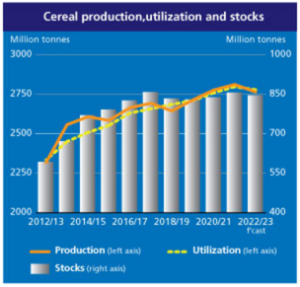
Source: www.fao.org
Winter wheat in the northern hemisphere is already mostly planted. According to the available data until now, the sown area is larger than in the previous period for almost all countries. Good cereal prices are one of the main reasons behind this increase in cultivated area. Just to cite an example, the planted area for the United States alone grew by 11% year-on-year.
As for cereal consumption, it is estimated that consumption levels will reduce by 19 million tons compared to the previous year. Which represents a 0.7% year-on-year contraction.
Table 1. World grain market.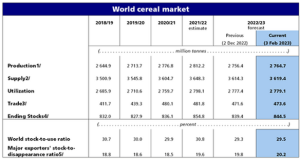
Source: www.fao.org
The recent FAO report has placed global cereal stocks at approximately 844 million tonnes. Raising the total number by 5 million tonnes compared to the values which were published during December 2022.

You may also be interested in reading: “Food security: Understanding the effects of a centralized global wheat supply.”
Source: “FAO Cereal Supply and Demand Brief”
Subscribe now to the technical magazine of animal nutrition
AUTHORS
From 2025 Data to 2026 Decisions: Managing Mycotoxin Risk in a Changing Climate

Alterion® NE Celebrates 10 Years of Poultry Gut Health Innovation
The Science Behind Kolin Plus: Beyond Choline Replacement

Summer Infertility in Sows: Managing Heat Stress and Reproductive Performance
AO-Biotics® Amaferm®: Supporting Livestock Digestion and Performance

Interview with Güner Gövenç
Güner Gövenç,
Net Energy and Precision Feeding Shape the Future of Poultry Nutrition
Edgar Oviedo
Mycotoxins in Swine: Health Risks and Nutritional Solutions
Giuseppe Carcò
Mycotoxins and Piglet Ear Necrosis: Cause, Cofactor or Coincidence?
Alberto Morillo
How Mycotoxins Affect Intestinal Health in Pigs and Poultry
Marcos Rostagno
From Antibiotics to Functional Feeds in Aquaculture
Babatunde Saliu
Peas as an Alternative to Soybean Meal in Beef Cattle Finishing Diets
Daniel Villalba Mata,
Improving Egg Yolk Pigmentation Through Better Nutrient Transport

Aquaculture and Aquaponics Nutrition: How Fish Shape the Growth of Greens
Trenton Corby
Consistency in Soybean Meal Drives Performance and Sustainability