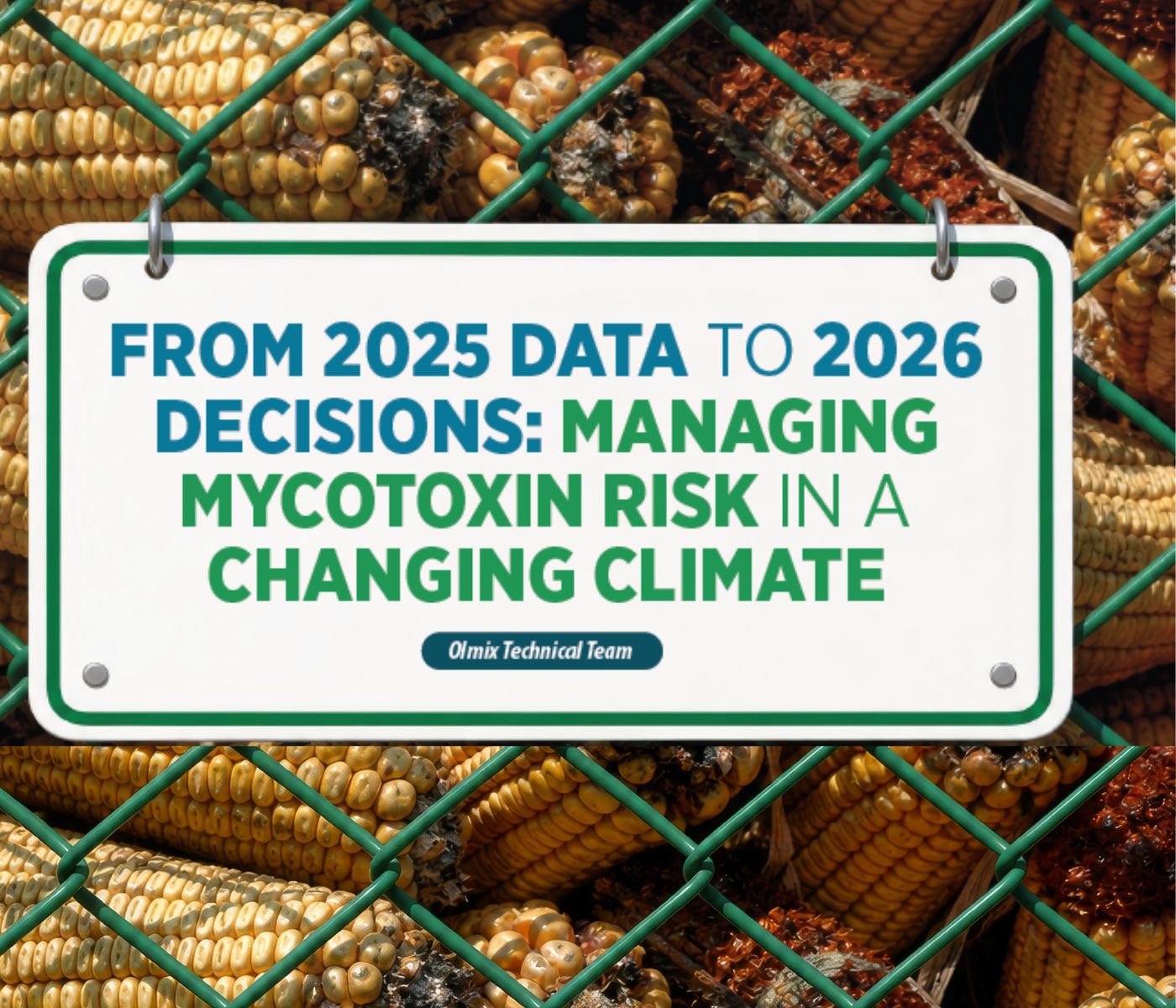
FROM 2025 DATA TO 2026 DECISIONS:
MANAGING MYCOTOXIN RISK
IN A CHANGING CLIMATE
Olmix Technical Team
Mycotoxins are no longer an occasional or local concern. They have become a structural challenge for modern feed systems.
The 2025 data from Latin America and Europe confirm a clear trend: fusariotoxins such as deoxynivalenol (DON), zearalenone (ZEN), and fumonisins (FUM) are widespread, frequently found together, and increasingly influenced by climate variability.
As corn and other cereals move through global supply chains, contamination originating in one production area can quickly become a concern for feed manufacturers, integrators, nutritionists, and farmers in another region.
The key question is no longer simply whether mycotoxins are present. In many cases, their presence must be expected.
Continua después de la publicidad.
The real challenge is to understand which mycotoxins are present, at what levels, in which combinations, and for which animal species the raw materials are intended.
In a changing climate, analysis, interpretation, and tailored risk management are becoming essential tools to protect feed safety, animal health, and performance.
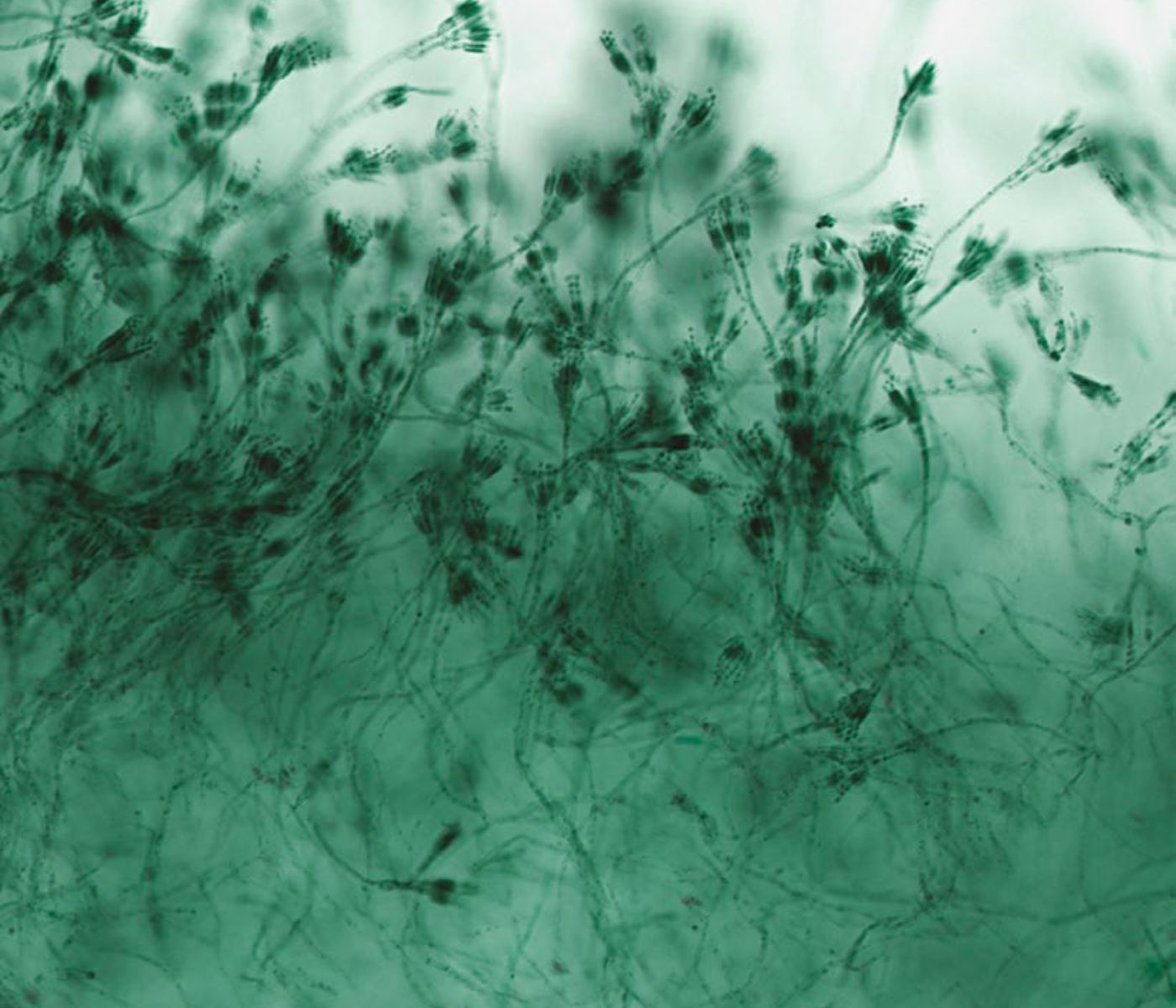
Mycotoxins are secondary metabolites produced by fungi such as Fusarium, Aspergillus, and Penicillium.
They can contaminate cereals and feed materials in the field, during harvest, in storage, and throughout transport.
Among them, fusariotoxins remain particularly important in corn-based feed systems.
Mainly associated with reduced feed intake, impaired performance, and immune modulation.
Known for its estrogenic effects and its impact on reproduction.
Can affect intestinal integrity, liver function, and overall animal resilience.
When these toxins occur together, the risk is not simply additive: combined exposure can increase biological effects and make interpretation more complex.
CLIMATE VARIABILITY AND CONTAMINATION
The 2025 contamination profile highlights the growing influence of climate variability.
Warmer temperatures, irregular rainfall, humid flowering periods, drought stress, and extreme weather events are reshaping fungal development patterns.
In corn-producing regions, these conditions can expand the ecological niche of Fusarium species and increase the probability of contamination.
At the same time, pressure on raw material availability encourages broader sourcing strategies, which may introduce greater variability in feed safety profiles.
This makes routine analysis more important than ever.
LATIN AMERICA: STRONG FUSARIOTOXIN PRESSURE
In Latin America, 2025 data confirm that corn remains under strong fusariotoxin pressure.
The region continues to be a hotspot for contamination, driven by climatic conditions favorable to fungal growth, intensive production systems, and, in some areas, post-harvest management challenges.
Across LATAM, 83% of samples showed general contamination, meaning that at least one mycotoxin was detected.
Detected in 69% of tested samples.
Average concentration: 1,760 ppb.
Detected in 30% of samples.
Average concentration: 357 ppb.
Detected in 34% of samples.
Average concentration: 74 ppb.
These figures confirm that polycontamination is a defining feature of the region.
Even when individual mycotoxin levels appear moderate, the simultaneous presence of FUM, DON, ZEN, or aflatoxins can increase the overall toxicological pressure.
This is especially relevant in animal production, where species sensitivity varies greatly.
Pigs, poultry, ruminants, and aquaculture species do not respond to mycotoxins in the same way. Young animals, breeding animals, and high-performance animals are often more vulnerable.
Consequently, analytical results should never be interpreted in isolation from the species, physiological stage, diet composition, and production objectives.
BRAZIL
Brazil continues to set the regional pattern.
As one of the world’s largest corn producers and exporters, the country plays a central role in global feed supply.
In 2025, the Brazilian contamination profile was dominated by fumonisins, detected in 68% of positive samples, with an average level of 1,654 ppb.
DON was present in 30% of samples, with an average of 350 ppb, while ZEN was detected in 33% of samples, averaging 72 ppb.
This pattern reflects the strong influence of Fusarium species across diverse production areas and reinforces the importance of monitoring corn destined for both domestic use and export markets.
ARGENTINA
Argentina presented a slightly different profile, with fumonisin and ZEN prevalence above the LATAM average.
Fumonisins were detected in 75% of samples, with a mean concentration of 1,739 ppb, while ZEN reached 40% prevalence, with an average of 56 ppb.
Aflatoxin prevalence was also higher than the regional average, reaching 30% of samples with a mean of 12 ppb.
This indicates that storage conditions and post-harvest management remain important levers for reducing risk.
In countries where corn is widely exported, improving risk control at origin has direct implications for international feed safety and regulatory compliance.
COLOMBIA AND PERU
Colombia and Peru illustrated the intensity of contamination that can occur under tropical or highly favorable fungal conditions.
In Colombia, fumonisin prevalence reached 100%, with an average concentration of 3,004 ppb, while DON prevalence was also high at 88%.
Peru was characterized by a predominant fumonisin risk, with 80% prevalence and an average contamination of 4,711 ppb.
ZEN was also a significant concern, with 53% prevalence and a mean of 147 ppb.
These profiles show why regional averages must be interpreted carefully. Behind an average value, local situations may present much higher risk levels and require specific mitigation strategies.
EUROPE
In Europe, the 2025 picture is different but equally important.
Historically, average contamination levels have often been lower than in LATAM, but prevalence remains high, especially for fusariotoxins.
DON was the most widespread mycotoxin across European cereals, detected in 88% of samples.
ZEN followed closely, with 79% prevalence, reflecting the dominance of Fusarium graminearum in many corn-growing systems.
Fumonisins were detected in 73% of positive samples, with an average concentration of 583 ppb.
FRANCE
France provides a clear example of this pattern. As one of Europe’s major cereal producers, the country remains highly exposed to DON and ZEN in corn.
In 2025, DON was detected in 95% of samples, with a mean concentration of 1,100 ppb.
ZEN was also frequent, with 88% prevalence and an average of 139 ppb.
Although fumonisins were less dominant than in Latin America, their presence remained significant, with 72% prevalence.
These figures confirm the link between humid flowering conditions and Fusarium pressure.
SPAIN
Spain illustrates how climate change is modifying traditional risk maps.
Historically associated with aflatoxin risk during hot and dry periods, Spain is now also facing increasing fusariotoxin pressure, especially in corn systems affected by irrigation, heat stress, and changing rainfall patterns.
In 2025, DON prevalence reached 62%, with an average of 1,300 ppb.
ZEN was detected in 72% of positive samples, confirming the spread of Fusarium graminearum pressure.
Fumonisin prevalence was lower, but the average level was relatively high at 2,000 ppb.
The European risk profile is therefore less about occasional acute contamination and more about repeated, chronic exposure through contaminated batches entering compound feed.
For feed manufacturers, this reinforces the need to assess not only whether a batch is contaminated, but how it should be used depending on the target species.
This overlap between DON, ZEN, and FUM creates more complex risk profiles and highlights the need for expert interpretation.
LOOKING AHEAD TO 2026
The main lesson from 2025 is clear: mycotoxin management must become more proactive, more analytical, and more contextual.
Climate instability is reducing the reliability of historical assumptions.
Regions once considered low risk may experience significant contamination under specific weather conditions, while traditionally high-risk areas may show changing toxin profiles from one season to another.
Risk maps are becoming more dynamic, and decisions based only on origin, past experience, or visual grain quality are no longer sufficient.
ANALYSIS AS THE FIRST STEP
Testing raw materials and finished feeds provides the factual basis for decision-making.
However, analysis alone is not enough.
A laboratory result must be interpreted in relation to the mycotoxins detected, their concentrations, their possible interactions, the inclusion rate of the contaminated ingredient, and the animal species for which the feed is intended.
A level considered manageable for one species may represent a significant risk for another.
The same result may require different actions in piglets, sows, broilers, dairy cows, or aquaculture species.
FROM DETECTION TO ACTION
Supporting customers in this interpretation is therefore central to effective mycotoxin risk management.
The objective is not only to detect contamination, but to translate analytical results into practical decisions.
- Which batches can be used safely?
- Should their inclusion rate be reduced?
- Are certain species or physiological stages more at risk?
- Is the contamination profile dominated by DON, ZEN, FUM, aflatoxins, or a combination of several toxins?
- What solution is most appropriate for this specific situation?
These are the questions that allow feed producers and animal production professionals to move from observation to action.
OLMIX: TURNING DATA INTO DECISIONS
In this context, Olmix supports customers with services designed to turn data into decisions.
MycoScreen helps interpret mycotoxin analyses by considering the toxins detected, their levels, the risk of co-contamination, and the destination species of the cereals or feed materials.
This approach allows each situation to be evaluated more precisely, taking into account animal sensitivity, production objectives, and practical constraints.
In parallel, Myco’Kingdom provides an online platform dedicated to sharing information on mycotoxins, from scientific understanding to practical management.
It brings together knowledge, tools, and guidance to help users better understand contamination profiles and implement adapted strategies.
ANTICIPATING RISK
The transition from 2025 to 2026 should therefore be seen as an opportunity to strengthen mycotoxin risk control.
The data are clear: fusariotoxins are established in both Latin American and European corn systems, polycontamination is frequent, and climate variability is likely to continue reshaping contamination patterns.
For the feed industry, the most resilient approach will be based on regular analysis, expert interpretation, and solutions adapted to each customer’s own context.
In a changing climate, managing mycotoxins is not about reacting once animal performance has already been affected.
It is about anticipating risk, understanding contamination profiles, and making informed decisions before the impact becomes visible.
With the right analytical strategy, expert support, and dedicated tools such as MycoScreen and Myco’Kingdom, feed producers, integrators, and nutritionists can better protect animals, secure performance, and prepare their risk management plans for the realities of 2026 and beyond.