



 30 Apr 2024
BronchoVest – The Great Ally for Respiratory Relief & Heat Stress Reduction
 There are countless challenges in poultry farming, regardless of the production phase, in terms of health, environment, and management. These challenges can favor the emergence of diseases, including those affecting the respiratory system, which economically compromise the system as a whole. The respiratory tract is one of the main entry points for opportunistic pathogens, increasing the risk of secondary infections. Challenging scenarios are very similar within poultry production sectors, and we can cite several situations that increase the risk of respiratory problems:
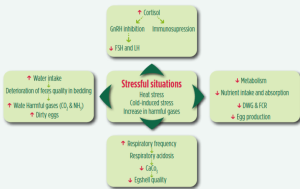
Such stressful situations elevate corticosterone concentration, responsible for compromising homeostasis capacity, leading to nutrient and energy diversion, resulting in decreased performance and, in more severe cases, increased mortality(Figure 1).
Figure 1: Physiological Effects of Stress on Poultry.
As a preventive support for these challenging situations that pose respiratory challenges, Biochem offers BronchoVest – a blend of high-quality essential oils with concentrated active ingredients. BronchoVest is composed of eucalyptus oil, mint, and menthol crystals, which have a synergistic effect focused on supporting bird respiratory system health. BronchoVest promotes the following beneficial effects:

In vivo Trial – Broilers
The aim of the experiment was to evaluate the effects of BronchoVest on the respiratory system of broilers. For this purpose, the product was administered between days 1-5, 16-20, and 23-27 at a dose of 200 ml per 1000 liters of drinking water (T2, T4) or 200 ml in 10 liters of water, sprayed 4 times a day (T3, T5). All groups were vaccinated against Newcastle disease on day 15. On day 22, 0.5 ml of a solution containing E. coli (108 CFU/ml) was intratracheally inoculated into groups T1, T4, and T5.

The clinical symptoms of the animals were evaluated per pen, 4 times a day, up to 7 days after infection. The following respiratory symptoms were evaluated: head swelling, rhinorrhea, sneezing, cough, and dyspnea. Each symptom was scored on a scale of 0 (absence of symptoms) to 3 (severe symptoms).
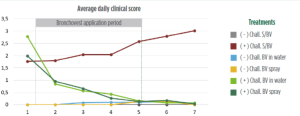
The E. coli inoculation challenge did not result in severe cases of the disease. However, irritation of the lower respiratory tract causing moderate clinical symptoms was observed.
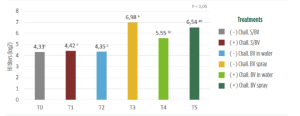
The results of this study demonstrated the synergistic effect of BronchoVest essential oils as a suitable alternative for animals experiencing mild to moderate respiratory symptoms and could be a useful tool in preventing symptom progression. Hemagglutination inhibition (HI) antibody titers increased after vaccination in groups sprayed with BronchoVest. The trial results demonstrated that the combination of BronchoVest ingredients helps increase vaccination titers against Newcastle disease.
Assertive Formulation!
BronchoVest has a 100% safe water-based formulation, allowing easy application due to its excellent solubility in different water temperatures, besides having no residual effect and not causing irritation to the skin and mucous membranes of the animals. Discover the key to success in preventing problems caused by respiratory difficulties and thermal stress. Invest in intelligent prevention with BronchoVest and ensure the well-being of your production system!

Learn more at biochem.net
Subscribe now to the technical magazine of animal nutrition
AUTHORS
From 2025 Data to 2026 Decisions: Managing Mycotoxin Risk in a Changing Climate
Alterion® NE Celebrates 10 Years of Poultry Gut Health Innovation

The Science Behind Kolin Plus: Beyond Choline Replacement

Summer Infertility in Sows: Managing Heat Stress and Reproductive Performance
AO-Biotics® Amaferm®: Supporting Livestock Digestion and Performance

Interview with Güner Gövenç
Güner Gövenç,
Net Energy and Precision Feeding Shape the Future of Poultry Nutrition
Edgar Oviedo
Mycotoxins in Swine: Health Risks and Nutritional Solutions
Giuseppe Carcò
Mycotoxins and Piglet Ear Necrosis: Cause, Cofactor or Coincidence?
Alberto Morillo
How Mycotoxins Affect Intestinal Health in Pigs and Poultry
Marcos Rostagno
From Antibiotics to Functional Feeds in Aquaculture
Babatunde Saliu
Peas as an Alternative to Soybean Meal in Beef Cattle Finishing Diets
Daniel Villalba Mata,
Improving Egg Yolk Pigmentation Through Better Nutrient Transport

Aquaculture and Aquaponics Nutrition: How Fish Shape the Growth of Greens
Trenton Corby
Consistency in Soybean Meal Drives Performance and Sustainability