Home » Beyond Feed Efficiency: Rethinking Sustainable Poultry Nutrition
 06 Oct 2026
Beyond Feed Efficiency: Rethinking Sustainable Poultry Nutrition
Poultry nutrition is being asked to achieve more than ever before.
A modern diet must support animal health and productive performance, remain economically viable and, increasingly, help reduce the environmental footprint associated with producing meat and eggs.
These objectives may appear complementary. Better feed efficiency, for example, means fewer resources are required to produce each kilogram of poultry product. Improving nutrient utilization can also reduce the amount of nitrogen and phosphorus excreted into manure.
But the relationship is not always so straightforward.
A recent review published in Veterinary Sciences examines the connections—and potential conflicts—between poultry health, production efficiency and greenhouse gas mitigation. Its central message is particularly relevant as the industry moves toward precision nutrition and lower-carbon production: improving one sustainability indicator does not necessarily improve the entire production system.
SUSTAINABILITY IS A MULTI-OBJECTIVE CHALLENGE
A nutritional strategy should not be considered successful simply because it reduces nitrogen excretion, improves feed conversion or replaces a conventional ingredient. Health, performance, product quality, economics and environmental impact need to be evaluated together.
Nutrient retention connects health, performance and sustainability
One of the most useful concepts emerging from the review is nutrient retention.
When intestinal function is maintained and nutrients are efficiently digested and absorbed, a greater proportion of the diet can be directed toward growth or egg production. At the same time, less undigested nitrogen and phosphorus is available for excretion.
This creates an important connection between gut health and environmental performance.
A stable intestinal environment and intact epithelial barrier may help improve nutrient utilization while reducing the metabolic costs associated with persistent inflammation. Better utilization can then translate into lower feed requirements per unit of product and fewer nutrients entering manure.
Conversely, intestinal dysfunction can reduce nutrient utilization, increase susceptibility to disease and increase the amount of dietary nutrients that fail to contribute to productive output.
Gut health, feed efficiency and environmental performance are not separate nutritional objectives. They are interconnected through the way birds digest, retain and ultimately use dietary nutrients.
Gut health remains a foundation for efficient production
As poultry production has reduced its reliance on antibiotic growth promoters, considerable attention has shifted toward nutritional approaches capable of supporting intestinal function.
The review highlights several categories of functional strategies, including probiotics, prebiotics, synbiotics, phytochemicals, organic acids, functional amino acids and micronutrients.
These interventions can act through different mechanisms. Some influence microbial populations, others support epithelial integrity or immune function, while certain compounds may improve digestive processes or antioxidant capacity.
However, an important distinction is necessary: results obtained with one product cannot automatically be extrapolated to an entire additive category.
Probiotic performance, for example, can depend on strain, viable dose, feed processing, storage and gastrointestinal survival. Plant-derived additives can vary according to botanical origin, extraction method and concentration of active compounds. Similarly, the effectiveness of organic acids depends on their chemical form, dose, release characteristics and interaction with the basal diet.
FROM “WHICH ADDITIVE?” TO “WHAT PROBLEM ARE WE SOLVING?”
Functional ingredients are most useful when they address a clearly identified biological or technological constraint. Product composition, effective dose, processing stability and farm conditions can all influence the response.
Lower-protein diets offer opportunities—but there is a limit
Reducing dietary crude protein is one of the most discussed nutritional approaches for lowering nitrogen losses from poultry production.
When diets are properly balanced with digestible amino acids, a moderate reduction in crude protein can improve nitrogen-use efficiency and decrease nitrogen excretion while maintaining productive performance.
The environmental logic is attractive: less nitrogen excreted means less substrate potentially available for ammonia volatilization and nitrous oxide formation during manure storage and management.
Studies reviewed by the authors illustrate the potential magnitude of this effect. In one broiler experiment, reducing crude protein by 1.5 or 3 percentage points lowered nitrogen excretion by approximately 9.5–17% in males and 11.8–14.6% in females. Another study estimated a reduction of approximately 31.1% in cumulative nitrogen excretion with an amino acid-balanced low-protein feeding strategy.
But reducing protein indefinitely is not the objective.
If crude protein falls below biologically appropriate levels, limitations involving essential and non-essential amino acids, glycine equivalents, dietary energy, electrolytes and intestinal function can emerge. Growth, intestinal integrity, carcass characteristics and meat quality may consequently suffer.
The practical target is therefore not the lowest possible crude-protein concentration, but the lowest level that remains biologically and economically appropriate for the specific production situation.
The hidden environmental cost of precision nutrition
There is another complication.
Low-protein diets frequently depend on greater inclusion of crystalline amino acids. While this can reduce soybean meal use and nitrogen excretion at farm level, manufacturing amino acids also requires raw materials, fermentation, energy, separation and drying.
Those upstream processes carry their own environmental footprint.
This means that a reduction in nitrogen excretion cannot automatically be interpreted as an equivalent reduction in the carbon footprint of the finished poultry product.
The key question changes from: “Did this diet reduce nitrogen excretion?”
to: “Did this diet reduce the total environmental burden once ingredient production, amino acid manufacturing, transport, animal performance and manure management are considered?”
Feed enzymes can unlock nutrients already in the diet
Feed enzymes represent another important route toward greater resource efficiency.
Phytase can release phosphorus bound in phytate, reducing dependence on supplemental inorganic phosphorus and potentially lowering phosphorus losses. Xylanases and β-glucanases can improve the utilization of nutrients trapped within plant cell-wall structures, particularly in diets containing ingredients rich in non-starch polysaccharides.
Proteases, meanwhile, can improve protein degradation and amino acid availability under appropriate dietary conditions.
But enzyme responses remain substrate-dependent. The enzyme must be matched to the ingredients and substrates present in the diet, and feed processing can affect the amount of active enzyme ultimately reaching the animal.
The same caution applies to “super-dosing.” Higher inclusion does not guarantee a proportional biological response, while additional supplementation increases formulation costs.
Alternative proteins are not automatically sustainable proteins
The search for alternatives to conventional protein ingredients has introduced possibilities ranging from insect meals and microalgae to single-cell proteins, oilseed coproducts and agro-industrial residues.
These resources could diversify feed supply chains and, in some situations, create opportunities to valorize materials that might otherwise be considered waste.
But origin alone does not establish sustainability.
An alternative ingredient may require drying, extraction, defatting, cell disruption or other energy-intensive processing. Its digestible amino acid profile may require additional supplementation. Supply may be seasonal or geographically limited, while transport requirements can change its environmental advantage.
Safety and consistency are equally important. Contaminants, anti-nutritional factors, microbial quality and batch-to-batch variability must all be considered before an ingredient can move from an interesting research concept to a commercially viable feed material.
“ALTERNATIVE” DOES NOT NECESSARILY MEAN “LOW-CARBON”
The environmental value of an ingredient depends on where and how it is produced, processed and transported, how much can be included, what supplementation it requires and how animals perform on the complete diet.
Precision feeding enters the digital era
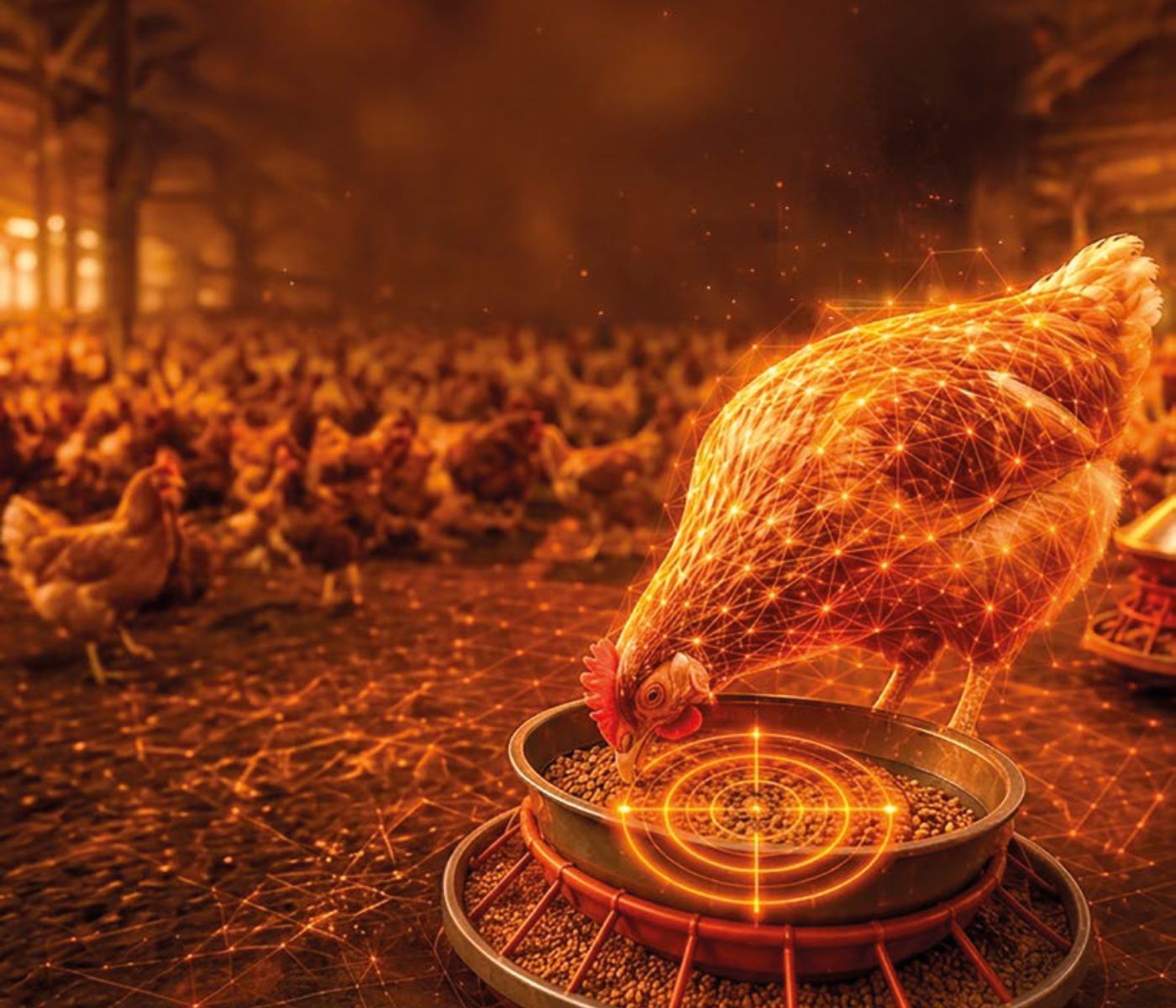
Digital technology is adding another dimension to poultry nutrition.
Sensors can increasingly provide information on variables such as feed and water consumption, body-weight distribution, temperature, humidity and air quality. When these data are combined with predictive models, feeding programs can potentially be adjusted more closely to the requirements and responses of a flock.
Artificial intelligence and data-driven models could further improve growth prediction, diet adjustment and early identification of abnormal patterns associated with environmental stress or disease.
Yet technological potential should not be confused with commercial validation.
A model that performs well on one farm or during one production cycle may not retain the same accuracy across different genetics, seasons, diets, housing conditions or sensor systems. Hardware, maintenance, connectivity and data-management costs must also be included when assessing economic value.
For digital nutrition, therefore, external validation under commercial conditions is as important as predictive accuracy during model development.
Where does poultry’s carbon footprint actually come from?
Understanding environmental impact also requires looking beyond the bird.
Feed production represents a major component of poultry’s climate footprint because it incorporates crop production, fertilizer use, land-use effects, processing and transportation. Manure management adds further emissions through nitrogen transformations and, depending on conditions, greenhouse gas production.
Unlike ruminants, poultry produce comparatively little enteric methane. Consequently, nutritional mitigation strategies are generally more relevant when they reduce the amount of feed required per unit of product, improve nitrogen and phosphorus utilization, influence manure composition or change the environmental burden of feed ingredients.
This is why feed efficiency remains important—but also why it cannot be considered in isolation.
When better feed efficiency does not necessarily mean lower emissions
A feed additive that improves feed conversion could theoretically reduce the amount of feed required to produce the same quantity of meat or eggs. That may decrease the upstream resources associated with crop production, processing and transport.
However, manufacturing that additive also carries an environmental cost.
Likewise, replacing soybean meal with another protein source may reduce one environmental burden while increasing processing energy, transport or supplementation requirements elsewhere.
These examples illustrate what the review describes as burden shifting: solving one problem while moving part of the cost or environmental impact to another stage of the production chain.
An improvement inside the poultry house is not necessarily an improvement across the entire poultry production system.
A four-step framework for smarter nutritional decisions
To address these competing objectives, the authors propose a four-level framework for evaluating poultry nutritional strategies.
1. Start with physiological adequacy.
The diet must first satisfy the fundamental requirements for maintenance, growth, egg production or reproduction. A strategy that compromises these functions cannot be considered sustainable simply because it improves an environmental indicator.
2. Improve precision nutrient supply.
Digestible amino acids, energy and minerals should then be balanced as closely as practical to animal requirements, reducing unnecessary nutrient inputs without compromising health, performance or product quality.
3. Use functional interventions for defined constraints.
Enzymes, probiotics, organic acids, phytochemicals and other additives should be introduced when there is a clear nutritional, physiological or technological reason for doing so—and when evidence supports their effectiveness under the intended conditions.
4. Verify the outcome across the whole production chain.
Finally, the strategy should be assessed beyond the farm, incorporating ingredient production, additive manufacturing, feed processing, transportation, animal performance, mortality and manure management.
Life cycle assessment becomes the reality check
This final step is where life cycle assessment (LCA) becomes particularly important.
LCA can help determine whether an apparent environmental improvement on the farm remains beneficial after upstream and downstream effects are included.
For example, replacing an ingredient may look advantageous when only feed conversion or nitrogen excretion is measured. The conclusion may change when ingredient origin, processing energy, land-use assumptions, transport and additional supplementation are incorporated.
The review therefore calls for more standardized and transparent LCA approaches, together with sensitivity analyses that account for regional differences in sourcing, energy systems and production responses.
There may be no universally sustainable poultry diet
Perhaps the most important implication is that sustainability cannot be reduced to a universal formulation.
The best nutritional strategy for one poultry operation may not be the best for another.
Genotype, production stage, disease pressure, climate, ingredient availability, farm scale and market objectives can all change the biological, economic and environmental response to a feeding strategy.
A producer with access to a consistent regional coproduct may have opportunities unavailable to another operation. A precision-feeding technology that makes economic sense on a large integrated farm may not be practical for a smaller producer. Likewise, a low-protein formulation appropriate under one set of ingredient prices and genetics may carry greater performance risk elsewhere.
THE BIGGER PICTURE
The future of sustainable poultry nutrition may be less about identifying a single “green” ingredient or additive and more about building diets that remain healthy, productive, economically realistic and environmentally advantageous when the entire system is considered.
From promising interventions to verified outcomes
Precision amino acid nutrition, feed enzymes, functional additives, alternative proteins and digital feeding technologies all offer tools for improving poultry production.
But the next stage will require moving beyond isolated indicators.
Future research will need to test nutritional interventions across different genetics, production stages, environmental conditions and commercial farms. Economic feasibility and product quality should be evaluated alongside biological performance, while environmental claims need to incorporate the complete feed and production chain.
Ultimately, the most useful question may not be whether a nutritional strategy improves health, efficiency or emissions.
It is whether that strategy can deliver reproducible benefits across all three without creating unacceptable trade-offs somewhere else.
Source
Zhao, D., Chai, H., Zhou, L., Han, R., Peng, W. & Wu, H. (2026). Synergies and Trade-Offs in Modern Poultry Nutrition: An Integrated Framework Linking Animal Health, Productivity and Greenhouse Gas Mitigation. Veterinary Sciences, 13(8), 789. https://doi.org/10.3390/vetsci13080789