INTRODUCTION
Meat production currently faces numerous challenges, among which its dependence on global markets stands out.
-
In particular, the use of soy as the main protein ingredient in fattening feeds is raising increasing concern due to dependence on imports from certain countries where it can have a considerable environmental impact (FEFAC, 2025).
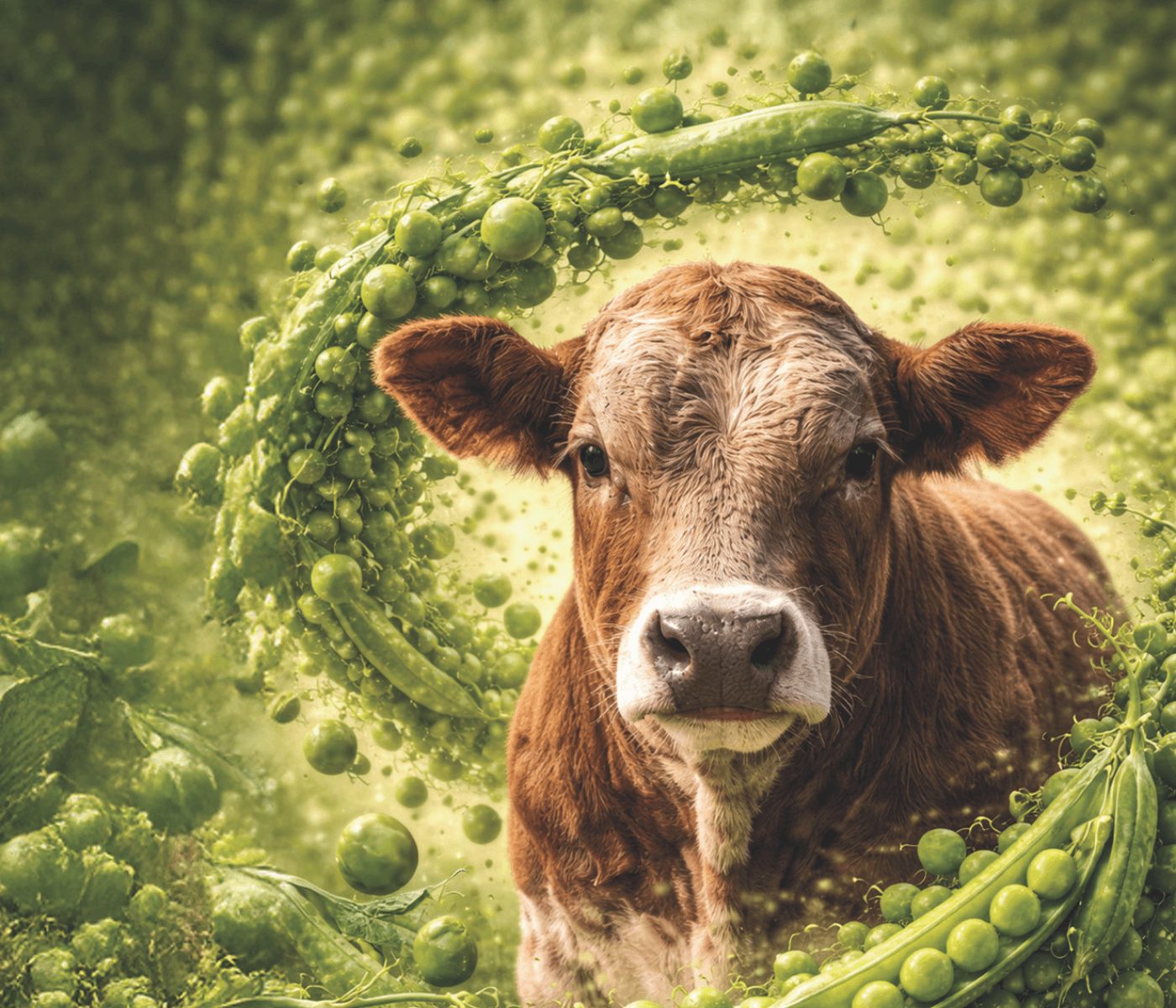
To promote protein autonomy, the European Parliament encourages the cultivation of high protein crops, highlighting peas, which account for more than half of such production in Europe.
-
Due to its high protein and starch content, this ingredient can replace both soy and cereals in feeds (Cerisuelo, 2024).
However, its inclusion rate could be limited by the high ruminal degradability of its protein (Khorasani et al., 2001; Rotger et al., 2006), which can result in greater ammonia production in the rumen. Additionally, it can promote a shift in nitrogen (N) excretion from feces to urine, which can be more polluting as it is more prone to leaching and volatilization.
So far, there are no studies on the potential inclusion of peas in intensive fattening diets for beef breeds (the most common commercial type in Spain).
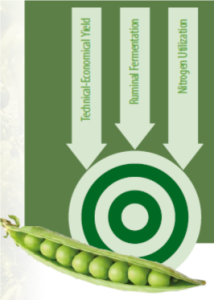
Therefore, the aim of this study was to determine the impact of different inclusion rates of peas replacing soy and corn on technical-economical yield, ruminal fermentation, and nitrogen utilization.
TRIAL DESIGN
-
The experiment was carried out at the La Garcipollera Experimental Farm (CITA-Aragón).
-
Using 32 male calves of the Parda de Montaña breed (210 ± 24.3 kg live weight and 152 ± 17.6 days old at the start of the trial).
-
Under intensive fattening with feed and barley straw ad libitum until reaching 500 kg in weight.
The animals were distributed into four groups receiving isoenergetic feeds (11.7 MJ ME/kg) and isoproteic feeds (13% crude protein) that differed in the proportion of peas (0%, 15%, 30%, and 45% peas) replacing soybean meal and corn (hereafter 0%P, 15%P, 30%P, and 45%P, respectively).
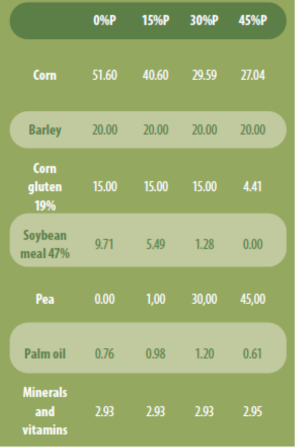
Table 1. Feed formulation.
During the trial, the following were recorded daily:
-
Individual feed intake using two ALPRO feeding stations (ALPRO Herd Management 7.0, DeLaval).
-
Straw intake was calculated in relation to total intake (Costa-Roura et al., 2020).
The animals:
-
Were weighed weekly to determine their average daily gain (ADG) and feed conversion ratio.
-
Monthly blood samples were taken to determine plasma urea concentration.
Samples of ruminal fluid, feces, and urine were taken at the beginning and end of the fattening period (Casasús et al., 2025) to characterize ruminal fermentation patterns and N balance in the different treatments.
-
In the ruminal fluid, pH, ammonia concentration (NH3-N), and the different volatile fatty acids (VFA, including acetic, propionic, butyric, and other minor acids) were determined.
-
To perform the N balance, total daily N intake and its excretion in feces and urine were considered.
When the calves reached 500 kg, they were slaughtered in a commercial abattoir.
After 24 hours of chilling at 4°C, the carcasses were weighed and the carcass yield was obtained in relation to the live weight prior to slaughter.
Then, fat cover and carcass conformation were visually assessed (SEUROP conformation transformed according to an 18-point scale, fat cover 1–5 on a 15-point scale).
The economic results of the four diets were compared using a partial budget analysis.
Technical and economic aspects were considered:
-
The affected costs and revenues (ADG, days on feed, feed cost, conformation, and carcass sale price).
-
Calculating the economic margin as the difference between revenues and the described costs (those in force in 2017).
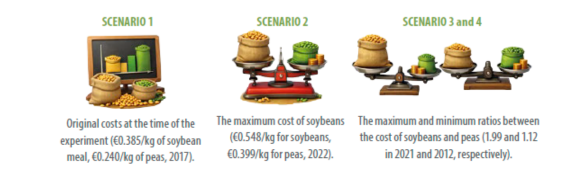
A sensitivity analysis of feed cost was also carried out in response to four scenarios with different relative costs of soybean meal and peas from 2010 to 2024 (Generalitat de Cataluña databases, 2024), analyzed in constant 2024 euros.
The scenarios considered were as follows:
MAIN RESULTS AND DISCUSSION
The proportion of peas in the feed did not affect growth, total feed intake, or feed conversion ratio (Figure 1), which is consistent with other studies (Greenwell et al., 2018) and suggests that its amino acid content or degradability did not limit performance.
In fact, the 30%P diet allowed for an ADG between 9% and 13% higher than the rest and tended to reduce the finishing period needed to reach the target slaughter weight.
- There were also no differences in carcass characteristics, with weight, conformation, and fatness being similar between diets (Table 2).
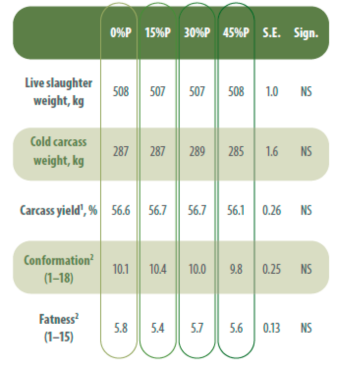
Table 2. Effect of the proportion of peas in the feed on slaughter weight and carcass characteristics.
1 (Cold carcass weight / slaughter weight) × 100
2 Visual assessment (SEUROP classification)
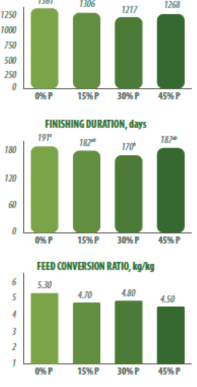
Figure 1. Effect of the proportion of peas in the feed1 on growth, finishing duration, feed intake, and feed conversion ratio.
1 Different letters (a, b) indicate significant differences between treatments (P<0.05).
Regarding ruminal fermentation, although all diets had a similar starch content, pH decreased and total VFA concentrations increased with the rate of pea inclusion (Figure 2).
-
The pH values were within the normal range, far from those considered to cause subacute acidosis (<5.6, Nagaraja and Titgemeyer, 2007).
Individual VFAs showed an increase in propionic acid and a reduction in the acetic:propionic ratio, which tended to be lower in the 30%P diet than in 0%P (1.78 and 2.73, respectively, p=0.07).
-
These results may be attributed to the higher degradability of pea starch compared to soybean and corn (Cerneau and Michalet-Doreau, 1991; Rotger et al., 2006), ingredients whose proportion in the feed decreases as that of pea increases.
Regarding ruminal protein degradation, the concentration of NH3-N increased with pea inclusion (Figure 2).
-
This is in agreement with other studies (Mendowski et al., 2021; Lobón et al., 2022), and is likely due to the fact that pea protein is highly soluble in the rumen and its effective degradability is greater than that of soybean (Pereira et al., 2017).
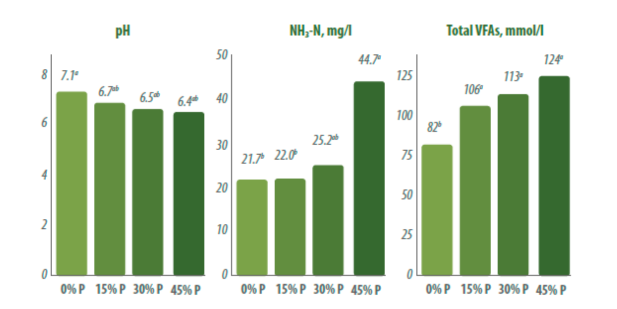
Figure 2. Effect of the proportion of peas in the feed1 on ruminal fermentation patterns (pH and concentration of NH3-N and volatile fatty acids).
1 Different letters (a, b) indicate significant differences between treatments (P<0.05).
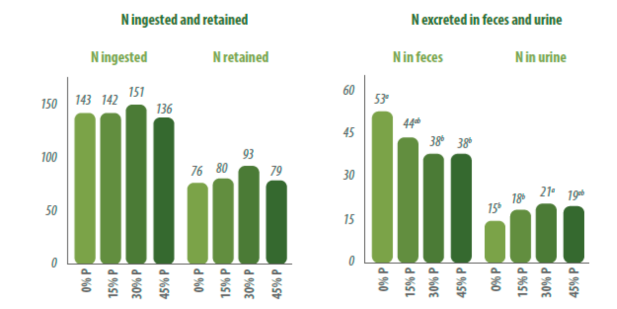
Figure 3. Effect of the proportion of peas in the feed1 on daily intake, fecal and urinary excretion, and N retention.
1 Different letters (a, b) indicate significant differences between treatments (P<0.05).
There were no differences between treatments in intake or N retention (Figure 3),
-
which is consistent with the similar performance and feed conversion ratio observed, and agrees with what has been described in dairy cows (Froidmont and Bartiaux-Thill, 2004; Vander Pol et al., 2008).
However, N excretion decreased in feces and increased in urine proportionally to the rate of pea inclusion (Figure 3).
This would indicate a greater loss of ammonia in the rumen, possibly due to an imbalance between energy and protein supply for microbial growth.
-
This excess ammonia is absorbed and metabolized to urea in the liver, which is released into the bloodstream and mostly lost in the urine (Calsamiglia et al., 2010).
|
As a consequence, there was an increase in plasma urea concentration with pea inclusion, which correlated with ruminal ammonia concentration (r=0.45) and with N excreted in urine (r=0.70). |
This greater elimination of unretained N through urine could have environmental repercussions, due to its higher probability of contaminating air, soil, and groundwater in the form of ammonia, nitrous oxide, and nitrate (Dijkstra et al., 2013).
The economic results (Table 3) indicate that increasing peas in the diets raises feed cost by up to 5%, but did not affect either the total feeding cost or the income from carcass sales (of similar weight and conformation).
Although the 30%P diet showed the best economic result (NS), the margin only varied by 3% between the highest and lowest values.
-
If the cost per unit of protein or energy differs between ingredients, higher costs should be offset by a better feed conversion ratio or a higher selling price (Froidmont and Bartiaux-Thill, 2004), which did not occur under our conditions, with a fixed final weight.
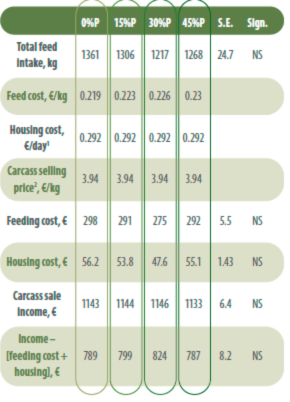
Table 3. Effect of the proportion of peas in the feed on economic performance.
Actual feed, housing, and carcass prices (2017).
1 Calculation based on days on feed
2 Calculation based on carcass weight and conformation (Table 2)
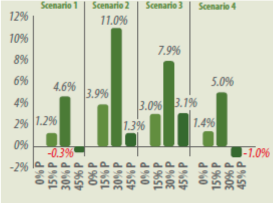
Figure 4. Effect of the proportion of peas in the feed on gross margin in different scenarios1 of ingredient costs.
1 Scenarios: 1. Original (year 2017), 2. Maximum soybean cost (year 2022), 3. Maximum soybean cost/pea cost ratio (year 2021), 4. Minimum soybean cost/pea cost ratio (year 2012).
Finally, the sensitivity analysis in the four scenarios with different relative costs of soybean, peas, and the other ingredients is presented in Figure 4.
-
The inclusion of peas in the diet resulted in a higher gross margin compared to 0%P in almost all scenarios, from the original (1) up to reaching a maximum difference in Scenario 2 (with the maximum soybean cost for 2022).
The profitability of intensive finishing diets is highly sensitive to fluctuations in ingredient prices.
-
Thus, the inclusion of peas is more profitable when soybean meal is expensive, but loses competitiveness when the opposite occurs.
Undi et al. (2024) also identified peas as a competitive alternative to distillers’ dried grains (DDGs),
-
but warned that feed manufacturing companies may be reluctant to replace the most common ingredients if the alternatives do not have a stable supply and price over time.
Although the area dedicated to legume cultivation has grown considerably in the last decade, with Spain leading European pea production, their contribution to the protein market for feed remains very low compared to imported soybean.
|
This generates uncertainty about their competitiveness and availability, which could be significantly reduced through incentives for domestic protein production (Rauw et al., 2023), in line with the European Strategy for a Competitive and Sustainable Bioeconomy (European Commission, 2025). |
In this regard, in addition to their interest for animal feed, the agronomic and environmental benefits of legume cultivation on soil and biodiversity should also be considered.
CONCLUSIONS
Our results indicate that, despite differences in ruminal fermentation and nitrogen utilization patterns, replacing soybean and corn with peas did not affect growth or feed conversion efficiency in finishing calves.
-
Furthermore, they support the economic interest of including up to 30% peas in the feed, although at the cost of increased urinary nitrogen excretion.
|
At the territorial level, it is necessary to assess whether the greater efficiency of pea crops in fixing atmospheric N in soils can offset the increase in N emissions from urine when used in livestock feed. |
Acknowledgements
To the technical staff of CITA in La Garcipollera and Zaragoza and of the FRIBIN meat processing plant (Binéfar). Funding from the projects INIA-RTA2014-00038-C02-01 and LIFE EFACC (contract 101213394) and from the Government of Aragón (INPASS Research Group A25_23R).
References available upon request.