IMPROVING EGG YOLK PIGMENTATION THROUGH BETTER NUTRIENT TRANSPORT
The Role of Phosphatidylcholine in Modern Layer Nutrition
Rahul AVI, DVM MSc, Technical Sales Manager at Nuproxa Group
THE PRACTICAL CHALLENGE
Egg yolk pigmentation is one of the most important quality parameters in egg production. Consumers often associate a deeper and more uniform yolk color with better nutritional value and higher product quality. For this reason, producers commonly add carotenoid pigments to layer diets.
However, in practice, achieving consistent yolk color is not always easy. Even when sufficient pigment is added, variation in yolk color is frequently observed. Increasing pigment inclusion levels often leads to higher feed costs without guaranteeing stable results. This indicates that the challenge is not only related to pigment supply, but also to how efficiently the bird can absorb, transport, and deposit these pigments into the egg yolk.
This becomes even more relevant in long laying cycles, where the liver is working continuously under high metabolic pressure and can increase the risk of fatty liver problems and meaningful variation in yolk color.
THE BIOLOGICAL LIMITATION: PIGMENT TRANSPORT, NOT JUST INTAKE
Carotenoid pigments are fat-soluble compounds. After ingestion, they must be absorbed in the intestine and then transported through the bloodstream to the ovary, where they are deposited into the yolk. This transport depends on lipid metabolism, especially the formation of very-low-density lipoproteins (VLDL) in the liver.
Continua después de la publicidad.
These lipoproteins act as carriers for both lipids and carotenoids. A key molecule in this process is phosphatidylcholine, which is essential for the formation and secretion of VLDL particles.
Without sufficient phosphatidylcholine, lipid and pigment transport becomes inefficient, leading to reduced deposition in the yolk. Therefore, even when pigments are present in the diet, inefficient lipid transport can result in lower carotenoid deposition in the yolk pigmentation performance.
LIMITATIONS OF CHOLINE CHLORIDE IN PIGMENTATION EFFICIENCY
Choline chloride (CC) is widely used in poultry nutrition as a source of choline. However, it presents several practical and metabolic limitations. First, CC is highly hygroscopic and can interact with other components in the premix. This can reduce the stability of sensitive compounds such as carotenoid pigments before the feed is even consumed. Second, CC must be metabolically converted into phosphatidylcholine in the liver.
Under high production conditions, this conversion may not be sufficient to meet the high demand for lipid transport. As a result, pigment utilization may be suboptimal, leading to variability in yolk color and reduced efficiency of pigment use.
SUPPORTING TRANSPORT WITH PHOSPHATIDYLCHOLINE
A more effective strategy is not only to provide choline, but to directly support the biological system responsible for lipid and pigment transport. Natu-B4 is a natural, polyherbal formulation that provides phosphatidylcholine in a bioavailable form.
This enhances the liver’s capacity to form VLDL particles and improves the transport of lipids and carotenoids to the egg yolk. This approach focuses on improving utilization rather than increasing input, allowing better efficiency of both pigments and choline.
TRIAL 1: EFFECT ON EGG YOLK PIGMENTATION (FRANCE, 2025)
A controlled trial with Lohmann layers was conducted over five weeks under intentionally challenging dietary conditions. The diet was composed mainly of horse bean (44.5%), corn (23.4%) and oats (9.4%), both low in natural carotenoids. No natural or synthetic pigments were added to the diet. This created a low pigment baseline diet where the efficiency of pigment utilization would be clearly visible.
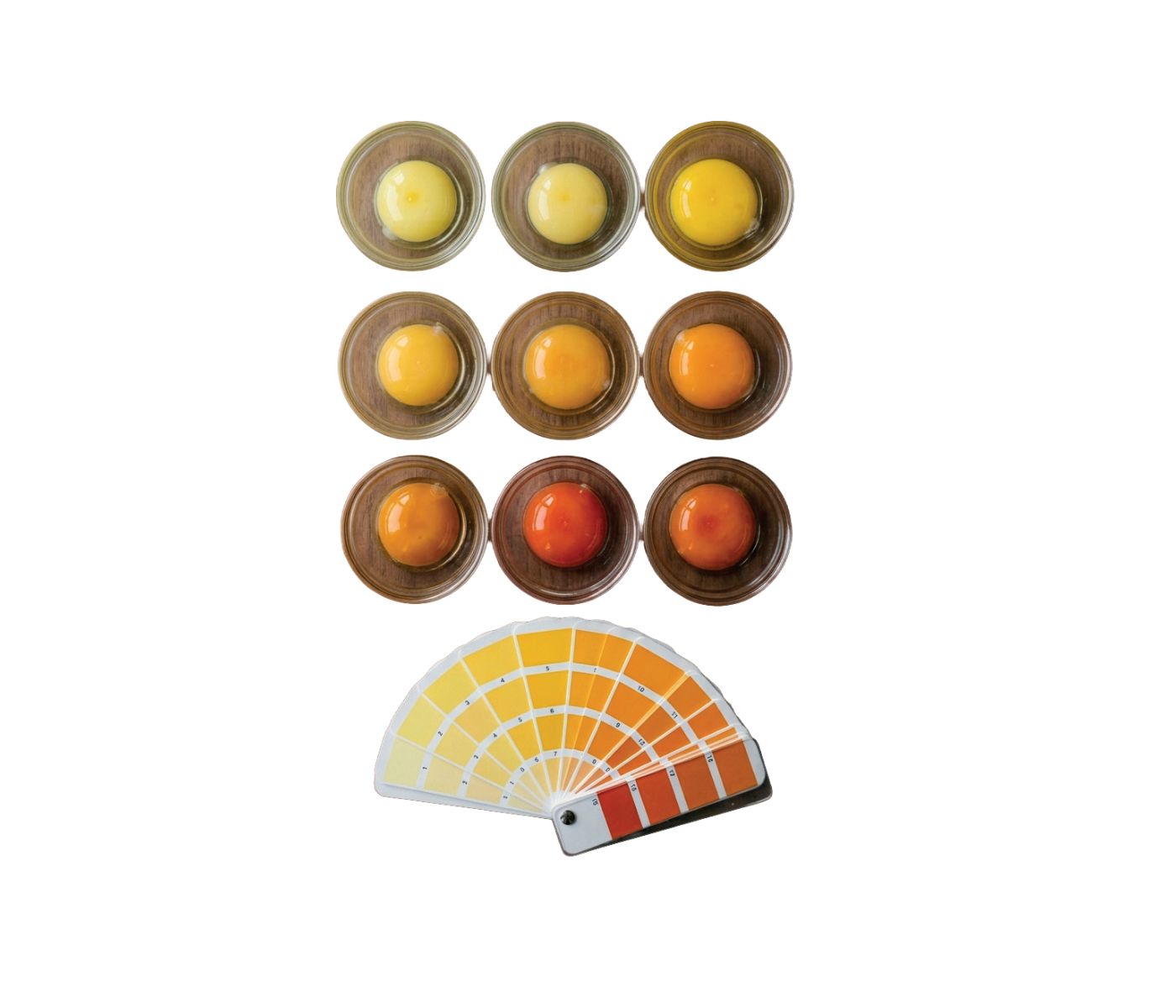
Three groups were compared: an unsupplemented control, a CC group (50%) at 1,200 g/ton and a Natu-B4 group at 200 g/t. Yolk color was scored using the YolkFan™ color. Natu-B4 produced significantly higher yolk color than both other groups, even without any extra pigment in the diet. More surprisingly, the CC group scored lower than the unsupplemented control. This suggests CC may have reduced pigment stability in the premix or negatively affected metabolic pigment utilization in the bird.
Trial 1: France, 2025 (Presented at PSA, 2025)
| Treatment |
Yolk Color Score (YolkFan™) |
| CON- |
6,04b |
| CON+ |
5,24c |
| Natu-B4 |
7,57a |
Note: p < .001. Means with different letters differ significantly.
TRIAL 2: EFFECT ON YOLK CHOLINE AND PIGMENTATION (INDIA, 2026)
A second study used BV300 layers over a 20 week production period with a low pigment diet. This trial went a step further and measured yolk choline concentration alongside yolk color. Three groups were compared: a control with no supplemental choline, a CC group at 1,000 g/t, and a Natu-B4 group at only 200 g/t as a full replacement. Result showed that Natu-B4 consistently improved the colour of the yolk at both measurement points, even at a dose five times lower than that of CC.
Trial 2: India, 2026 (Presented at IPPE, 2026)
| Treatment |
Week 27 Yolk Color |
Week 35 Yolk Color |
| C (Control) |
4,4 |
4,6 |
| T1 (Choline chloride) |
4,4 |
4,6 |
| T2 (Natu-B4) |
4,8 |
5 |
While these results are promising, it is also important to consider them in the context of the specific conditions under which these trials were conducted. Further research needed with different genetic lines, production environments and dietary formulations would help to better define the practical scope of this approach.
CONCLUSION
In modern layer production, achieving consistent yolk pigmentation requires more than just adding pigment to the diet. The efficiency of pigment utilization depends strongly on liver metabolism and lipid transport capacity. Supporting phosphatidylcholine availability through functional nutrition is a practical and evidence-based strategy to improve both pigmentation efficiency and overall yolk quality. The results presented here confirm that this approach can deliver measurable improvements under both short-term and long-term production conditions.
From a commercial perspective, this also offers a real opportunity to optimize pigment costs. When the bird’s transport system works well, the existing dietary pigments are used more efficiently means producers do not always need to increase inclusion levels to achieve a target yolk color score.
The use of polyherbal phosphatidylcholine, such as Natu-B4, represents an interesting nutritional strategy and one that merits further consideration in this context. According to the available trial data, it appears to offer a significant advantage in terms of lipid transport efficiency and could be a viable alternative approach to pigments or conventional choline supplementation for improving yolk pigmentation.
In modern layer nutrition, the pigmentation challenge is not simply how much carotenoid enters the diet, but how efficiently the bird can absorb, transport and ultimately deposit those pigments into the yolk.