Understanding phytogenic feed additives and their potential
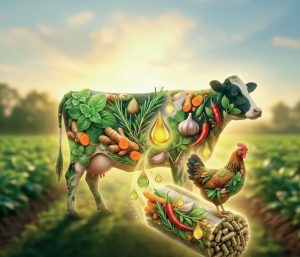
Phytogenic feed additives are plant-derived products designed to support animal health, improve productivity, and enhance sustainable livestock production through the power of phytotechnology.
Introduction
Phytotechnology consists of applying plant-related scientific knowledge to discover and develop solutions for existing challenges in animal production.
Phytochemicals are chemical compounds naturally produced by plants (metabolites) with biological effects, while phytocomplexes are combinations of multiple phytochemicals within a plant or product.
Finally, phytogenics are products derived from plants (botanicals) through phytotechnology that contain these bioactive compounds.
More specifically, phytogenic feed additives are products of plant origin added to animal diets for specific nutritional, productive, or health-supporting purposes.
Why They Matter
Phytogenics are not simply “natural alternatives” — they are strategic nutritional tools capable of improving resilience, supporting biological functions, and enhancing production efficiency.
Where Does the Concept Come From?
The use of plant materials has a long history in both human nutrition and medicine as:
- Flavors and spices
- Food preservatives
- Basic nutrition sources
- Traditional medicine and health promotion
These applications have been accepted worldwide for centuries, and most of the global population still relies on plants for primary or supportive healthcare.
Scientific knowledge has grown significantly in recent decades, supported by peer-reviewed research focused on understanding benefits and modes of action.
As the field evolves, new phytogenic feed additives will continue to emerge and gain importance across modern animal production systems.
The Different Types of Phytogenics
In general, phytogenics can be divided into several main categories:
Whole Plant or Plant Part Extracts
Commonly known as herbs and spices, these products usually consist of dried and finely ground plant materials such as roots, seeds, bark, flowers, stems, and leaves.
Plant extracts are substances removed from plant tissues for specific applications and are often rich in several phytochemicals, forming a phytocomplex.
Extraction methods range from traditional maceration to advanced technologies such as:
- Microwave-assisted extraction
- Ultrasound-assisted extraction
- Supercritical fluid extraction
These techniques aim to improve yield, consistency, and cost-efficiency.
Essential Oils, Oleoresins and Natural-Identical Compounds
Important phytogenic categories also include:
- Essential oils — aromatic liquid substances containing multiple volatile phytochemicals
- Oleoresins — semi-solid mixtures of essential oils and natural resins
- Phytochemical extracts — purified extracts of specific bioactive compounds
- Natural-identical compounds — synthetic laboratory-produced copies of naturally occurring phytochemicals
Since plant variety, climate, cultivation, and processing directly affect phytochemical composition,
standardization, quality control, and formulation consistency are critical.
“Not all plants — or even the same plant grown differently — deliver the same phytochemical profile.”
How Do Phytogenics Work?
Phytogenics can provide a wide range of beneficial biological effects, including:
- Antioxidative effects
- Anti-inflammatory effects
- Antimicrobial activity
- Neuromodulatory responses
- Digestive enhancement
- Immune modulation
Their effects depend on both the qualitative composition and the quantitative concentration of active compounds.
Biological responses are often not linear—more is not always better. In many cases, responses follow a
quadratic dose-response, and effects can vary significantly between animal species.
Science-Based Application
Modern phytogenic use should be based on mode of action, dose-response understanding, and species-specific precision rather than trial-and-error decisions.
Do Phytogenics Have Antimicrobial Properties?
The short answer is: yes.
Many phytochemicals show antimicrobial effects in vitro against potential pathogens. However, this does not mean phytogenics should be considered
alternatives to antibiotics.
In vitro conditions do not accurately represent in vivo conditions, and in-feed inclusion levels are usually much lower than concentrations tested in laboratory studies.
Phytogenics should not be used as therapeutic agents, but rather as tools to support:
- Animal resilience
- Immune competence
- Biological balance
- Gut health
- Productivity and efficiency
Potential Applications in Animal Production
Modern animal production faces complex multifactorial challenges that rarely have simple “silver-bullet” solutions.
Phytogenics work best as part of broader preventive strategies targeting underlying disruptions before clinical problems appear.
Some potential applications include:
- Appetite and feed intake modulation
- Behavioral and stress modulation
- Digestive function support
- Intestinal health and microbiome balance
- Antioxidant protection
- Immune modulation
- Reproductive performance
- Embryonic development
- Passive immunity improvement
- Lactation performance
- Meat quality and carcass traits
- Reduction of ammonia and methane emissions
Main Challenges for Phytogenics
The potential is enormous, but several obstacles still limit broader adoption:
- Human resistance to change and skepticism
- Variability in plant raw materials
- Supply chain and manufacturing consistency
- Lack of standardized formulations
- Regulatory approval complexity across regions
- Misguided expectations created by positioning phytogenics as antibiotic replacements
Overcoming these challenges will determine whether the full potential of phytogenics can be realized across global animal production.
Conclusion
Phytogenic feed additives represent one of the most promising areas of innovation in modern animal nutrition.
Their diversity of applications, combined with advances in science, technology, and regulation, positions them as increasingly valuable tools for improving animal resilience, health, and production efficiency.
Final Perspective
Phytotechnology is still in its early stages, but its potential is enormous. The future of animal production will increasingly depend on how well we understand and apply these powerful plant-derived solutions.
🔒 Contenido exclusivo para usuarios registrados.
Regístrate gratis para acceder a este post y a muchos más contenidos especializados. Solo te llevará un minuto y tendrás acceso inmediato.
Iniciar sesiónRegístrate en nutriNews
REGISTRARME