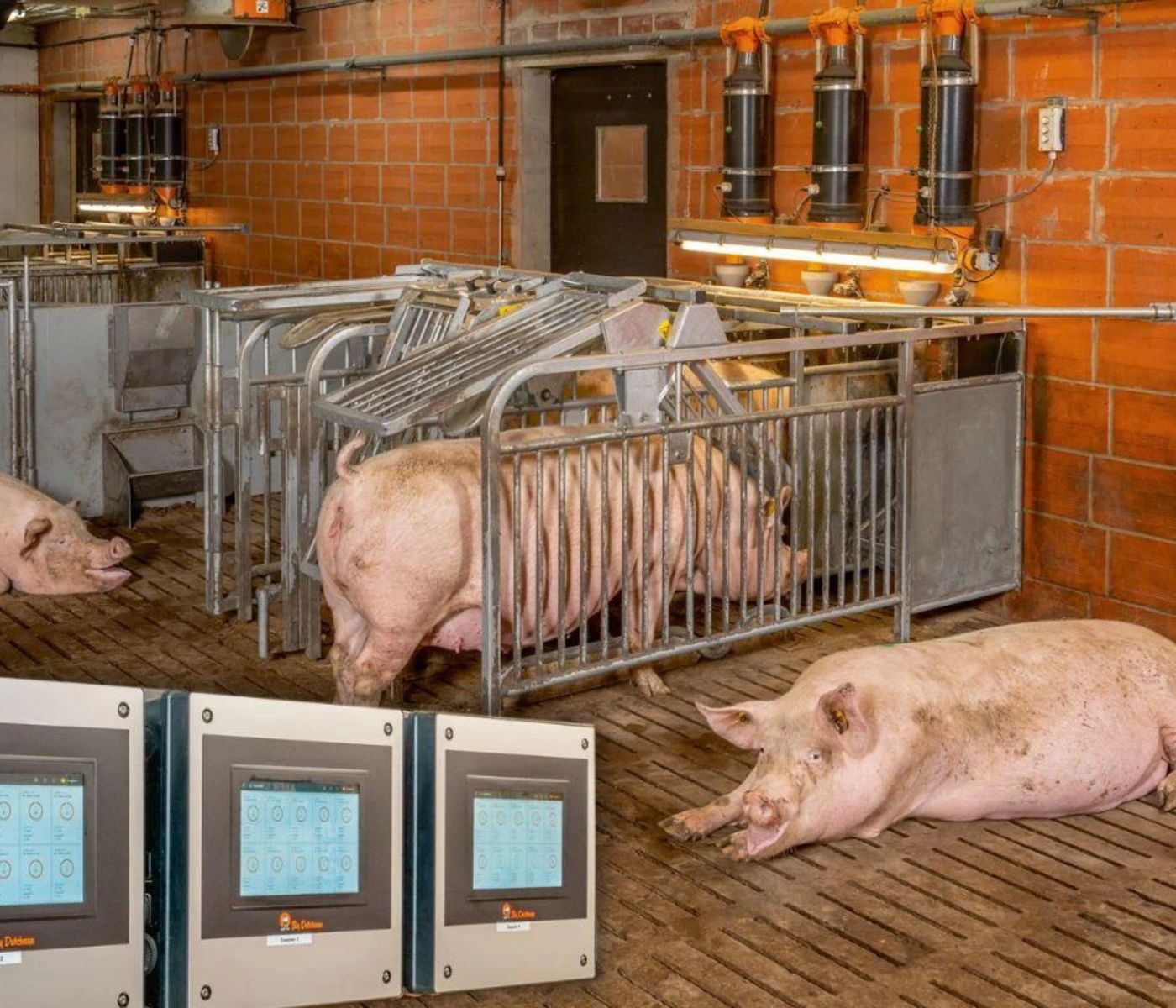
Electronic sow feeding (ESF) systems are opening new opportunities for precision nutrition and data-driven management in commercial pig production. While these technologies are primarily used to deliver individual feed allowances to group-housed gestating sows, the information they collect could offer valuable insights into feeding behavior, animal welfare and herd management.
A recent study published in the Irish Veterinary Journal examined feeding records from gestating sows to identify behavioral patterns and investigate their associations with parity and reproductive performance.
The findings, also highlighted in a recent
Pig Progress / Food & Agribusiness
article, suggest that ESF data may provide additional management information beyond daily feed intake, although further research is needed before these records can be used as validated indicators of health or reproductive outcomes.
KEY INSIGHT
Electronic sow feeding systems can provide information on feeding time, station preference, visit frequency and feeding order, creating opportunities for more individualized monitoring of gestating sows.
From Automated Feeding to Precision Sow Management
Electronic sow feeding systems use individual identification technologies, typically radio-frequency identification (RFID), to recognize animals as they enter a feeding station.
The system then delivers a predetermined feed allowance according to the sow’s individual feeding curve, which can be adjusted based on gestation stage, parity, body condition and nutritional requirements.
According to the
University of Pennsylvania School of Veterinary Medicine,
individualized feeding allows producers to better align feed allocation with the changing nutritional needs of gestating sows.
This approach can support body condition management and feed utilization while maintaining the benefits of group housing.
However, ESF systems also generate records of individual animal activity, including when each sow visits a feeder, how often it enters, and whether its daily feed allowance has been consumed.
These records provide an opportunity to move from simple feed delivery toward precision livestock monitoring.
What Did the 2026 Research Investigate?
Researchers from Teagasc, the University of Lisbon, Scotland’s Rural College and University College Dublin examined feeding patterns in group-housed gestating sows using electronic feeding systems.
The study, published by Ornelas and colleagues in the Irish Veterinary Journal, analyzed 15 weeks of feeding records from 276 sows housed in a dynamic group.
The researchers evaluated several aspects of feeding behavior, including:
- Feeding station visits: How frequently animals entered the feeding system.
- Non-nutritive visits: Entries that did not result in feed consumption.
- Feeding time: When animals consumed their daily allowance.
- Feeding order: Which sows accessed the feeding stations earlier or later.
- Station preference: Whether individual sows repeatedly selected particular feeders.
- Parity and reproductive performance: How feeding patterns varied with sow age and selected reproductive outcomes.
The objective was to determine whether feeding data contained recognizable behavioral patterns that could eventually support on-farm decision-making.
STUDY AT A GLANCE
- Study population: 276 group-housed gestating sows analyzed
- Monitoring period: 15 weeks of feeding records per sow
- Housing: Dynamic group with electronic feeding stations
- Main variables: Feeding visits, timing, order, station preference and parity
- Additional objective: Explore associations with reproductive performance
Most Feeding Station Visits Did Not Involve Feed Consumption
One of the most interesting findings concerned the frequency of visits that did not result in feed consumption.
The researchers found that approximately 60% of feeding station visits were non-nutritive.
At the same time, sows consumed their daily feed allowance predominantly during a single feeding visit, with this pattern observed in approximately 98.3% of individual feeding cycles.
These findings suggest that the number of visits to a feeding station should not be interpreted as a direct measure of feed consumption.
Additional visits may reflect feeding motivation, access patterns or other aspects of individual behavior.
The researchers also observed that non-nutritive visits became less frequent as gestation progressed and with increasing parity.
This reinforces the importance of accounting for gestation stage and parity when interpreting behavioral information.
RESEARCH FINDING
Approximately 60% of feeder visits did not involve feed consumption, while daily rations were consumed predominantly in one visit. Visit frequency alone is therefore not a reliable indicator of how much feed a sow has eaten.
Feeding Time and Order Reveal Individual Behavioral Patterns
The study also identified differences in when sows accessed electronic feeding stations.
Feeding activity was concentrated during the first half of the feeding cycle, although individual animals showed distinct feeding schedules.
Some sows consistently accessed feeders earlier, while others tended to feed later.
Importantly, feeding order remained relatively stable over time despite the dynamic nature of the group.
Parity was associated with feeding order. The odds of being among the first 15% of sows to eat increased with each additional parity, with a reported odds ratio of 2.16.
These results indicate that feeding behavior is not randomly distributed across animals and may reflect stable individual characteristics.
Why does this matter for producers?
Recognizing an individual sow’s normal feeding schedule could help producers identify unexpected changes in behavior.
For example, a sow that normally accesses the feeder early but begins feeding much later may warrant closer observation, particularly if the change occurs alongside reduced intake or altered activity.
However, a change in feeding time is not, by itself, evidence of disease or compromised welfare. Such observations should be interpreted alongside clinical assessments and other management information.
Do Sows Prefer Particular Feeding Stations?
Another important finding was the consistency of individual feeding station preferences.
The industry report indicated that sows selected their preferred station for approximately 89.2% of feeding visits, on average.
The peer-reviewed study also identified strong individual preferences and associations between station use, parity and feeding behavior.
This suggests that station choice may represent an additional behavioral characteristic worth monitoring.
From a management perspective, an unexpected change in station preference could justify checking feeder functionality, access conditions or animal behavior.
Nevertheless, the study did not establish that a change in station preference can reliably diagnose health or welfare problems.
Can Feeding Behavior Predict Reproductive Performance?
Beyond describing feeding patterns, the researchers investigated associations with reproductive performance.
The peer-reviewed study reported an association between average feeding time and pre-weaning piglet mortality.
However, the results should be interpreted carefully. The accompanying industry report notes that when parity and feeding time were considered together in a multivariable analysis, parity remained the statistically significant factor.
This distinction is important because older sows may differ from younger animals in both feeding behavior and reproductive outcomes.
Consequently, the observed associations do not demonstrate that feeding earlier or later directly influences piglet survival.
The study also did not establish consistent associations between feeding time and outcomes such as total piglets born alive or average birth weight.
IMPORTANT SCIENTIFIC DISTINCTION
Associations between feeding behavior and reproductive outcomes do not establish causation. Parity and other animal-level characteristics must be considered before using ESF records to predict reproductive performance.
How Can ESF Data Support Precision Sow Nutrition?
Although the study focused primarily on behavioral patterns, its findings have important implications for precision feeding strategies.
ESF systems already allow producers to adjust individual feed allowances according to gestation stage and animal requirements.
According to the University of Pennsylvania, this flexibility can help maintain appropriate body condition and improve feed utilization.
When feeding records are combined with other management information, such as body condition scores, weight, parity and reproductive history, they may support more individualized nutritional decisions.
Potential applications include:
- Individual feeding curves: Adjusting feed allocation to meet changing requirements during gestation.
- Body condition management: Identifying animals that may require nutritional adjustments.
- Feed intake monitoring: Detecting animals that repeatedly fail to consume their allocated ration.
- Behavioral monitoring: Recognizing deviations from individual feeding patterns.
- Herd management: Integrating feeding records with reproductive and health information.
These applications highlight the potential of ESF systems to support more precise nutritional management, although the effectiveness of specific monitoring approaches must be validated under commercial conditions.
From Data Collection to Practical Farm Decisions
The availability of feeding data does not automatically translate into improved management.
For ESF information to become useful, producers need systems that transform large volumes of records into clear, actionable information.
The researchers emphasized that further work is needed to improve the interpretation and presentation of feeding records for practical farm use.
Rather than relying exclusively on total feed intake, future monitoring tools could incorporate individual behavioral baselines and account for normal variation associated with parity and gestation stage.
Potential applications include alerts for unusual feeding patterns, identification of animals requiring observation and improved integration between feeding and herd management software.
However, these tools should support rather than replace routine animal inspections.
Management and training remain essential
The
University of Minnesota Extension
emphasizes the importance of appropriate animal training, facility management and feeding system selection in group-housed sow production.
Likewise, the University of Pennsylvania highlights the role of staff training and daily management in successful ESF implementation.
Technology can improve the availability of information, but its value ultimately depends on how that information is interpreted and used.
PRACTICAL PRIORITIES FOR ESF MANAGEMENT
- Review daily feed intake and missed-feeding alerts.
- Consider parity and gestation stage when interpreting records.
- Investigate persistent changes in individual feeding patterns.
- Check feeder access, identification tags and equipment function.
- Combine digital information with direct animal observation.
- Train staff to interpret feeding data and respond appropriately.
What Are the Main Limitations?
Despite the potential of ESF systems, several challenges remain.
First, the 2026 study was observational. It identified patterns and associations but did not test whether interventions based on those patterns improve health, welfare or reproductive performance.
Second, feeding behavior may vary according to farm design, stocking density, group composition, feeding station availability and management practices.
Third, commercial implementation requires reliable animal identification, regular equipment maintenance and staff capable of responding to alerts.
Finally, the large quantity of data generated by ESF systems can become difficult to interpret without appropriate analytical tools.
Further research is needed to determine which behavioral indicators provide reliable and economically useful information under different commercial conditions.
Looking Ahead: Making Better Use of Electronic Feeding Data
Electronic sow feeding systems offer more than automated feed allocation.
By recording individual feeding activity, they create opportunities to better understand sow behavior and support more individualized management.
The 2026 research demonstrates that gestating sows exhibit recognizable patterns in feeding time, station preference and visit frequency, with important differences associated with parity and gestation stage.
However, these findings should not yet be interpreted as validated tools for diagnosing health problems or predicting reproductive outcomes.
For pig producers, the greatest opportunity lies in combining precision feeding technology with sound nutritional management, careful animal observation and better use of existing farm data.
FINAL TAKEAWAY
The next step for electronic sow feeding is not simply collecting more information, but turning existing feeding records into practical, scientifically validated tools for precision nutrition and herd management.
Sources and Further Reading
- Ornelas, M. A. S., Garcia Manzanilla, E., Nunes, T., & Rodrigues da Costa, M. (2026).
Electronic sow feeding: characterizing feeding patterns of gestating sows and their associations to reproductive performance.
Irish Veterinary Journal, 79, 25. - Azarpajouh, S. (2026, October 21).
How to make more use of ESF systems at pig farms.
Pig Progress / Food & Agribusiness. - University of Pennsylvania School of Veterinary Medicine.
Electronic Sow Feeding.
- University of Minnesota Extension.
Group Sow Housing.
- Ontario Ministry of Agriculture.
Group Housing Systems for Gestating Sows.
🔒 Contenido exclusivo para usuarios registrados.
Regístrate gratis para acceder a este post y a muchos más contenidos especializados. Solo te llevará un minuto y tendrás acceso inmediato.
Iniciar sesiónRegístrate en nutriNews
REGISTRARME