Home » From Fruit Waste to Feed: Persimmon Peel Shows Potential in Goat Diets
 02 Oct 2026
From Fruit Waste to Feed: Persimmon Peel Shows Potential in Goat Diets
Turning agricultural and food-processing by-products into livestock feed is becoming an increasingly important part of the search for more circular and resource-efficient animal production systems. New research suggests that dried persimmon peel could be one such ingredient.
A study published in Animal Nutrition evaluated whether dried persimmon peel (DPP) could partially replace corn in diets for goats while maintaining nutrient utilization and animal performance.
The researchers first tested different inclusion levels using an in-vitro rumen fermentation system. They then selected the most promising level for an in-vivo trial with Guanzhong dairy goats.
KEY FINDING
Replacing 20% of the corn with dried persimmon peel did not negatively affect dry matter intake, average daily gain or apparent total-tract nutrient digestibility in goats. In the preceding in-vitro experiment, the same replacement level also reduced methane production per gram of digestible dry matter.
Why persimmon peel?
The livestock industry faces a dual challenge: maintaining productive and economically viable feeding systems while reducing competition for conventional feed resources and limiting environmental impacts.
At the same time, large quantities of agricultural and food-processing residues are generated every year. Using suitable by-products as feed ingredients can potentially recover nutritional value from materials that might otherwise be discarded while reducing reliance on conventional ingredients.
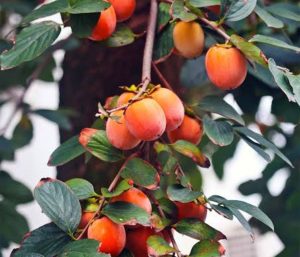
Persimmon processing generates substantial quantities of peel. Rather than treating this material solely as waste, the researchers investigated whether dried persimmon peel could become a useful ingredient in ruminant diets.
FROM BY-PRODUCT TO FEED INGREDIENT
The study reflects a broader principle in circular animal nutrition: food and agricultural by-products can potentially be redirected into livestock diets when their nutritional characteristics, safety and effects on animal performance are adequately evaluated.
First step: testing persimmon peel in vitro
The researchers began with an in-vitro batch fermentation experiment to determine an appropriate inclusion level before moving into animals.
Four total mixed rations were evaluated in which dried persimmon peel replaced:
The objective was to determine how increasing substitution affected rumen fermentation, nutrient digestibility and methane production.
Replacing 20% of the corn with dried persimmon peel reduced methane production expressed per gram of digestible dry matter (P = 0.042), while dry matter digestibility was not adversely affected (P = 0.708).
An important distinction: the reduction in methane was observed in the in-vitro fermentation experiment. The subsequent feeding trial did not directly measure methane emissions from the goats.
Based on these results, the researchers selected the 20% corn-replacement level for the in-vivo phase.
Testing the strategy in goats
The animal trial involved 12 first-parity, non-lactating Guanzhong dairy goats, approximately 22 months old and with an initial body weight of 53.29 ± 1.92 kg.
The goats were divided into two groups, with six animals per treatment:
MDPP
Diet in which 20% of the corn in the basal ration was replaced with dried persimmon peel on an air-dried basis.
The experiment lasted 35 days, consisting of a 28-day feeding period followed by a seven-day digestion and metabolism trial.
Performance and digestibility were maintained
One of the most practically relevant findings was what did not change.
Replacing 20% of the corn with dried persimmon peel had no significant effect on dry matter intake, average daily gain or apparent total-tract digestibility compared with the control diet.
Under the conditions of the trial, replacing one-fifth of the dietary corn with dried persimmon peel maintained feed intake, growth and apparent nutrient digestibility.
This is an important consideration when evaluating alternative feed ingredients. A by-product may offer environmental or economic advantages, but its practical value is limited if inclusion compromises nutrient utilization or animal performance.
Changes in blood antioxidant and metabolic indicators
The researchers also examined several serum biochemical and antioxidant indicators.
Goats receiving the dried persimmon peel diet had significantly lower serum creatinine concentrations (P = 0.012) and significantly higher catalase activity (P = 0.046).
Several additional parameters showed statistical tendencies rather than significant differences. Aspartate aminotransferase (AST; P = 0.068), the AST-to-ALT ratio (P = 0.073), and blood urea nitrogen (P = 0.076) tended to be lower in goats receiving dried persimmon peel.
INTERPRETING THE RESULTS CAREFULLY
The changes with P-values above 0.05 were reported as trends rather than statistically significant effects. They should therefore not be interpreted as definitive improvements in liver or nitrogen metabolism.
Rumen fermentation also responded
Including dried persimmon peel altered some aspects of rumen fermentation.
The concentration of valerate increased significantly when 20% of the corn was replaced with DPP (P = 0.034).
Meanwhile, ruminal acetate concentration (P = 0.079) and the acetate-to-propionate ratio (P = 0.094) showed tendencies to increase.
These changes suggest that the alternative ingredient can influence the rumen fermentation environment even when overall intake, growth and apparent digestibility remain unchanged.
Changes in the rumen microbial community
The researchers also identified differences in specific bacterial groups between goats receiving the control and dried-persimmon-peel diets.
LEfSe analysis showed significantly greater relative abundance of g_Izemoplasmatales, g_Moryella and g_Lachnoclostridium in goats fed the DPP-containing diet.
Conversely, the relative abundance of g_Eubacterium_ventriosum_group, g_Candidatus_Saccharimonas, g_Tyzzerella and g_Clostridia_UCG_014 was significantly lower compared with control goats.
These results demonstrate that replacing part of the corn with dried persimmon peel altered the rumen microbial ecosystem. Further research would be needed, however, to determine the functional importance of individual microbial shifts and their contribution to fermentation or animal metabolism.
What about methane mitigation?
The methane finding is particularly interesting from a sustainability perspective, but it requires careful interpretation.
During the initial laboratory fermentation experiment, the 20% replacement treatment reduced methane production relative to digestible dry matter without compromising dry matter digestibility.
This suggests that compounds or nutritional characteristics of dried persimmon peel could potentially influence pathways associated with methanogenesis.
The study supports methane-mitigation potential—not yet demonstrated methane reduction in live goats. Direct respiration or emission measurements in animals would be needed to confirm whether the in-vitro response translates into lower enteric methane emissions under commercial feeding conditions.
A circular approach to ruminant nutrition
The broader significance of the research lies in the possibility of combining feed-resource efficiency with environmental objectives.
Using persimmon-processing residues as livestock feed could potentially create value from an agricultural by-product while partially replacing a conventional energy ingredient such as corn.
At the same time, the observed in-vitro methane response raises the possibility that certain by-products could contribute not only to circularity but also to strategies aimed at reducing the environmental footprint of ruminant production.
However, moving from an experimental feeding trial to widespread practical use requires additional considerations, including ingredient availability, consistency, processing and drying costs, storage, nutrient variability, safety and economic competitiveness.
What can producers take from the study?
The results provide promising evidence that dried persimmon peel can replace part of the corn in goat diets without compromising key productive and digestive outcomes.
Under the conditions evaluated, replacing 20% of corn maintained dry matter intake, average daily gain and apparent total-tract digestibility while producing changes in rumen fermentation, microbial composition and selected metabolic indicators.
The in-vitro phase additionally identified potential for methane mitigation, although this effect still needs to be demonstrated directly in animals.
Taken together, the findings position dried persimmon peel as a promising example of how food-processing by-products could contribute to more circular ruminant feeding systems—provided that nutritional value, economics and environmental benefits can be confirmed under larger-scale production conditions.
Source
Zhang, X., Yin, Q., Hui, J., Wu, A., Zhu, Y., Balasubramanian, B., Ge, G., Yang, J., Liu, Z., Deng, L., Yao, J., & Lei, X. (2026). Dried persimmon peel as a sustainable feed ingredient for goats: Effects on nutrient digestion, energy-nitrogen metabolism, and methane mitigation. Animal Nutrition, 26, 71–84. DOI: 10.1016/j.aninu.2025.12.009.