28 Sep 2026
One major strength of USSEC’s Soy Connext global conference is extending the experience beyond meeting rooms and into soybean fields, grain terminals and export facilities.
Many international attendees participate in trade team tours immediately before or after Soy Connext. This year, 19 teams of soybean buyers and supply chain members visited farms and supply chain facilities across the US. These tours allow customers to see and experience the depth and strength of the US Soy supply chain.
Plus, hosting Soy Connext in Chicago, in the heart of the US Midwest, also allowed USSEC and the Illinois Soybean Association to host about 430 international attendees on three nearby farms.
These farm visits, held simultaneously on August 4, 2026, provided first-hand looks at the current soybean crop. That perspective grounded conversations throughout the conference.


A Soy Connext attendee documents the condition of the soybean crop at an Illinois farm during the farm tour.
Awareness on the farm


Soy users want to know where their inputs come from, and US farmers enjoy telling their stories and answering customer questions.
“Soy Connext offered a fantastic opportunity to showcase what we do and share our passion as farmers,” said Steve Pitstick, a farmer from Elburn, Illinois, who hosted attendees from the Americas, China, Morocco, Saudi Arabia and Nigeria at a family farm.
“I am always open to showing customers what we do, how we do it and why. We discussed sustainable production, cost structure, fertilizer prices, crop rotation and more.”
Each location featured panel discussions on topics including diverse soy uses, sustainability and handling practices. In addition, visitors spent time in fields, exploring equipment and talking with local farmers.
“After visiting customers in the Middle East and Southeast Asia, I recognize the value of face-to-face conversations between buyers and sellers,” said Ryan Frieders, a Waterman, Illinois, farmer.
He and his family welcomed Soy Connext attendees from Algeria, Europe, Japan, Tunisia, South Korea and others to their farm.
“In person, we can talk about needs and solutions, and customers can see for themselves how we produce and handle their raw materials,” he said.
The farms near Chicago represented soybean production for much of the Midwest, but some trade team agendas included farm visits in other states.
Those participants experienced the diversity in US soybean production, which contributes to the reliability of the supply of US soy products. Several farmers hosting those visits also attended the conference in Chicago, strengthening relationships.
“To have a meaningful exchange and lasting growth, you have to have relationships,” said Jeff O’Connor. His farm in Kankakee, Illinois, hosted participants from throughout Asia, including China, India, Indonesia, Japan, Korea, Nepal, Sri Lanka and more.
“I invited a couple neighboring farmers to be part of our farm tour, because talking with customers is part of our own education as farmers.”

Illinois farmer Steve Pitstick shows Soy Connext attendees his grain handling and storage system, the first step in moving soybeans from the field to customers around the world.
Insights along the supply chain
Trade team tours highlighted links in the supply chain between soybean fields and loading soy products for export.
That journey often starts with on-farm grain handling and storage, highlighted by Pitstick, Frieders and O’Connor on their Illinois farms and by others across the country.
Host farmers shared the typical routes their soybeans take for export, whether that be whole commodity soybeans, soybean meal crushed locally or identity-preserved soybeans shipped via bags and containers.
Those steps often take US soybean through local grain elevators that aggregate area production for shipping via train or river toward US ports. US soybean meal and other soy products add stops for crushing and processing, as well.
The trade team tours linked to Soy Connext included various combinations of these supply chain links. Participants saw first-hand the facilities that load soy into train cars and river barges.
They met with export companies that manage sales and shipping companies that manage logistics. Members of the soy supply chain demonstrated how soybean and soy product quality is preserved and protected at every step.
Some trade teams visited seed companies, learning how soybean quality and yield potential starts before farmers plant their crop. Several trade teams visited research facilities and institutions that demonstrated efforts to continuously improve US soybeans and soy products.
USSEC worked with members and partners to customize these tours for each group, building confidence in the value US Soy brings to their businesses.

Illinois farmer Jeff O’Connor explains to Soy Connext attendees how his soybeans can move out of the state and toward ports for export.
Understanding export infrastructure
Soy Connext trade team tours also showcased the US advantage of multiple shipping points. In Illinois, Pitstick and Frieders usually rely on the Illinois River, which flows into the Mississippi River. While that is an option for O’Connor, discussions at his farm described options for loading containers.
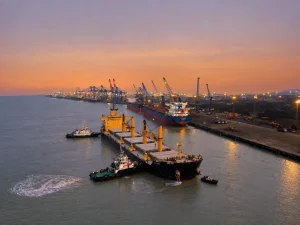
Several international groups started their visit to the US by celebrating the opening of a soybean meal shipping terminal at the Port of Grays Harbor, Washington. The Pacific Northwest location will help meet the needs of many customers throughout Asia and beyond.

Some Soy Connext participants began their trip to the U.S. at the grand opening celebration for an AGP terminal for soybean meal at the Port of Grays Harbor, Washington.
Some trade teams visited facilities in Louisiana, where the Mississippi River meets the Gulf of Mexico. This region continues to ship the largest percentage of US Soy exports.
Others explored less traditional port facilities that offer specific advantages to their regions. A team of attendees from France, Italy, Portugal and Spain visited the Port of Milwaukee in Wisconsin, along Lake Michigan.
They discussed potential benefits of shipping soy products through the Great Lakes and the St. Lawrence Seaway. The Port of Virginia on the Atlantic Ocean hosted a group from Türkiye.
Regardless of where they traveled before or after Soy Connext, customers gained invaluable first-hand insight into the soy supply chain in the US, from farms across the country to relevant ports. Combined with what they learned during the conference, attendees returned home with bright ideas and connections to capitalize on the full value of US Soy.

Subscribe now to the technical magazine of animal nutrition
AUTHORS
From 2025 Data to 2026 Decisions: Managing Mycotoxin Risk in a Changing Climate
Alterion® NE Celebrates 10 Years of Poultry Gut Health Innovation

The Science Behind Kolin Plus: Beyond Choline Replacement
Summer Infertility in Sows: Managing Heat Stress and Reproductive Performance
AO-Biotics® Amaferm®: Supporting Livestock Digestion and Performance

Interview with Güner Gövenç
Güner Gövenç,
Net Energy and Precision Feeding Shape the Future of Poultry Nutrition
Edgar Oviedo
Mycotoxins in Swine: Health Risks and Nutritional Solutions
Giuseppe Carcò
Mycotoxins and Piglet Ear Necrosis: Cause, Cofactor or Coincidence?
Alberto Morillo
How Mycotoxins Affect Intestinal Health in Pigs and Poultry
Marcos Rostagno
From Antibiotics to Functional Feeds in Aquaculture
Babatunde Saliu
Peas as an Alternative to Soybean Meal in Beef Cattle Finishing Diets
Daniel Villalba Mata,
Improving Egg Yolk Pigmentation Through Better Nutrient Transport

Aquaculture and Aquaponics Nutrition: How Fish Shape the Growth of Greens
Trenton Corby
Consistency in Soybean Meal Drives Performance and Sustainability