Home » Queensland Targets Feed Innovation with FutureFeed & New Protein Opportunities
 19 Aug 2026
Queensland Targets Feed Innovation with FutureFeed & New Protein Opportunities
Queensland targets feed innovation with FutureFeed and new protein opportunities
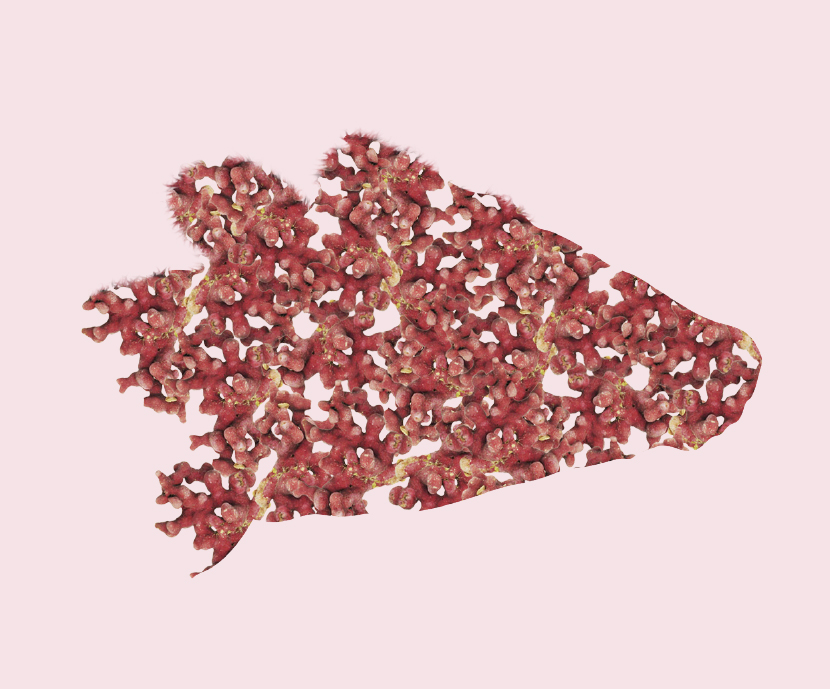
Queensland is positioning its agricultural sector as a destination for investment in new feed technologies, sustainable livestock production and alternative ingredient development. One of the opportunities showcased through the state’s Global AgInvesting program is FutureFeed, the Australian-developed technology using Asparagopsis seaweed to reduce methane emissions from ruminants.
At the same time, Queensland’s broader agricultural investment strategy highlights opportunities in future foods, plant-based proteins, AgTech and higher-value agricultural processing. Together, these areas illustrate how feed innovation is expanding beyond conventional commodity sourcing toward technologies that can improve productivity, resilience and environmental performance.
For Queensland, the opportunity is not simply to produce more feed ingredients, but to develop technologies and value chains that make livestock production more efficient, resilient and lower-emission.
FutureFeed puts methane reduction at the center
FutureFeed is based on research originally developed by CSIRO, Meat & Livestock Australia and James Cook University. The company holds global intellectual property covering the use of Asparagopsis seaweed as a livestock feed ingredient.
Queensland’s Department of Primary Industries currently lists the technology as an investment and licensing opportunity under its Global AgInvesting program. The offering focuses on a technology package available for non-exclusive licensing, with the potential to expand commercial production and adoption of methane-reducing feed ingredients.
Research underpinning FutureFeed has shown that appropriately formulated Asparagopsis products can reduce enteric methane emissions from ruminants by 80% or more under suitable feeding conditions.
The ingredient works through naturally occurring compounds in the seaweed that interfere with a key step in methane formation in the rumen. Products can be delivered in forms including dried meal or an oil carrier, allowing incorporation into feeding programs for beef and dairy cattle.
Why feed innovation matters
Livestock producers are under increasing pressure to improve productivity while managing feed costs, supply-chain volatility and environmental performance. Feed is one of the largest operating costs in intensive animal production and also represents a significant share of the environmental footprint associated with meat, milk and egg production.
That makes feed innovation attractive for several reasons:
- Diversifying ingredient supply and reducing exposure to volatile international markets.
- Making greater use of local crops, co-products and processing streams.
- Improving nutrient and feed-use efficiency.
- Reducing emissions intensity through nutritional interventions.
- Developing new value chains around agricultural biotechnology and feed processing.
The next generation of feed ingredients will increasingly be judged on more than protein or energy content alone. Cost, consistency, environmental impact, scalability and biological functionality are all becoming part of ingredient value.
Queensland has scale on its side
Queensland has several structural advantages for developing new feed technologies. Approximately 80% of the state’s land is used for agriculture, and Queensland is home to around 45% of Australia’s beef herd, according to Trade and Investment Queensland.
That creates an unusually strong testing and commercialization environment: ingredient developers can operate close to large livestock industries while also accessing grains, sugarcane, horticulture, seafood and other agricultural sectors capable of generating potential feedstocks and co-products.
Queensland’s advantage lies in connecting feed innovation with an existing agricultural base large enough to test, validate and eventually scale new technologies.
Beyond seaweed: a broader protein opportunity
FutureFeed itself is a methane-reduction technology rather than a protein-replacement program. However, it sits within a broader Queensland strategy that identifies future foods and plant-based proteins as areas of investment potential.
For livestock nutrition, this wider innovation landscape could include several ingredient categories:
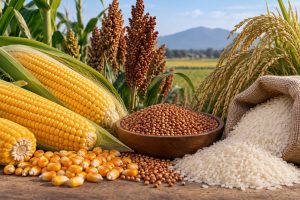
Canola and other oilseed co-products can provide locally sourced protein and energy.
Lupins, faba beans and other crops can diversify protein supply.
Food, fermentation and biofuel streams can be upgraded into feed ingredients.
Insects, microbial proteins and fermentation technologies remain active areas of development.
Queensland has previously promoted alternative food and feed production as a way to complement existing agricultural industries rather than replace them. That approach is particularly relevant in regions with substantial crop and food-processing infrastructure, where residues and by-products may become feedstocks for new value chains.
Circularity creates another source of value
One of the strongest arguments for new feed ingredients is their ability to turn low-value agricultural or processing streams into useful nutrition.
Distillers grains, oilseed meals, fermentation biomass and other co-products can retain considerable protein, fiber, minerals or energy. When these materials can be safely and efficiently incorporated into animal diets, they reduce waste while creating additional economic value from the original crop.
Circular feed systems are most compelling when they solve two problems at once: reducing waste or emissions while supplying a competitively priced nutrient to livestock.
Commercialization remains the real test
Promising nutritional performance alone does not guarantee that a new ingredient will reach commercial scale.
Novel feed technologies must also demonstrate:
- Reliable and scalable production
- Consistent nutrient composition
- Feed and animal safety
- Regulatory compliance
- Compatibility with existing feed manufacturing systems
- Competitive cost per unit of useful nutrient or biological benefit
This is where Queensland’s emphasis on investment becomes particularly relevant. Scaling an ingredient from research to commercial feed production often requires capital for processing infrastructure, supply chains, quality assurance, regulatory work and large-scale animal validation.
The challenge is no longer simply discovering novel feed ingredients. It is developing production systems that can deliver them consistently, safely and at a price livestock producers can justify.
Investment becomes part of the feed equation
The Global AgInvesting Australia conference held in Brisbane in June 2026 provided Queensland with a platform to showcase agricultural investment opportunities to international investors, agribusiness leaders and fund managers.
The state has set a broader objective of increasing the value of primary production to A$30 billion by 2030, with innovation, investment and expanded global trade positioned as important parts of that strategy.
Feed technologies fit naturally into this investment agenda because they sit at the intersection of agriculture, biotechnology, livestock productivity and emissions reduction.
Outlook
Queensland’s promotion of FutureFeed illustrates how feed innovation is becoming part of a much broader agricultural investment strategy. In this case, the immediate opportunity is the commercial expansion of a methane-reducing seaweed technology, but the same ecosystem also offers potential for local protein crops, agricultural co-products, microbial ingredients and other emerging feed technologies.
Success will ultimately depend on whether these solutions can combine scientific efficacy, regulatory acceptance, reliable supply and clear economic value at farm level.
Queensland’s opportunity is to turn agricultural scale and research capability into commercially viable feed technologies—using nutrition not only to supply animals with nutrients, but also to improve resilience, efficiency and environmental performance.
Sources and references
- Queensland Department of Primary Industries. Future Feed: Asparagopsis methane-reducing feed additive, Global AgInvesting opportunity, 2026.
- Trade and Investment Queensland. Agricultural investment opportunities, future foods, plant-based proteins and AgTech.
- Queensland Government. Global AgInvesting Australia conference and Queensland primary-industry investment strategy, June 2026.
- CSIRO. FutureFeed and research on Asparagopsis as a methane-reducing livestock feed ingredient.
- Industry and scientific literature on alternative proteins, agricultural co-products and circular feed systems in Australia.