AQUACULTURE | AQUAFEED | SUSTAINABILITY
Canadian Salmon Feed Reaches 80% Non-Fish Ingredients as Industry Advances Sustainable Aquaculture
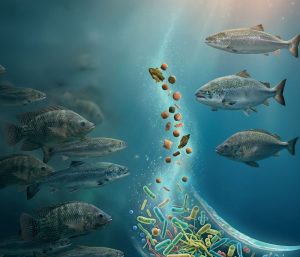
Canada’s salmon farming industry is highlighting progress in feed ingredient diversification, with new industry figures indicating that 80% of salmon feed now comes from non-fish sources. The transition reflects decades of nutritional innovation, alongside growing interest in algae-derived oils, microbial proteins and other alternative ingredients.
The composition of salmon feed has undergone a major transformation over the past several decades, as aquaculture producers seek to reduce their dependence on wild-caught marine resources while maintaining fish health, growth and nutritional quality.
According to preliminary sustainability data released by Canadian Seafood Farmers, formerly the Canadian Aquaculture Industry Alliance, approximately 80% of the feed used in Canadian salmon farming now consists of non-fish-derived ingredients.
The organization also reports that 95% of the fish-derived products incorporated into salmon feed originate from certified sustainably managed fisheries.
The findings, highlighted in industry reporting including AquaFeed, illustrate the changing role of marine and agricultural ingredients in modern aquaculture nutrition.
The figures were initially announced on October 9, 2026, ahead of a more comprehensive sustainability data release planned for November.
CANADIAN SALMON FEED: KEY FIGURES
80%
Of salmon feed comes from non-fish-derived sources.
95%
Of fish-derived feed products reportedly come from certified sustainably managed fisheries.
CAD 250 million+
Spent on grains, seeds, oils and other proteins sourced from Canadian farmers, according to the industry association.
Source: Canadian Seafood Farmers, October 2026. Preliminary industry-reported data.
From marine ingredients to diversified salmon diets
When commercial salmon farming began developing in Canada approximately 50 years ago, feed formulations relied almost entirely on fish and fish-derived products, according to Canadian Seafood Farmers.
Fishmeal and fish oil were traditionally important because they provide highly digestible protein, essential amino acids, energy and long-chain omega-3 fatty acids.
However, the expansion of aquaculture has increased interest in alternative raw materials capable of supplying essential nutrients without relying exclusively on marine resources.
Modern salmon diets now incorporate a wider range of ingredients, including plant proteins, vegetable oils, agricultural co-products and other non-marine materials.
This diversification has been supported by improvements in feed processing, ingredient evaluation, nutritional formulation and understanding of salmon nutrient requirements.
The Global Salmon Initiative also identifies feed innovation as an important contributor to improved resource efficiency, highlighting reductions in marine ingredient inclusion and improvements in feed conversion over time.
Nevertheless, reducing fishmeal and fish oil inclusion requires careful nutritional formulation to maintain the balance of digestible amino acids, essential fatty acids and other nutrients required throughout the salmon production cycle.
Nutritional consideration: Replacing fish-derived ingredients is not simply a matter of substituting one protein or oil source for another. Alternative ingredients must be evaluated for digestibility, nutrient composition, safety, availability and their effects on fish performance.
Responsible sourcing remains important for marine ingredients
Although non-fish ingredients now account for the majority of Canadian salmon feed, marine-derived raw materials continue to play an important nutritional role.
According to Canadian Seafood Farmers, 95% of the fish-derived ingredients used in salmon feed come from fisheries certified as sustainably managed.
This indicates the industry’s efforts to improve traceability and sourcing standards for the marine ingredients that remain in commercial formulations.
However, certification is only one component of responsible feed sourcing.
The environmental performance of aquafeed also depends on factors such as fisheries management, raw material processing, transportation, land use, greenhouse gas emissions and the overall efficiency with which feed is converted into fish biomass.
The Global Salmon Initiative emphasizes that ingredient sourcing decisions should be assessed holistically, since replacing a marine ingredient with a terrestrial alternative does not automatically produce a lower environmental impact.
For example, some plant ingredients may have environmental impacts associated with agricultural land use, fertilizer application, water consumption or changes in land cover.
Consequently, the sustainability of salmon feed increasingly depends on evaluating the full supply chain rather than focusing only on the percentage of fish-derived ingredients.
Algal oils offer an alternative source of omega-3 fatty acids
One of the most promising areas of aquafeed innovation involves the use of microalgae-derived oils as alternatives to conventional marine fish oils.
Salmon require appropriate supplies of essential fatty acids, including the long-chain omega-3 fatty acids eicosapentaenoic acid (EPA) and docosahexaenoic acid (DHA).
These nutrients contribute to physiological functions in fish and are also important components of the nutritional value of salmon for consumers.
Certain microalgae can produce EPA and DHA through controlled cultivation and fermentation processes, offering an alternative source of these fatty acids for aquafeed formulation.
In April 2024, Cermaq Canada announced trials of a salmon feed developed by Cargill incorporating Veramaris algal oil at several farms in British Columbia.
The initiative followed Canadian regulatory authorization for the ingredient and was intended to explore opportunities to reduce reliance on marine fish oil while supporting fish health and product quality.
The European Commission’s Blue Economy Observatory also identified algal oils as a promising alternative to fish-derived feed ingredients in a June 2026 publication.
However, challenges remain regarding production costs, commercial availability, scalability and the environmental performance of different algae production systems.
AQUAFEED INNOVATION
Omega-3 fatty acids from microalgae
Algal oils can provide EPA and DHA without requiring these nutrients to be extracted directly from wild-caught fish, creating new possibilities for diversifying lipid sources in salmon diets.
Fermentation-derived proteins and insect ingredients gain attention
Beyond algae-based oils, Canadian feed producers are investigating other alternative ingredients that could help diversify salmon nutrition.
Timothy Kennedy, president and CEO of Canadian Seafood Farmers, highlighted single-cell proteins produced through fermentation and insect-derived proteins among the technologies being developed and tested.
Single-cell proteins can be produced from microorganisms such as yeasts and bacteria using controlled fermentation processes.
Depending on the organism and production method, these ingredients may provide concentrated protein and other nutrients suitable for inclusion in aquaculture feeds.
Insect-derived ingredients, including those produced from black soldier fly larvae, represent another potential protein and lipid source.
Their nutritional characteristics depend on factors such as the insect species, rearing substrate, processing method and final ingredient composition.
Both technologies could contribute to ingredient diversification, although their practical adoption requires evaluation of nutritional performance, production costs, regulatory requirements and environmental impacts.
For salmon feed manufacturers, the objective is to identify ingredients that can complement existing raw materials while maintaining consistent feed quality and predictable animal performance.
Canadian agriculture is becoming an important supplier to aquaculture
The transition toward more diversified feed formulations is also creating commercial opportunities beyond the aquaculture industry.
According to Canadian Seafood Farmers, salmon producers purchase more than CAD 250 million in grains, seeds, oils and other proteins from Canadian farmers.
This connection between aquaculture and terrestrial agriculture illustrates how feed innovation can generate demand for domestic agricultural commodities and processing co-products.
Canada’s established oilseed and grain industries provide opportunities to develop locally sourced feed ingredients, including canola-derived products.
Canola meal and canola protein concentrates are of particular interest because they offer opportunities to utilize co-products from domestic oilseed processing.
However, their inclusion in salmon diets must account for factors such as fiber content, amino acid digestibility and antinutritional compounds.
Advances in ingredient processing and protein concentration may help improve the nutritional suitability of these products for aquaculture applications.
More broadly, using regional feed ingredients could help diversify supply chains and create additional markets for Canadian agricultural producers.
Industry opportunity: Greater collaboration between Canadian agriculture and aquaculture could support the development of locally sourced feed ingredients, agricultural co-product utilization and new value-added processing opportunities.
What does sustainable salmon feed really mean?
The increasing use of non-fish ingredients is an important indicator of changing feed formulation practices, but it should not be interpreted as a complete measure of sustainability.
A comprehensive evaluation of aquafeed requires consideration of the environmental impacts associated with ingredient production, processing, transportation and feed utilization.
Feed conversion ratio (FCR) is another important factor because it describes the amount of feed required to produce a unit of fish weight gain.
More efficient feed utilization can reduce the quantity of feed ingredients required for a given level of production.
The Global Salmon Initiative reports that technological and nutritional improvements have contributed to substantial reductions in marine ingredient inclusion and improvements in feed conversion across salmon farming.
However, these industry-wide developments do not establish the environmental performance of every individual feed formulation.
Life-cycle assessment (LCA) can help evaluate greenhouse gas emissions, land occupation, resource use and other environmental indicators associated with different ingredients and production systems.
The Better Aquafeed Blueprint, an initiative supported by the Aquaculture Stewardship Council, emphasizes responsible marine sourcing, deforestation- and conversion-free soy supply chains, and environmental assessment of alternative ingredients.
These approaches demonstrate why the next phase of feed sustainability will increasingly depend on traceable sourcing, nutritional efficiency and measurable environmental outcomes.
Key opportunities for aquafeed manufacturers
Priorities for sustainable feed development
- Alternative protein sources: Evaluate plant proteins, fermentation-derived ingredients and insect meals for nutritional quality and practical inclusion levels.
- Omega-3 supply: Explore algae-derived oils to diversify sources of EPA and DHA.
- Responsible marine sourcing: Improve traceability and certification of fishmeal and fish oil supply chains.
- Local ingredient development: Investigate agricultural co-products and regional raw materials where nutritionally and economically appropriate.
- Feed efficiency: Optimize digestibility, nutrient balance and feed conversion.
- Environmental assessment: Use life-cycle methodologies to compare ingredient sourcing strategies and identify potential trade-offs.
The next stage of sustainable salmon nutrition
The preliminary figures released by Canadian Seafood Farmers demonstrate the extent to which salmon feed formulation has changed since the industry’s early development.
With approximately 80% of feed now coming from non-fish sources, Canadian salmon farming has moved toward a more diversified ingredient base.
At the same time, the reported certification of 95% of fish-derived feed ingredients reflects efforts to strengthen sourcing practices for the marine resources that remain important in salmon nutrition.
Innovations involving algae-derived oils, microbial proteins, insect ingredients and Canadian agricultural co-products could further expand the options available to feed manufacturers.
Nevertheless, the next challenge will be demonstrating that these developments deliver measurable benefits across nutritional, economic and environmental indicators.
For Canada’s aquaculture industry, sustainable feed development will increasingly depend not only on replacing marine ingredients, but also on improving feed efficiency, responsible sourcing and the overall environmental performance of salmon production.
Sources and further reading
AquaFeed.
Canadian Salmon Feed Advances in Sustainability.
Canadian Seafood Farmers. October 9, 2026.
Canadian Salmon Feed is an Innovation and Sustainability Success Story.
Feed Strategy. October 23, 2026.
Canadian Salmon Farmers Say 80% of Feed Is Now Non-Fish.
Cermaq Canada. April 24, 2024.
Cermaq Canada Adopts Cargill Salmon Feed with Veramaris Algal Oil.
Global Salmon Initiative.
Responsible Feed Sourcing.
European Commission, EU Blue Economy Observatory. June 3, 2026.
Replacing Fish-Based Feed with Algae-Based Feed in Aquaculture.
Better Aquafeed Blueprint.
Better Salmon Starts with Better Feed.
The 80%, 95% and CAD 250 million figures are attributed to preliminary data released by Canadian Seafood Farmers. They should not be interpreted as independent verification of the environmental performance of all Canadian salmon feed formulations. Examples of alternative ingredients and industry trials are provided as supplementary context.