AQUACULTURE | AQUAFEED | SUSTAINABLE NUTRITION
Microalgae Could Replace Fishmeal and Fish Oil in Rainbow Trout Diets, Study Finds
A new study suggests that microalgae-derived ingredients could completely replace marine fishmeal and fish oil in rainbow trout diets without compromising growth performance or feed efficiency. The findings also highlight the importance of ingredient processing, nutritional composition and cost when developing sustainable aquafeed formulations.
The search for alternatives to conventional marine ingredients has become a major priority for the aquaculture industry as producers seek to improve sustainability while maintaining the nutritional quality and economic competitiveness of aquafeeds.
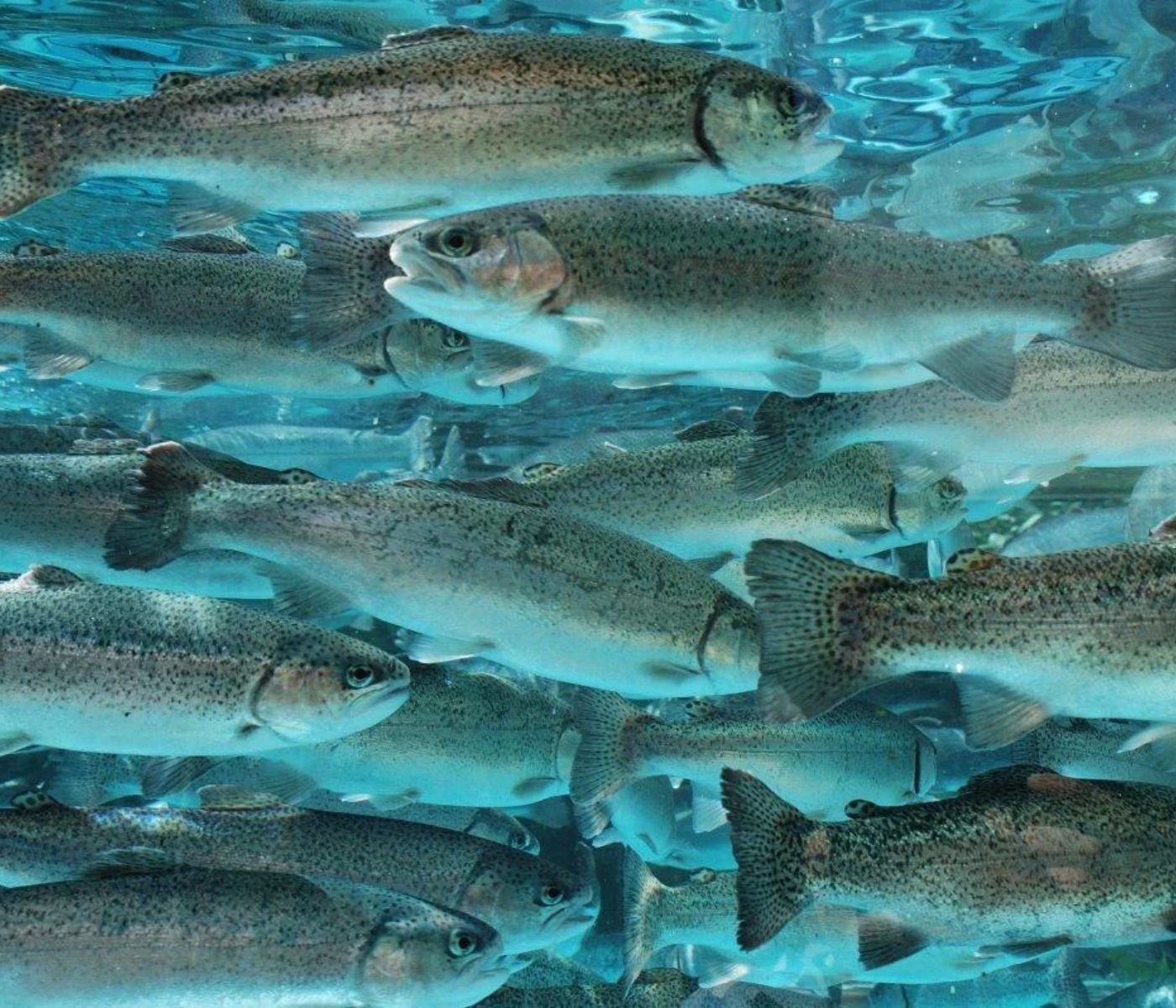
A recent study published in the scientific journal Antioxidants investigated whether two microalgal ingredients could replace both fishmeal and fish oil in diets for juvenile rainbow trout (Oncorhynchus mykiss).
The research, led by Pallab Sarker and colleagues at the University of California, Santa Cruz, evaluated diets incorporating a protein-rich by-product from Nannochloropsis oculata and either whole-cell biomass or extracted oil from Schizochytrium species.
The findings indicate that a carefully formulated combination of these ingredients can support growth and feed conversion comparable to a conventional fishmeal- and fish oil-based diet.
However, the study also demonstrated that the form in which microalgal ingredients are incorporated into feed can influence productive performance.
KEY RESEARCH FINDING
100% replacement
A diet containing Nannochloropsis oculata by-product and whole-cell Schizochytrium completely replaced fishmeal and fish oil while maintaining growth and feed conversion comparable to the conventional reference diet.
Why is aquaculture looking beyond fishmeal and fish oil?
Fishmeal and fish oil have traditionally been important components of aquafeeds, particularly for carnivorous species such as salmon and trout.
Fishmeal provides highly digestible protein and essential amino acids, while fish oil supplies long-chain omega-3 fatty acids, including eicosapentaenoic acid (EPA) and docosahexaenoic acid (DHA).
These nutrients play important roles in fish growth, physiological function and the nutritional characteristics of seafood intended for human consumption.
However, conventional marine ingredients are associated with several challenges, including fluctuations in supply, price volatility and concerns about dependence on wild-caught forage fish.
As aquaculture production expands, feed manufacturers are increasingly exploring alternative ingredients that can provide adequate nutrition while reducing reliance on marine resources.
Plant-derived ingredients have already become common in aquafeeds, but their use may be limited by differences in amino acid composition, digestibility, antinutritional factors and the absence of substantial quantities of EPA and DHA.
Microalgae offer a potentially complementary solution because selected species can provide protein, essential fatty acids and bioactive compounds.
Nutritional opportunity: Microalgae can supply nutrients traditionally obtained from marine ingredients, potentially allowing feed manufacturers to reduce dependence on wild-caught fish without sacrificing essential dietary components.
Two microalgal ingredients with complementary nutritional functions
The researchers selected two microalgal ingredients with different nutritional characteristics.
Nannochloropsis oculata: a potential alternative protein source
The first ingredient was a residual biomass obtained from Nannochloropsis oculata, a marine microalga cultivated commercially for the production of EPA-rich oils.
After oil extraction, the remaining biomass retains protein, residual lipids and other nutrients that may be valuable for aquaculture feed.
Rather than discarding or underutilizing this material, the researchers investigated its potential as a substitute for fishmeal.
This approach could also support more efficient utilization of microalgal production streams by creating additional applications for materials generated during omega-3 oil manufacturing.
Schizochytrium: a source of DHA and bioactive compounds
The second ingredient was Schizochytrium, a marine microorganism widely investigated for its ability to produce DHA-rich lipids.
The study compared two forms of this ingredient: whole-cell biomass and extracted algal oil.
Whole-cell biomass contains lipids alongside other cellular components, including certain pigments and antioxidant-related compounds.
Extracted oil, in contrast, provides a more concentrated lipid ingredient but does not necessarily retain the same composition of other bioactive substances.
This distinction became particularly relevant when the researchers compared fish growth across the different experimental diets.
How was the feeding trial conducted?
The researchers conducted an 84-day feeding experiment using juvenile rainbow trout at the University of California, Santa Cruz.
The trial included 640 fish distributed across 16 independent tanks, with four replicate tanks assigned to each dietary treatment.
The fish had an average initial body weight of approximately 0.85 g.
Four diets were evaluated: a conventional reference formulation containing fishmeal and fish oil, one diet replacing 75% of both ingredients, and two diets achieving complete replacement.
The experimental diets were formulated to provide comparable levels of protein, lipid and energy, with amino acid supplementation used to support nutritional adequacy.
| Diet | Replacement strategy |
|---|---|
| Reference | Conventional fishmeal and fish oil formulation. |
| NSW75 | 75% replacement using Nannochloropsis by-product, whole-cell Schizochytrium and canola oil. |
| NSW100 | 100% replacement using Nannochloropsis by-product, whole-cell Schizochytrium and canola oil. |
| NSO100 | 100% replacement using Nannochloropsis by-product, extracted Schizochytrium oil and canola oil. |
Source: Sarker et al., Antioxidants (2026). Replacement percentages refer to fishmeal and fish oil, not to all ingredients of marine or animal origin.
Throughout the trial, the researchers monitored growth, feed conversion, protein digestibility, survival and nutrient composition.
They also analyzed whole-body and fillet characteristics, including fatty acid profiles, essential amino acids and selected antioxidant-related compounds.
Complete replacement maintained growth when whole-cell microalgae were used
One of the most important findings was that the NSW100 diet achieved growth performance comparable to the conventional reference diet.
Fish receiving the fully substituted formulation containing whole-cell Schizochytrium did not show statistically significant differences in final body weight or weight gain compared with the reference group.
The same was true for the diet replacing 75% of fishmeal and fish oil.
However, fish receiving the NSO100 diet, which used extracted Schizochytrium oil instead of whole-cell biomass, showed significantly lower growth than the reference group.
This suggests that replacing fish oil with an algal-derived ingredient is not simply a question of supplying sufficient dietary lipids.
The composition and physical form of the ingredient may also influence its nutritional performance.
Importantly, feed conversion ratios did not differ significantly among the four dietary treatments, and survival was comparable across groups.
Growth and feed conversion results
| Diet | FCR | Growth outcome |
|---|---|---|
| Reference | 0.88 | Conventional benchmark |
| NSW75 | 0.93 | Comparable to reference |
| NSW100 | 0.89 | Comparable to reference |
| NSO100 | 0.98 | Significantly lower growth than reference |
Source: Sarker et al. (2026), Tables 4 and 10. FCR differences were not statistically significant (p = 0.087).
What happened to the nutritional quality of the fish?
Replacing conventional marine ingredients must not compromise the nutritional characteristics of the fish produced.
To evaluate this, the researchers analyzed the composition of whole fish and fillets after the feeding period.
The results showed no statistically significant differences in fillet protein, fat, moisture, ash or essential amino acid composition between dietary treatments.
This suggests that the experimental formulations maintained several important aspects of fillet nutritional quality.
The researchers also evaluated fatty acid deposition, particularly omega-3 fatty acids.
Total whole-body omega-3 polyunsaturated fatty acid content and DHA did not differ significantly among groups.
However, EPA concentrations were significantly higher in fish receiving the conventional diet, and the omega-3 to omega-6 fatty acid ratio was also higher in the reference group.
These findings highlight an important consideration: maintaining overall growth and fillet composition does not necessarily mean that all individual fatty acids remain unchanged.
Important nutritional distinction: Microalgae-based diets maintained several measures of nutritional quality, but the conventional diet produced higher whole-body EPA concentrations and a higher omega-3 to omega-6 ratio. Future formulations may need further fatty acid optimization.
Could antioxidant compounds explain the difference between whole cells and oil?
Another interesting aspect of the study was the analysis of antioxidant-related compounds present in the ingredients.
The researchers measured carotene, xanthophylls and vitamin E in the experimental diets and microalgal materials.
Whole-cell Schizochytrium contained higher measured concentrations of carotene and xanthophylls than the extracted oil.
The Nannochloropsis by-product also contained higher measured carotene and vitamin E concentrations than the fishmeal ingredient evaluated in the study.
These observations raise the possibility that whole-cell microalgae may provide additional nutritional components beyond their fatty acid content.
However, the researchers emphasized that antioxidant activity and physiological antioxidant responses were not directly measured in the fish.
Consequently, the study cannot establish whether differences in antioxidant compounds were responsible for the observed growth responses.
Further research is needed to determine whether these bioactive compounds contribute to improved physiological function, oxidative stability or resilience under commercial production conditions.
Microalgae-based feeds also showed promising cost estimates
Beyond nutritional performance, the researchers evaluated the potential economic implications of replacing fishmeal and fish oil.
Using the Cruz Aquafeed Sustainability Tool, they estimated formulated feed costs and economic conversion ratios for each diet.
The NSW100 formulation had the lowest estimated feed cost, at approximately US$0.87 per kilogram, compared with US$0.97 per kilogram for the conventional reference diet.
The same formulation also had the lowest numerical economic conversion ratio, estimated at US$0.77 per kilogram of fish produced, compared with US$0.86 for the reference group.
| Diet | Feed cost (US$/kg) | Economic conversion (US$/kg fish) |
|---|---|---|
| Reference | 0.97 | 0.86 |
| NSW75 | 0.92 | 0.85 |
| NSW100 | 0.87 | 0.77 |
| NSO100 | 0.88 | 0.86 |
Source: Sarker et al. (2026), Table 10. Economic conversion differences were not statistically significant (p = 0.105). Ingredient prices were based on historical market data, not current commercial quotations.
Although these results suggest potential economic competitiveness, the authors did not find statistically significant differences in economic conversion ratios.
Furthermore, the cost estimates relied on historical ingredient prices compiled from several sources between 2020 and 2022.
Actual commercial feasibility will depend on current ingredient prices, manufacturing capacity, processing requirements, transportation costs and the availability of microalgal biomass.
What does this mean for sustainable aquafeed production?
The findings offer encouraging evidence that microalgae can become an important component of alternative aquafeed formulations.
In particular, the use of residual biomass from microalgal oil extraction could create opportunities to improve resource utilization and develop additional value streams within the ingredient industry.
This approach aligns with broader efforts to develop circular production systems in which materials generated during one industrial process can be used as inputs for another.
Nevertheless, the environmental advantages of microalgae-based ingredients should not be assumed automatically.
Cultivation methods, energy consumption, nutrient inputs, harvesting, drying and oil extraction can all influence their environmental footprint.
The present study evaluated nutritional performance and estimated feed economics, but it did not establish a complete comparative life-cycle assessment of the experimental diets.
Consequently, further evaluation will be necessary to determine how these formulations perform environmentally at commercial production scale.
Further research is needed before commercial implementation
Although the study provides valuable experimental evidence, several questions remain.
The trial was conducted with juvenile rainbow trout over 84 days under controlled recirculating aquaculture conditions.
Additional studies involving larger fish, longer production periods and commercial aquaculture systems will be important to determine whether the results can be reproduced under different environmental and management conditions.
Further investigation is also needed to optimize fatty acid profiles, understand the contribution of bioactive compounds and evaluate the consistency of microalgal ingredients obtained from different production processes.
An additional distinction is that the experimental diets eliminated fishmeal and fish oil, but were not entirely free of animal-derived ingredients. All four formulations still contained feather meal and blood meal.
The findings therefore demonstrate the feasibility of replacing the two conventional marine ingredients tested, rather than producing a completely animal-free aquafeed.
A promising direction for the future of aquaculture nutrition
The development of alternative protein and lipid sources is becoming increasingly important as the aquaculture industry seeks to expand production while reducing its dependence on finite marine resources.
This study demonstrates that complete replacement of fishmeal and fish oil is possible in juvenile rainbow trout diets when appropriate microalgal ingredients are combined within nutritionally balanced formulations.
The results also reinforce the importance of considering ingredient form, fatty acid composition, digestibility and the presence of additional bioactive compounds.
While the economic and environmental advantages require further commercial validation, the findings suggest that microalgae-derived ingredients could contribute to more flexible and resource-efficient aquafeed production.
For aquaculture nutritionists and feed manufacturers, the central message is clear: the future of marine ingredient replacement will depend not only on identifying alternative nutrient sources, but on understanding how different ingredients perform together in complete diets.
Source and further reading
Sarker, P., Labbe, M., Schoffstall, B. V., Kapuscinski, A. R., McKuin, B., Fitzgerald, D., Greenwood, C., O’Shelski, K., Pasion, E. N., et al. (2026).
Toward Sustainable Aquaculture: Microalgae Fully Replace Fishmeal and Fish Oil in Rainbow Trout Diets While Maintaining Growth, Nutritional Quality, and Cost Viability.
Antioxidants, 15(10), 1343.
DOI: 10.3390/antiox15101343