 05 May 2026
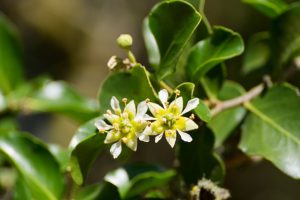
Macleaya cordata is a medicinal plant from the Papaveraceae family , known for its high content of isoquinoline alkaloids, especially anguinarine, queleritrin, protopine, and allocryptopine . These compounds possess antimicrobial, anti-inflammatory, and immune response modulating properties.
Macleaya cordata extract (Sangrovit®) improved feed conversion (-0.041 in FCR) and reduced cumulative mortality on farms by approximately 25% in relative terms, without compromising animal growth rate.
According to the National Chicken Council , broiler mortality in the United States has increased in recent years (Figure 1), putting pressure on margins and making it more challenging to meet animal welfare indicators.
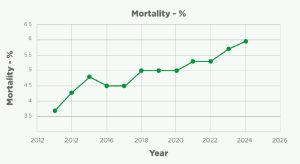
Figure 1. Mortality rate (%) of broiler chickens per year, according to the NCC ( National Chicken Council ).
In this context, integrators and producers have been seeking alternatives, questioning whether plant-based solutions can improve productive performance and reduce mortality, especially in heavier birds and those under stress at the end of the production cycle. A recent meta-analysis with Macleaya cordata (MCE) extract provides a consistent and data-supported answer to this question.
The analysis comprised 36 experimental tests, totaling 72 direct comparisons between control treatment and treatment supplemented with MCE, conducted in various countries, years, and production conditions. This experimental breadth lends greater robustness to the results, as it encompasses different sanitary, environmental, and management contexts.
Approximately 50% of the studies included explicit sanitary challenge models, such as coccidial infection, Clostridium perfringens, heat stress, high housing density, or exposure to mycotoxins.
Therefore, the meta-analysis evaluated not only standard production conditions but also scenarios of greater physiological and sanitary pressure, allowing for an understanding of the effectiveness of MCE in different scenarios.
The production period evaluated in the studies extended up to 56 days, encompassing the entire broiler chicken production cycle, including critical phases such as accelerated growth and the finishing period.
Macleaya cordata extract (Sangrovit®) is a standardized phytogenic, rich in benzophenanthridine and isoquinoline alkaloids, especially sanguinarine and chelerythrine. These bioactive compounds exhibit recognized biological activity in the gastrointestinal tract, acting primarily in the modulation of inflammatory responses and in maintaining intestinal integrity.
Its mechanism of action can be understood from two main pillars.
1. The first involves the modulation of inflammatory pathways, reducing the activation of signaling associated with NF- κB and Toll-like receptors (TLRs) in the intestinal mucosa, as well as the production of pro-inflammatory mediators such as TNF-α, IL-1β, and IL-6. By attenuating subclinical inflammatory processes, MCE contributes to reducing the energy cost associated with the immune response, redirecting energy towards growth and productive performance, which is consistent with the improvements observed in feed conversion.
2. The second pillar refers to supporting the integrity of the intestinal barrier. MCE promotes the maintenance of tight junction proteins, such as ZO-1, occludin, and claudins, in addition to contributing to the preservation of intestinal villi. Reduced intestinal permeability is associated with less translocation of pathogens and toxins, as well as a decrease in enteric disorders.
From a physiological standpoint, the combination of reduced mucosal inflammation, increased intestinal barrier integrity, and modulation of pathogenic pressure results in improved feed efficiency and reduced losses associated with enteric disorders.
Because it acts predominantly through local modulation of the host’s intestinal response, MCE is compatible with various animal health management strategies, including coccidiosis vaccines, ionophores or chemical anticoccidials, probiotics (such as Bacillus spp.), organic acids, and essential oils.
The main results obtained from the meta-analysis show a consistent impact of supplementation with MCE on productive and sanitary indicators. Feed conversion was significantly improved, increasing from 1.66 in the control group to 1.619 in animals supplemented with MCE (Δ −0.04; p < 0.001), as illustrated in Figure 2. This reduction, although numerically small, represents a relevant gain in feed efficiency when considered on a commercial scale.
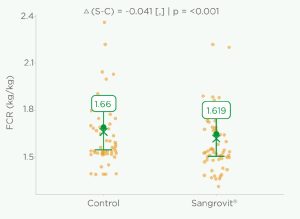
Figure 2. Feed conversion (FCR) by treatment, based on 72 direct comparisons ( head-to-head ).
Regarding farm-level mortality, a reduction from 6.1% in the control treatment to 4.6% in the MCE treatment was observed, corresponding to a decrease of 1.5 percentage points, approximately 25% in relative terms (p < 0.001), as shown in Figures 3 and 4. This is not only a statistically significant effect, but also an operationally significant one, with direct implications for profitability and animal welfare indicators.
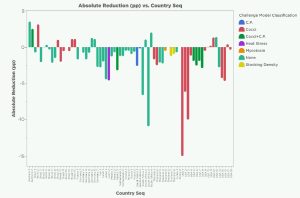
Figure 3. Absolute difference in mortality (MCE − Control, in percentage points, pp) for each comparison, grouped by country and colored by challenge class. Negative values indicate lower mortality with MCE.
The distribution shows a predominantly negative pattern in different regions and challenge models (coccidiosis, C. perfringens , coccidiosis + C. perfringens , heat stress, housing density, mycotoxins , or absence of
challenge), demonstrating the consistency of the response, since 57 of the 72 comparisons showed a reduction in mortality.
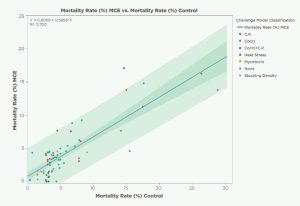
Figure 4. Mortality with MCE versus control in 72 comparisons. The shaded blue bands represent the 95% confidence/prediction intervals. Mortality in the MCE group increases more slowly than in the control group as risk increases (slope ≈ 0.60). For each +1% increase in baseline risk, approximately 0.40 additional percentage point reduction is observed with MCE, indicating that the benefit is more pronounced in poultry houses with higher risk levels.
Regarding average daily gain, the values were 0.062 kg/day in the control treatment and 0.063 kg/day in the MCE treatment, with no statistically significant difference.
This result demonstrates that the improvement in feed conversion and the reduction in mortality occurred without compromising the growth rate, reinforcing the biological and productive consistency of the strategy.
The integration of Macleaya cordata extract (MCE) into coccidiosis and necrotic enteritis control programs can be carried out strategically and in a complementary way to tools already established in commercial production.
MCE is compatible with different coccidiosis control approaches, including vaccines, ionophores , chemical anticoccidials , and rotation programs, allowing its inclusion without interfering with established sanitary protocols.
In the context of integrated gut health programs, MCE can be combined with probiotics (such as Bacillus spp.), organic acids, and essential oil blends, forming a multifactorial strategy without compromising zootechnical performance.
This characteristic is particularly relevant in systems seeking to replace antibiotic growth promoters (AGPs), where feed efficiency and mortality reduction need to be sustained by non-antibiotic solutions.
In this scenario, the gains in feed conversion and the reduction in mortality observed with MCE tend to complement the improvements obtained with adjustments in ventilation, litter management, stocking density, and water quality.
From an operational standpoint, it is recommended to prioritize its use in farms or complexes with accumulated losses equal to or greater than 5–7%, in batches of heavier or older birds, or in systems with a known history of pressure from necrotic enteritis.
Considering that mortality in the field generally intensifies after approximately the 40th day of rearing, the strategy may include the ntroduction or intensification of the use of ECM (Extracorporeal Medication) from the 35th day until slaughter, especially in programs focused on the production of birds with a live weight between 3.6 and 4.5 kg. This approach concentrates the intervention in the period of greatest risk and greatest economic impact.
To ensure the effectiveness and correct positioning of the tool, it is recommended to monitor losses weekly (distinguishing between early and late mortality), maintain the separation between culling, condemnations, and mortality on the farm, and preserve the routine iagnostic testing for coccidiosis (lesion scores and oocyst count).
This monitoring allows for validating the complementarity of the MCE within the sanitary program and optimizing the timing of its application throughout the production cycle.
Overall, the data demonstrate that, in different countries and under varying sanitary challenges, Macleaya cordata extract promoted consistent improvements in feed conversion and reduced mortality, without compromising the growth rate of the birds. These results reinforce the potential of MCE in different production contexts.
Additionally, MCE exhibits high compatibility with major sanitary control programs, including coccidiosis vaccines, ionophores, and anticoccidials , and when combined with other additives such as probiotics, organic acids, and essential oils.
This characteristic favors its inclusion in multifactorial intestinal health programs and systems aimed at reducing antibiotic use.
The application of Macleaya cordata extract It proves to be particularly strategic from 35 days of age onwards, especially in poultry production with a final weight between 3.6 and 4.5 kg. Thus, the MCE (Manual of Controlled Feeding) proves to be a relevant tool to mitigate losses at the end of the production cycle, while simultaneously sustaining feed efficiency.
Subscribe now to the technical magazine of animal nutrition
AUTHORS

From 2025 Data to 2026 Decisions: Managing Mycotoxin Risk in a Changing Climate

Alterion® NE Celebrates 10 Years of Poultry Gut Health Innovation

The Science Behind Kolin Plus: Beyond Choline Replacement

Summer Infertility in Sows: Managing Heat Stress and Reproductive Performance

AO-Biotics® Amaferm®: Supporting Livestock Digestion and Performance

Interview with Güner Gövenç
Güner Gövenç,
Net Energy and Precision Feeding Shape the Future of Poultry Nutrition
Edgar Oviedo
Mycotoxins in Swine: Health Risks and Nutritional Solutions
Giuseppe Carcò
Mycotoxins and Piglet Ear Necrosis: Cause, Cofactor or Coincidence?
Alberto Morillo
How Mycotoxins Affect Intestinal Health in Pigs and Poultry
Marcos Rostagno
From Antibiotics to Functional Feeds in Aquaculture
Babatunde Saliu
Peas as an Alternative to Soybean Meal in Beef Cattle Finishing Diets
Daniel Villalba Mata,
Improving Egg Yolk Pigmentation Through Better Nutrient Transport

Aquaculture and Aquaponics Nutrition: How Fish Shape the Growth of Greens
Trenton Corby
Consistency in Soybean Meal Drives Performance and Sustainability